Java Project Structure Explained: The Four-Layer Architecture of Modules, Packages, Classes, and Methods

A systematic overview of Java project's four-layer architecture: modules, packages, classes, and methods.
This article is aimed at Java beginners, systematically introducing the four-layer architecture of Java projects: modules divide projects by major functionality, packages organize code by sub-functionality with layering (controller, service, dao, entity), classes encapsulate data and operations, and fields and methods provide concrete implementations. The article also covers advanced topics including the evolution of modularization, the underlying mechanism of packages, MVC architecture correspondence, SOLID design principles, and the role of interfaces.
Overview
When first getting into Java development, understanding the project structure is the very first step. A Java project doesn't just pile all the code together — it follows a clear hierarchical organization. This article systematically walks through the four core components of a Java project from macro to micro: Modules, Packages, Classes, Fields and Methods, helping you build a complete understanding of project structure.
The Four-Layer Architecture of Java Projects
A standard Java project typically consists of four layers:
- Module
- Package
- Class
- Field and Method
The relationship between these layers is top-down with increasingly fine granularity: a project contains multiple modules, a module contains multiple packages, a package contains multiple classes, and a class contains multiple fields and methods. Each lower layer provides implementation details for the layer above it.
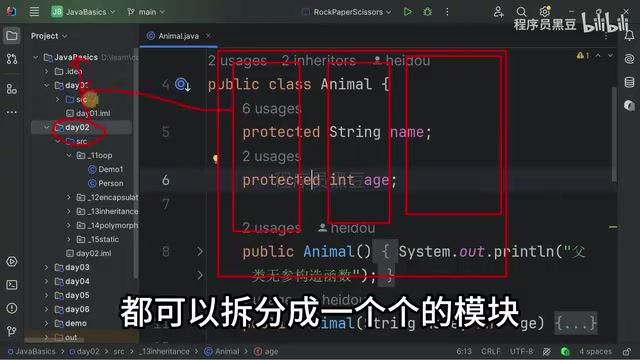
Modules: Dividing Projects by Major Functionality
A module is the unit for dividing a project's major functionalities. Taking an e-commerce project as an example, the shopping cart, product selection, and payment are all independent functional modules. Each module handles a relatively independent business responsibility.
Through modular design, we can achieve:
- Encapsulation: Internal module implementation is hidden from the outside
- Dependency Management: Clear dependency relationships between modules
- Team Collaboration: Different teams can develop different modules in parallel
The Evolution of Modularization: Java's modularization went through a long development process. Before Java 9, there was no official module system — developers primarily relied on build tools like Maven or Gradle with multi-module project structures to achieve logical module separation. Java 9 officially introduced JPMS (Java Platform Module System), also known as Project Jigsaw, which declares module exports and dependencies through
module-info.javafiles, implementing strong encapsulation at the language level. However, in actual enterprise development, the Maven/Gradle multi-module approach remains mainstream due to its better compatibility with the existing ecosystem and lower learning curve.
Packages: Organizing Code by Sub-Functionality
Each major functional module can be further broken down into many smaller functions, which are placed in corresponding packages. The core roles of packages in a Java project include:
- Access Control: Limiting code visibility through package-level access control
- Avoiding Naming Conflicts: Classes with the same name can exist in different packages without interference
- Logical Layering: Organizing packages by controller layer, service layer, data layer, etc.

The Underlying Mechanism of Packages: Java packages are not just a logical way of organizing code — they directly correspond to directory structures at the file system level. For example, the package name
com.example.payment.servicemaps to thecom/example/payment/service/directory on disk. When the JVM loads a class, the ClassLoader searches for the corresponding.classfile in directories along the Classpath. The reversed domain name naming convention (e.g.,com.google,org.apache) originates from the Java Language Specification's recommendation, aiming to guarantee globally unique package names since domain names are inherently globally unique. This convention is widely followed in open-source communities and enterprise development, effectively preventing naming conflicts between code from different organizations.
The Correspondence Between Package Layering and MVC Architecture
The package layering structure (controller, service, dao, entity) is not arbitrary — it corresponds to the classic MVC (Model-View-Controller) architecture in software engineering and its evolved forms in backend development:
- The
controllerlayer corresponds to the Controller in MVC, responsible for receiving HTTP requests, parameter validation, and response encapsulation - The
servicelayer carries core business logic, implementing business rules - The
dao(Data Access Object) ormapperlayer handles database interaction, abstracting data persistence operations - The
entitylayer stores entity classes (POJOs) that correspond to database tables
This layered design follows the Separation of Concerns principle, making each layer's responsibilities clear and independently testable and replaceable. In Spring Boot projects, these four layers correspond to the annotation system of @RestController, @Service, @Repository, and plain POJO classes, respectively.
Classes: Encapsulating Data and Operations
Classes are the core unit of Java's object-oriented programming, encapsulating data and operations together:
- Fields: Describe an object's characteristics (e.g., a user's name, age)
- Methods: Implement business logic and encapsulate specific behaviors (e.g., calculating prices, verifying identity)
Class Design Principles — SOLID: The design quality of classes directly affects the maintainability of the entire project. The industry has summarized the SOLID principles to guide class design: the Single Responsibility Principle (S) requires a class to be responsible for only one thing; the Open-Closed Principle (O) requires being open for extension but closed for modification; the Liskov Substitution Principle (L) standardizes the correct use of inheritance; the Interface Segregation Principle (I) prevents interfaces from becoming too bloated; the Dependency Inversion Principle (D) requires depending on abstractions rather than concrete implementations. In modern frameworks like Spring Boot, these principles are embodied through annotations (such as
@Service,@Repository,@Controller), and the framework's layered design itself serves as a best-practice example of the SOLID principles.
Interfaces: Defining Specifications and Standards
Besides the four components mentioned above, Java projects have another important role — Interface. Interfaces are used to establish specifications and standards, making code more standardized and easier to maintain. They define "what to do," while concrete classes implement "how to do it."
The Difference Between Interfaces and Abstract Classes: Interface and Abstract Class are two important abstraction mechanisms in Java that beginners often confuse. An Interface defines a contract of "what can be done," emphasizing behavioral specifications — a class can implement multiple interfaces (Java supports multiple interface implementation). An Abstract Class defines "what something is."
Related articles
 Tutorials
ChatGPT Plus Subscription Guide: Are GPT-5.5, image-2, and Codex Worth the Upgrade?
A detailed look at ChatGPT Plus features — GPT-5.5, image-2, and Codex — with a Plus vs Pro comparison and a complete step-by-step subscription guide for users outside the US.
 Tutorials
Harness AI Engineering in Practice: Using Claude Code to Master Enterprise-Level E-Commerce Development
Deep dive into Harness AI Engineering: master enterprise e-commerce development with Claude Code using the Rules, Skills, Wiki, and Changes framework.
 Tutorials
Cursor + Codex Dual-IDE Collaboration: A Practical Methodology for Open-Source Project Customization
A complete methodology for open-source project customization based on real-world experience, detailing the Cursor+Codex dual-IDE workflow, seven-stage process, MVP validation, and AI source code reading techniques.