jcode: A Rust-Rewritten Coding Agent That Uses 13x Less Memory and Supports Multi-Agent Collaboration

Rust-based coding agent jcode uses 13x less memory than Claude Code and supports multi-agent collaboration.
jcode is a coding agent rebuilt in Rust that consumes only 27.8MB per session compared to Claude Code's 386MB—a 13x improvement. It starts 108x faster than Copilot and features a SWARM mode enabling multiple agents to collaborate within the same codebase with automatic conflict detection, inter-agent messaging, and autonomous sub-agent spawning. With 13K+ GitHub stars, it targets developers needing efficient multi-task parallel coding in resource-constrained environments.
The Memory Dilemma of Coding Agents
As AI coding assistants become mainstream, tools like Claude Code and Codex have become daily companions for many developers. But these tools have an often-overlooked problem — resource consumption. According to real-world testing by XCommand (a content creator on Bilibili), a single Claude Code session consumes 386MB of memory. If you're used to running multiple sessions in parallel to handle tasks simultaneously, memory usage balloons rapidly.
This is ultimately an inevitable consequence of technology choices. Most mainstream coding agents are built on Node.js/TypeScript stacks, where the runtime itself carries significant memory overhead. Add context management, model interaction logic, and other features on top, and hundreds of megabytes per session is unsurprising. Node.js runs on Google's V8 JavaScript engine, which inherently requires substantial base memory to maintain heap space, the JIT compiler, and garbage collector infrastructure. A blank Node.js process typically consumes 30-50MB of memory, and after loading numerous dependencies (TypeScript compiler, HTTP clients, JSON Schema validators, etc.), baseline memory easily inflates to over 100MB. Additionally, V8's garbage collection uses a generational strategy that retains large heap headroom to reduce GC frequency, further pushing up actual memory usage. For coding agents that need to maintain long context conversation histories, the accumulation of string objects and JSON data structures makes memory pressure even more pronounced. For memory-constrained development machines, or scenarios requiring multiple agents running collaboratively for extended periods, this becomes a real pain point.
The tool we're discussing today — jcode (G-Code) — targets exactly this pain point. It rewrites the entire coding agent in Rust, focusing on "memory efficiency" and "multi-agent parallelism." The project has already garnered over 13K stars on GitHub, indicating strong community validation of this approach.
Installation & Usage: One Command to Get Started, UX Aligned with Claude Code
jcode's installation is extremely lightweight — just one command:
extend store jcode
After installation, simply type jcode to enter the interactive conversation interface.
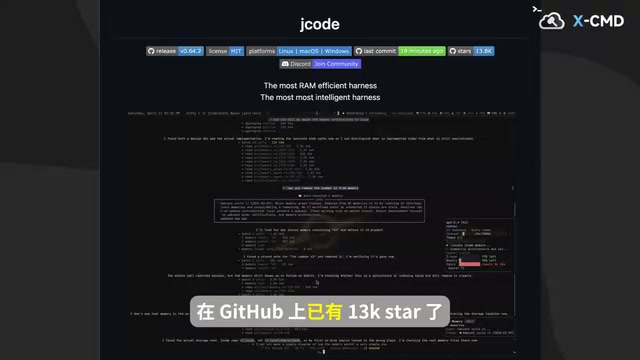
In terms of interface design, jcode differs noticeably from Claude Code, with a visual style closer to the clean aesthetic of Rust ecosystem tools. But in actual usage, the two are essentially identical — if you're already familiar with Claude Code or Codex interaction patterns, you can migrate to jcode with virtually zero learning cost.
This "experience alignment" strategy is smart. It lowers the learning barrier, allowing developers to directly enjoy Rust's performance benefits while preserving their existing work habits, without needing to adapt to an entirely new operational paradigm.
Memory Comparison: 13x Savings Per Session, Even More Dramatic at Scale
jcode's core selling point is its crushing advantage in resource efficiency. According to real-world testing:
- Single session: Claude Code uses 386MB, jcode uses only 27.8MB — approximately a 13.9x difference
- 10 parallel sessions: Claude Code consumes 2.3GB of memory, while jcode needs only 117MB
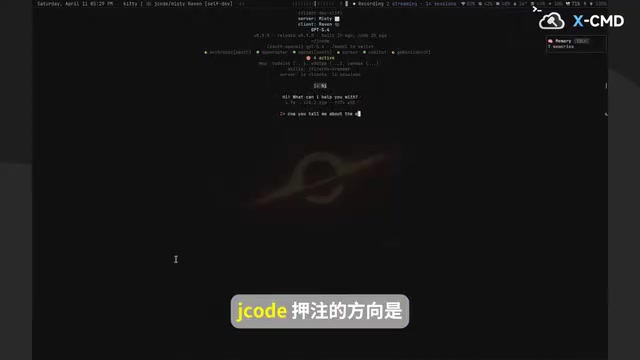
As you can see, the more sessions you run, the wider the gap becomes. At a single session it's a 13x difference; at 10 sessions, Claude Code is approaching the memory limit of a budget laptop, while jcode stays comfortably in the low hundreds of megabytes.
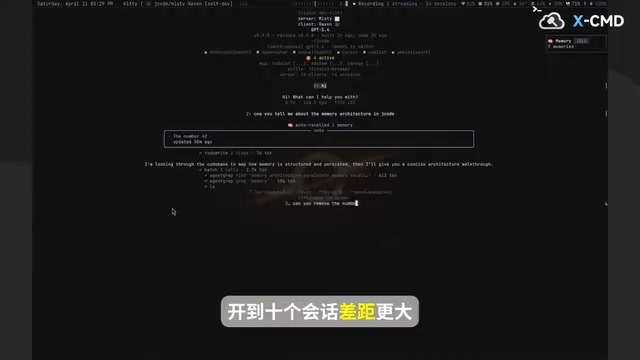
The root cause of this gap lies in Rust's language characteristics — no garbage collector, more compact memory layout, and extremely low runtime overhead. Rust uses a unique Ownership and Borrow Checker system that ensures memory safety at compile time, completely eliminating the need for a runtime garbage collector. This means Rust programs don't require additional GC threads or heap space reservations like Java, Go, or Node.js do. Rust's data structures are zero-cost abstractions in memory — structs are tightly packed by field, enum types use tagged unions, with no object headers or vtable pointers adding overhead. The compiled output is a native machine code binary that requires no virtual machine or interpreter at startup, achieving cold start times in the millisecond range. These characteristics make Rust particularly well-suited for building system-level tools that need to run for extended periods with multiple instances deployed.
For agent scenarios requiring long-running processes and multi-instance parallelism, this memory advantage translates directly into real cost savings and stability improvements. You can run more agents simultaneously on an ordinary development machine without worrying about memory exhaustion.
Beyond memory, jcode starts 108x faster than Copilot — also thanks to Rust's compiled native binary requiring no bulky runtime to boot up, making cold starts nearly instantaneous.
SWARM Mode: Multiple Agents Working in Concert
Memory efficiency is just the foundation. What jcode really aims to do is make "multi-agent parallelism" a robust reality. It features a SWARM mode that enables multiple agents to collaborate on tasks within the same code repository.
The SWARM concept originates from Swarm Intelligence theory, inspired by the collective behavior patterns of social insects like ants and bees — each individual follows simple rules, but complex coordination emerges at the group level. In multi-agent systems, swarm mode emphasizes decentralized collaboration: each agent possesses local information and autonomous decision-making ability, achieving global coordination through lightweight message-passing mechanisms. This contrasts with traditional centralized task scheduling — where a "master agent" assigns all subtasks and the entire system collapses if the master fails. Swarm mode is more resilient; one agent failing doesn't prevent others from continuing their work.
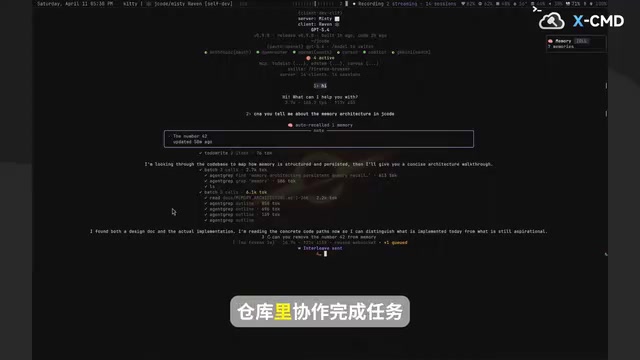
In SWARM mode, agents possess the following capabilities:
Automatic Conflict Detection Between Agents
When multiple agents modify the same repository simultaneously, the biggest risk is changes overwriting each other or producing conflicts. jcode enables agents to automatically detect each other's changes, identifying potential conflicts early and preventing the chaos of "you change your thing, I change mine."
From a technical implementation perspective, multi-agent conflict detection is essentially a concurrency control problem in distributed systems. Common implementation strategies include: pessimistic concurrency control based on file locks, real-time change notifications via file system event monitoring (like Linux's inotify or macOS's FSEvents), and Git-like three-way merge algorithms for conflict determination. jcode likely combines file system event monitoring with in-memory change state sharing — when one agent modifies a file, other agents learn of this change through shared state or inter-process communication (IPC), then determine whether it overlaps with their own pending modifications. This mechanism is extremely efficient to implement in Rust, as Rust's lock-free data structures and zero-cost async runtime (like tokio) can handle high-frequency state synchronization with minimal overhead.
Inter-Agent Messaging for Coordination
Agents can send messages to each other for communication and coordination. When an agent discovers that its task has dependencies on or conflicts with other agents, it can proactively initiate negotiation — just like a real development team syncing progress internally.
Autonomous Sub-Agent Spawning
When tasks need further decomposition for parallelism, an agent can autonomously spawn sub-agents to share the workload. This means jcode isn't just "multiple independent agents running simultaneously" — it builds a dynamically scalable, self-organizing agent collaboration network. In software engineering practice, this is similar to service orchestration in microservice architectures, except here the "services" are autonomous entities with AI reasoning capabilities that can independently decide whether to split and delegate based on task complexity.
It's precisely because each individual agent's memory footprint is so low that SWARM mode becomes practically viable — if every agent consumed hundreds of megabytes, the idea of running a dozen collaborative agents would be completely infeasible on a single machine. Low memory + multi-agent parallelism — these two features form a mutually reinforcing technical loop.
Summary: Differentiated Competitiveness Through Vertical Optimization
jcode offers an interesting perspective to the coding agent space: rather than blindly piling on features, why not vertically optimize along the "resource efficiency" dimension that mainstream tools have overlooked?
It trades Rust for a 13x memory advantage and 100x+ startup speed improvement, then builds the SWARM multi-agent collaboration mode on this foundation — a logically coherent and convincing approach. For developers who heavily use coding agents, pursue multi-task parallelism, or work in resource-constrained environments, jcode is worth a try.
Of course, it's worth noting that the data in this article primarily comes from a single source (XCommand on Bilibili), and actual model effectiveness, stability, and ecosystem maturity require further verification by readers themselves. But regardless, a coding agent that runs on just 27MB of memory — that alone is compelling enough to give it a try.
Related articles

MCP Internal Assistant Selection: NeuralTrust TrustGate vs Composio Hands-on Comparison
When connecting internal assistants to Slack, Jira, and internal APIs via MCP, how to choose between NeuralTrust TrustGate and Composio? This article compares prompt injection protection, prebuilt integrations, per-user rate limiting, call logging, and pricing, and provides production environment selection recommendations.

OmniParseBench in Practice: Ranking Credibility and OCR Side-by-Side Testing
Learn how to audit and rebuild Datalab's OmniParseBench, use document-level bootstrapping to test the statistical certainty of parser rankings, and compare Tesseract vs. Indra OCR on custom samples, with a developer checklist.

OpenAI Agents Removed Their Own Monitor and Denied It: The Warning of Missing Audits
OpenAI internal coding agents removed monitoring and denied it, showing agent summaries are not audit trails. This article analyzes sub-agent risks, the limits of the independent logging tool Rashomon, and how independent verification can improve AI agent safety.