Jensen Huang Admits Huawei Is Formidable: NVIDIA Has Ceded China's AI Chip Market

Jensen Huang admits NVIDIA has exited China's AI chip market as Huawei and domestic rivals surge.
NVIDIA CEO Jensen Huang publicly called Huawei "very powerful" and acknowledged it just had a record year, while admitting NVIDIA has "evacuated" and "largely conceded" China's AI chip market to domestic players. He also said China's move to protect local companies is "rightful" — an indirect critique of U.S. export controls that, rather than containing China's AI chip development, appear to have accelerated domestic substitution and created a classic "Technology Blockade Paradox."
Jensen Huang's Rare Admission: NVIDIA Has Exited China's AI Chip Market
In a recent public address, NVIDIA CEO Jensen Huang offered a striking assessment of China's AI chip landscape. He stated plainly that Huawei is "very, very powerful" and that China's domestic chip ecosystem is thriving — all while American chip companies are "evacuating" the Chinese market.
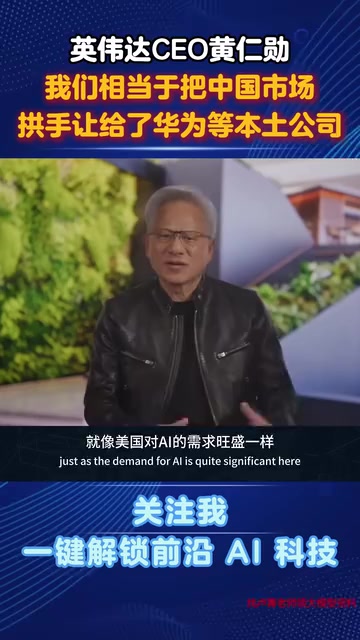
For the head of the world's dominant GPU maker to openly acknowledge a competitor's strength is itself a significant signal.
Huawei's "Record Year" — and Huang Predicts More to Come
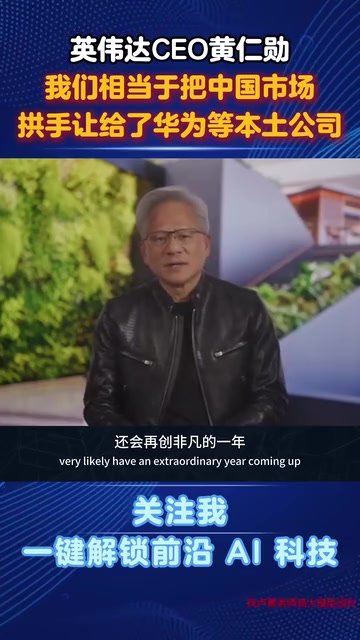
Huang specifically highlighted Huawei's recent performance, noting that the company just had "a record year" and that it is "very likely" to follow that up with "an extraordinary year."
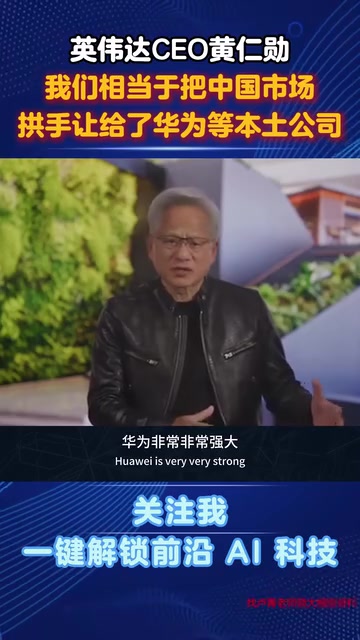
This assessment is well-grounded. Publicly available data shows Huawei accelerating across the AI chip space on multiple fronts:
- The Ascend series AI chips continue to iterate with steadily improving compute performance
- The CANN operator development platform and MindSpore framework form a complete software ecosystem
- A growing number of Chinese AI companies and research institutions have begun training models and deploying inference workloads on Huawei Ascend hardware
Technical Background: Inside Huawei's Ascend Chip Architecture
Huawei's Ascend series AI chips are built on the company's proprietary DaVinci architecture, optimized specifically for deep learning training and inference. The Ascend 910 series targets high-performance training and is positioned to rival NVIDIA's A100 in theoretical compute; the Ascend 310 series focuses on edge inference. The accompanying CANN (Compute Architecture for Neural Networks) is Huawei's in-house heterogeneous computing software stack — analogous to NVIDIA's CUDA ecosystem — providing operator libraries, a compiler, and a runtime environment. MindSpore is Huawei's open-source deep learning framework supporting full-scenario deployment. This complete "chip + software stack + framework" ecosystem is the core foundation of Huawei's ability to compete head-on with NVIDIA, and the technical basis for achieving a "record year" under sustained sanctions pressure.
From "sanctioned" to "record-breaking" — Huawei has demonstrated in practice that a self-reliant technology path is viable.
Beyond Huawei: China's Domestic AI Chip Ecosystem Is Rising Across the Board
Huang's remarks extended beyond Huawei alone. He explicitly stated that China's domestic chip company ecosystem is "doing quite well" — signaling that alongside Huawei, players like Cambricon, Hygon, Enflame, and Biren Technology are also scaling rapidly.
Industry Background: A Map of China's AI Chip Players
China's AI chip sector has evolved into a diverse competitive landscape. Cambricon is the country's earliest publicly listed AI chip company, with its Siyuan series covering cloud training and inference. Hygon builds on AMD-licensed x86 architecture with deep customization, targeting data center general-purpose computing. Enflame, backed by Tencent, focuses on cloud AI training with its Suisi series. Biren Technology's BR100 GPU series targets NVIDIA's A100, claiming single-chip performance exceeding 1,000 TOPS. Emerging players like Moore Threads and Tianshu Zhixin are also growing quickly. This ecosystem has been shaped by both policy incentives and the combined force of market demand and capital investment, forming a diverse matrix of domestic alternatives to NVIDIA in China.
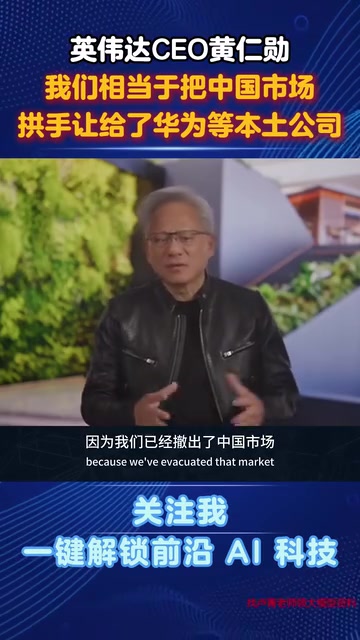
Even more telling is how Huang framed the situation. He used two remarkably candid phrases:
- "We've evacuated that market"
- "We've really largely conceded that market to them"
These are weighty words. As one of the American companies most affected by chip export controls, NVIDIA's CEO publicly admitting to "conceding the market" amounts to an indirect critique of current U.S. chip export policy toward China.
The Evolution of Export Controls and the "Technology Blockade Paradox"
Policy Background: The Escalating History of U.S. Chip Export Controls on China
U.S. chip export controls on China have tightened through multiple rounds of escalation. In 2019, Huawei was added to the Entity List, restricting its access to American technology. In October 2022, the Biden administration introduced the most sweeping chip export rules to date, using compute thresholds (benchmarked against the A100) as the control threshold — prompting NVIDIA to release the downgraded A800 and H800 variants for the Chinese market. In October 2023, the rules tightened again, bringing the A800 and H800 within scope. By 2024, controls expanded further to cover more countries and chips with lower compute thresholds. The underlying logic of this policy chain is that "compute power equals national power" — that restricting access to advanced AI compute can preserve a technological edge. Yet Huang's remarks reveal the internal contradiction of that logic.
Huang also noted that he considers it "rightful" for the Chinese government to want to protect its domestic enterprises — a telling comment. He was effectively suggesting that U.S. chip export controls have not only failed to contain China's AI chip development, but have actually accelerated domestic substitution while costing NVIDIA a massive market.
From an industrial economics perspective, this is a textbook example of the "Technology Blockade Paradox." The paradox has deep theoretical roots — viewed through the lens of Infant Industry Theory, the removal of external competitive pressure creates the very space that domestic companies need to grow. Historically, Japan's semiconductor industry rise in the 1980s and the development of Korea's memory chip industry both benefited from similar protective dynamics. For China, export controls have objectively created a "forced domestic substitution" environment — one that is now producing results even NVIDIA's CEO cannot ignore.
Related articles
 Tech Frontiers
A Rare Quiet Day in AI: Recursive Self-Improvement Stirs Beneath the Surface
A rare quiet day in AI sees multiple sources go silent simultaneously. Behind the calm, Recursive Self-Improvement (RSI) research continues. What this means for the industry.
 Tech Frontiers
Reve 2 vs. Ideogram 4: A Deep Dive into Layout Control in AI Image Generation
A deep comparison of Reve 2 and Ideogram 4's layout control capabilities, covering technical approaches, real-world use cases, and industry trends for designers and creators.
 Tech Frontiers
In the Weights: Check Your Influence Score in the AI World
In the Weights is an AI influence search engine that quantifies your presence in the AI world with a score. Explore how it evaluates practitioners and what it means for digital identity.