Jensen Huang Denies Trump Helped Him Return to Nvidia: Rumor Is False
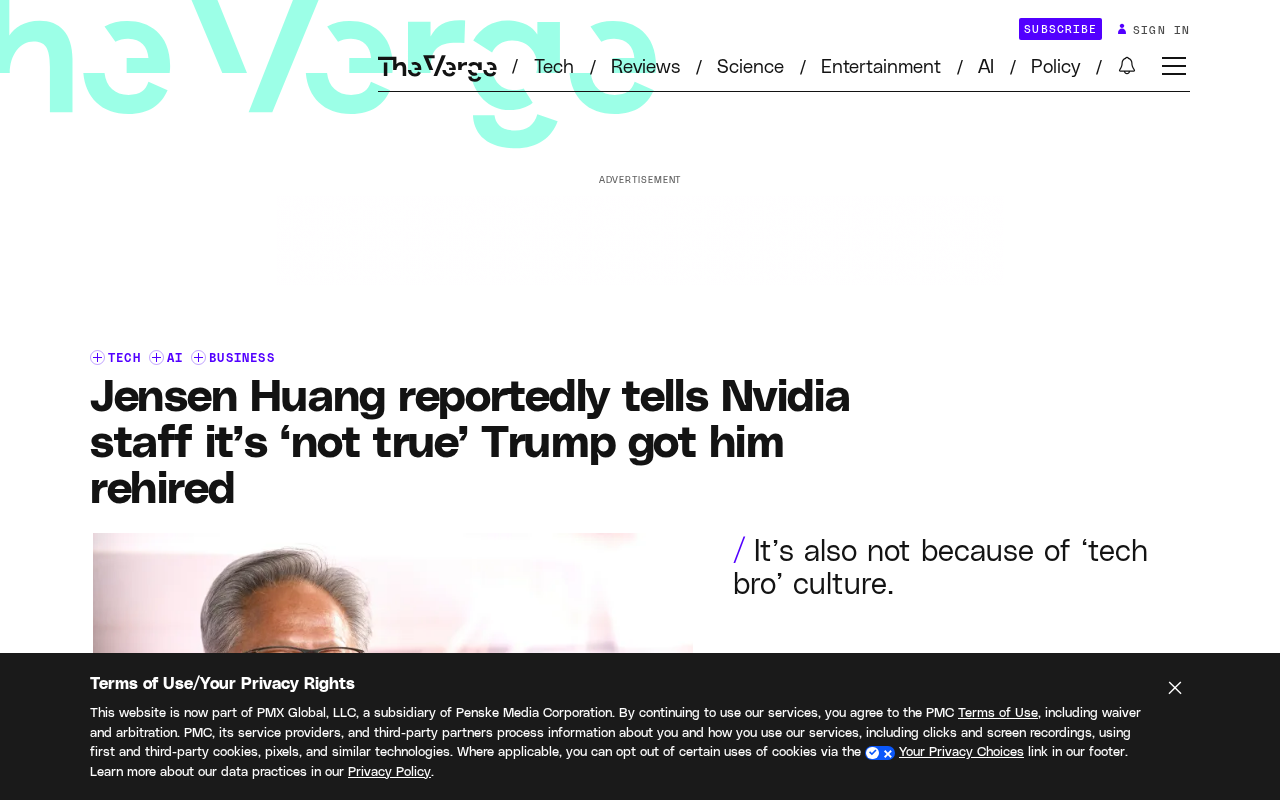
Huang denies at all-hands meeting that Trump helped his return, seeks to distance from politics.
At his first all-hands meeting after returning, Nvidia CEO Jensen Huang denied claims that the White House and tech leaders facilitated his return, calling them "not factual." Per Bloomberg, NYT, and reporter Marisa Kabas, he also apologized to employees without disclosing details. The response strategy separates his position from politics, prioritizing internal morale.
Jensen Huang Denies Trump Helped Him Return to Nvidia: Rumor Is False
At his first all-hands meeting after returning to the company, Nvidia CEO Jensen Huang personally addressed the widely circulating claim that "the White House and tech leaders facilitated his return." According to Bloomberg, The New York Times, and The Handbasket reporter Marisa Kabas, Huang made clear at the meeting that this narrative is "not factual" and sought to distance himself from political forces.
Where Did the Rumor Come From?
Recently, public opinion has linked Huang's return to behind-the-scenes efforts by the Trump administration and some figures in the tech world, suggesting a political deal behind his position change. This narrative continued to gain traction on social media and in some media reports, ultimately forcing Huang to respond directly at an internal meeting.
According to cross-verification from multiple sources, Huang not only denied at the meeting that Trump was involved in his return, but also expressed an apology to employees. However, the reports did not disclose the specific recipient or reason for the apology.
In Nvidia's governance structure, the CEO is not directly elected by shareholders but appointed by the board of directors, which typically consists of the founding team and external independent directors. As a co-founder, Huang has long served simultaneously as CEO and director, and changes to his position would theoretically require board procedures rather than direct intervention by political forces. Understanding this governance framework helps assess that narratives such as "the White House facilitated the return" lack an operable path at the institutional level—the U.S. government has no legal authority to directly appoint or dismiss executives of private companies, and such rumors are more a product of public opinion construction than corporate governance fact.
Huang's Public Distancing
Huang's response strategy is clear: completely separate his personal position changes from political factors. Against the backdrop of increasingly sensitive relationships between tech company CEOs and governments, this distancing has practical significance—as a core supplier in the global AI chip sector, Nvidia's leadership's political leanings could affect the company's relationships with regulators, customers, and partners in multiple countries.
Multiple independent media outlets consistently reported Huang's denial, which constitutes the core fact of the incident. As for the apology portion, details from different sources are limited, and its full context cannot yet be confirmed.
Nvidia's dominant position in the AI chip market exposes it simultaneously to U.S. export controls, EU antitrust scrutiny, and compliance requirements in markets such as China. A CEO's public political stance may be interpreted by regulators, customers, and investors as the company's inclination, thereby affecting licensing approvals and business trust. Therefore, tech leaders typically deliberately maintain distance from partisan politics, distinguishing personal views from company positions to reduce operational risks brought by geopolitical friction.
What It Means for Nvidia
Huang chose to respond directly at an all-hands meeting rather than through a PR statement, indicating that he wanted to prioritize stabilizing internal morale. For a company at the center of the AI wave, leadership stability and independence are key concerns for employees and investors.
Nvidia has not yet issued an official statement on the meeting's content, and it remains to be seen whether more details will be disclosed later.
One-line Summary
Huang denied at an all-hands meeting that Trump helped him return and sought to distance himself from politics.
Paragraph Summary
At his first all-hands meeting after returning to the company, Nvidia CEO Jensen Huang personally denied the widely circulating claim that "the White House and tech leaders facilitated his return," calling the narrative "not factual." According to Bloomberg, The New York Times, and reporter Marisa Kabas, Huang also apologized to employees at the meeting but did not disclose the recipient or reason. The article analyzes that Huang's response strategy is to completely separate his personal position changes from political factors, which is significant against the backdrop of increasingly sensitive relationships between tech company CEOs and governments. Choosing to respond at an internal meeting rather than through a PR statement shows his priority on stabilizing internal morale. Nvidia has not yet issued an official statement, and further details remain to be seen.
Related articles
Java4Shell Vulnerability Analysis: Has Java's Memory Safety Myth Been Shattered?
Computerphile breaks down the Java4Shell vulnerability: OpenJDK's native Base64 decoder mishandles AVX-512 mask calculation, causing out-of-bounds writes and RCE. Covers root cause, Base64 padding mechanics, AI-assisted discovery debate, and fixes.

Controversial US Surveillance Law Section 702 Nears Expiration: Congress Races to Renew
FISA Section 702 surveillance authority is nearing expiration. Congress is urgently pushing reauthorization, possibly attaching it to the NDAA. This article analyzes the controversies, legislative strategy, and future outlook.

iFood Manages 15,000 Repositories with Coding Agents: An Architectural Lesson at 4 Cents per Run
How iFood scaled coding agents to 15,000 repositories with its Remote Agents Platform: REST API-driven, GPT-5.6 Luna selection, structured output acceptance, $0.04 per run, security fixes doubled.