Jensen Huang on AI and Climate Change: Must We Suffer Greatly Before Things Get Better?

Jensen Huang claims AI can save the climate, but only after great human suffering — a take drawing fire for its contradictions and techno-solutionist logic.
Nvidia CEO Jensen Huang sparked controversy on a podcast by arguing AI could help address the climate crisis — but only after humanity endures tremendous suffering. The remarks drew criticism on multiple fronts: as the leader of the world's largest AI chip supplier, Huang's own push for unlimited computing expansion is a primary driver of surging energy consumption, making the "emit now, fix later" narrative deeply contradictory. The piece also flags how his comments reflect Silicon Valley's entrenched techno-solutionism, which risks undermining the urgency of acting on emissions today.
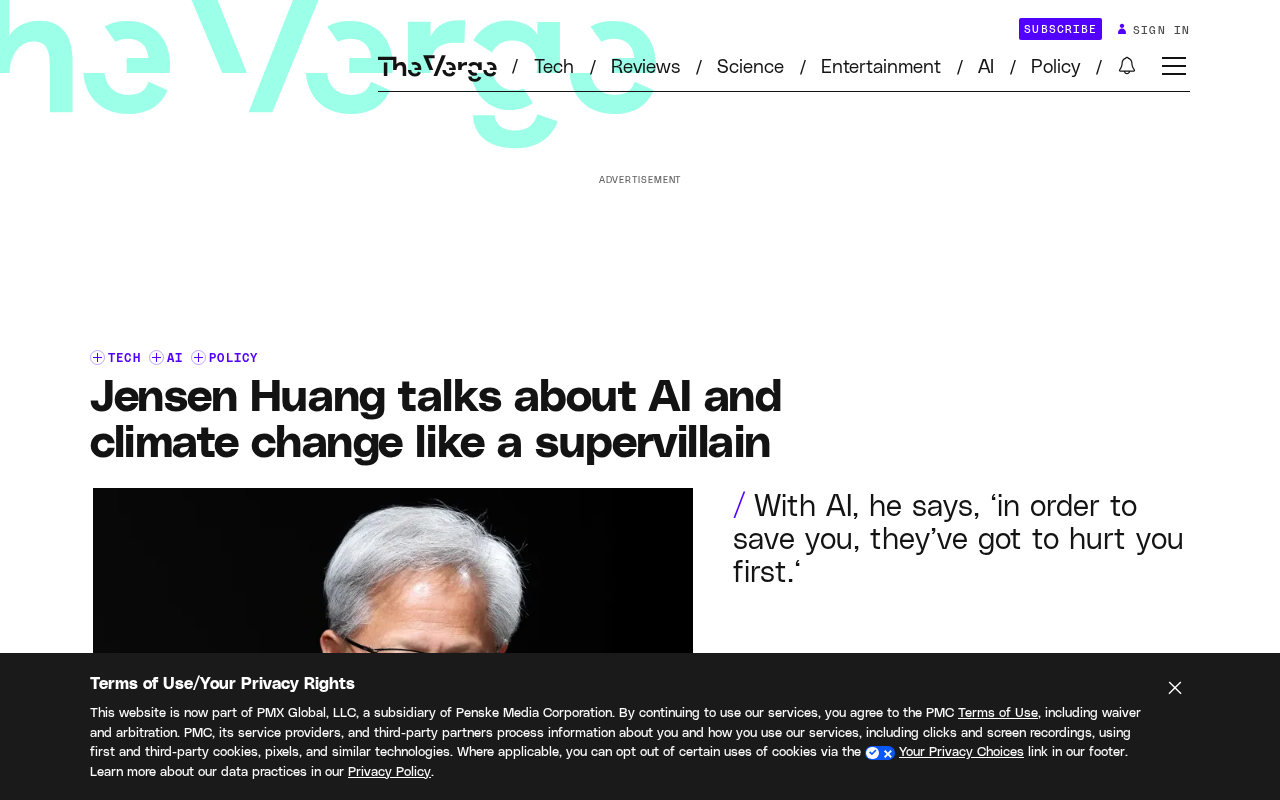
Nvidia CEO Jensen Huang recently appeared on The Ezra Klein Show podcast and shared a controversial take on the relationship between AI and climate change. His core argument: AI does have the potential to help humanity address the climate crisis — but only after we've first endured "tremendous amounts of pain and suffering." The media quickly described his remarks as sounding like something "a movie villain would say," sparking widespread debate across the tech world.
What Did Jensen Huang Actually Say
In the podcast episode, Huang discussed the future of energy and AI's impact on the planet. His view was simultaneously pessimistic and colored by a kind of technological optimism: humanity won't take sufficient action on the climate crisis before it causes serious consequences, and only when the suffering reaches a breaking point will AI technology be truly mobilized at scale to solve the problem.
In other words, Huang doesn't see AI as a preventive vaccine we can take in advance — more like an emergency rescue tool that will only be fully deployed after a crisis erupts. This "won't act until forced to" judgment implies a deep skepticism about humanity's collective decision-making capacity.
Why These Remarks Sparked Controversy
Huang's comments stung precisely because they frame AI as a force whose value can only be realized at the cost of suffering. As the head of the world's largest AI chip supplier, his statements carry an inherent perspective — Nvidia is one of the biggest beneficiaries of the current AI computing boom.
The Contradiction Between Computing Expansion and Energy Consumption
There's an uncomfortable reality that can't be ignored: AI itself is becoming a massive source of energy consumption. Training and running large models requires enormous amounts of electricity, and the carbon footprint of data centers continues to rise. When the leader of an AI hardware giant simultaneously advocates for unlimited computing expansion and talks about using AI to save the climate, the internal tension in that narrative is hard to miss.
Critics would ask: if AI must first generate massive energy consumption and emissions before we can hope it solves the climate problem down the road, does that math actually work? This is exactly why Huang's remarks got labeled as "villain logic" — they sound like seeking after-the-fact redemption for inevitable destruction.
The scale of data center energy consumption has drawn widespread attention. The International Energy Agency (IEA) estimates that global data centers account for roughly 1–1.5% of total electricity consumption — a share expected to keep rising with the explosive growth of generative AI. Training a single large language model (at the scale of GPT-4) can consume as much electricity as hundreds of households use in an entire year. The inference phase — the real-time computation triggered by every user query — accumulates even greater energy use than training due to its sheer scale. Nvidia's GPUs are the core infrastructure of today's AI computing, with its H100 chip drawing up to 700 watts per card. The carbon emissions from the AI industry are not a distant concern — they are a present reality, and that makes Huang's "AI will save the climate" argument directly vulnerable to challenge from the energy consumption data itself.
The Risk of Techno-Solutionism
Huang's perspective also reflects a mindset pervasive in Silicon Valley: techno-solutionism — the belief that sufficiently powerful technology will ultimately solve all of humanity's problems, including those the technology itself has exacerbated. The danger in this thinking is that it may erode the urgency of taking concrete action today — cutting emissions, improving efficiency — in favor of pinning hopes on immature future technologies.
"Techno-solutionism" is a long-standing intellectual framework in Silicon Valley culture, systematically critiqued by scholar Evgeny Morozov in his writings. Its core assumption is that any social problem — poverty, disease, climate change — can ultimately be solved through sufficiently advanced technological means, without needing to touch economic structures, consumption patterns, or political systems. This line of thinking is particularly dangerous when applied to climate: technologies like "negative emissions" and "carbon capture and storage (CCS)," still far from mature, have repeatedly been used as justifications for delaying emissions reductions. When AI is folded into this narrative, it risks shifting from a tool that assists climate action to a rhetorical resource that defends the status quo: if future technology will save us anyway, today's large-scale emissions feel less urgent.
How to Think About This Statement Rationally
Stripping away the dramatic framing, Huang's assessment does contain some elements worth serious reflection. Humanity's tendency to procrastinate and think short-term when facing long-term risks is a recurring obstacle in climate governance. And AI's genuine potential in energy optimization, materials science, and climate modeling is well-documented.
The real question isn't whether AI can help address climate change — it's whether we should accept the passive path of "suffer first, get saved later." Tying technological progress to enormous human cost could be a form of clear-eyed realism, or it could become a convenient excuse for avoiding present-day responsibility.
For general readers, what's most worth scrutinizing in these remarks is the underlying position and interests — when industry leaders paint a picture of the technological future, understanding where they stand often matters more than accepting their conclusions.
Conclusion
Huang's comments are less a scientific assessment of AI's relationship to climate change than a pessimistic prophecy about human behavioral patterns and the role of technology. Whether AI will become the savior of the climate crisis remains an open question. What is certain, however, is that placing all our hopes in a "technological miracle after the suffering" is far from wise.
Related articles

Should U.S. College Fraternities Be Banned? A Researcher's Incisive Observations
Why not just ban U.S. college fraternities? A researcher finds the key resistance comes from decision-makers' own fraternity identities and schools' "willful ignorance."

Microsoft Discovery: Accelerating Scientific Discovery with AI Agents
Microsoft's Discovery platform runs specialized AI agents to help researchers screen and prioritize the most promising compounds and experimental paths, reducing experiments and accelerating scientific discovery.

Cambridge Heavy Industries Secretly Develops Desktop-Scale Nuclear Fusion Device
Cambridge Heavy Industries is secretly developing a desktop-scale laser-driven nuclear fusion device, targeting the equipment supply market for fusion power plants. This article analyzes its miniaturization technology path, commercialization logic, and unique positioning in the fusion startup wave.