Jensen Huang Praises DeepSeek and Kimi: Markets Have Twice Misjudged the Impact of Chinese Open-Source Models

Jensen Huang argues markets wrongly see Chinese open-source AI models as threats to compute demand.
NVIDIA CEO Jensen Huang publicly praised Chinese open-source models DeepSeek and Kimi, arguing that markets have twice misjudged their impact. Rather than reducing GPU demand, he contends that cheaper, more capable open-source models lower adoption barriers, spawn more AI applications, and ultimately amplify total compute consumption — a dynamic consistent with the Jevons Paradox.
Jensen Huang Publicly Champions Chinese Open-Source Models
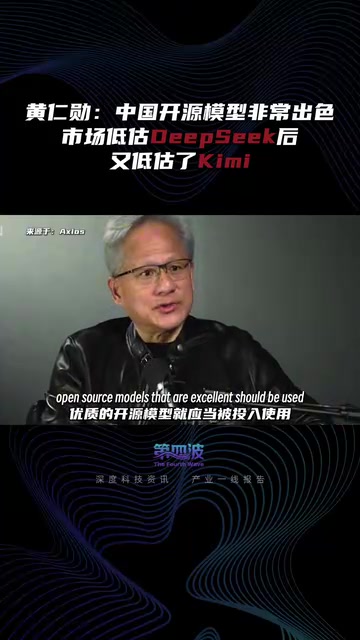
NVIDIA CEO Jensen Huang recently gave high praise to Chinese open-source large language models in a public appearance. He stated plainly: "These Chinese models are very good, and good open-source models should be used." This statement drew widespread attention across the AI industry, especially as he explicitly named two Chinese models — DeepSeek and Kimi.
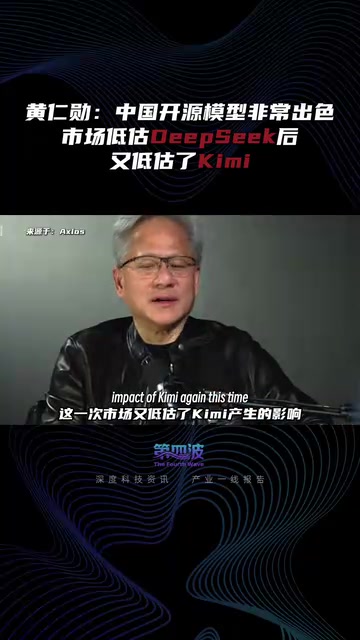
Huang argued that capital markets have clearly misjudged the impact of these Chinese models. "The market misunderstood DeepSeek's impact the first time, and now it's misunderstanding Kimi's impact." The context behind these remarks is a recurring pattern: whenever Chinese open-source models achieve breakthroughs, the market tends to interpret them as bearish signals for compute infrastructure providers like NVIDIA, triggering stock price volatility.
From DeepSeek to Kimi: Two Market Misjudgments
Looking back, when DeepSeek released its high-performance, low-cost models, it briefly sparked fears about whether "AI compute demand would decline," causing sharp swings in NVIDIA's stock price. DeepSeek is a large language model series developed by DeepSeek (formerly under the Chinese quantitative hedge fund High-Flyer). It employs a Mixture of Experts (MoE) architecture and an innovative Multi-head Latent Attention (MLA) mechanism, dramatically reducing inference costs while maintaining performance close to GPT-4 levels. Now, with Moonshot AI's Kimi series delivering another impressive showing, a similar wave of market panic has resurfaced. Kimi was developed by Moonshot AI, founded by Tsinghua University alumnus Yang Zhilin. It initially gained fame for supporting ultra-long context windows (2 million characters), and its latest Kimi K2 model features a trillion-parameter-scale MoE architecture that has demonstrated competitive performance against top international models across multiple benchmarks. These two companies represent two distinct paths in Chinese AI entrepreneurship: one driven by financial capital powering algorithmic innovation, the other by academic elites pursuing technical ventures.

Huang's core argument is that the market's reaction has the cause-and-effect relationship exactly backwards. Stronger and cheaper AI models don't weaken compute demand — they amplify overall demand by making AI accessible to far more applications.
Why Open-Source Models Are Good News for the Entire AI Industry
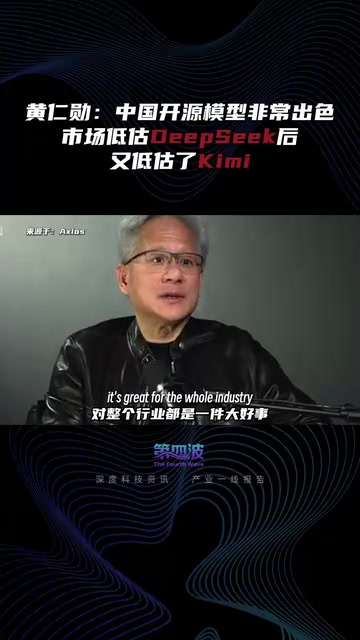
Huang repeatedly emphasized the positive impact of open-source models on the industry. He stated: "First of all, having excellent open-source AI models is a tremendously good thing for the entire industry."
The rise of open-source large models is fundamentally reshaping the competitive landscape of the AI industry. Meta's LLaMA series first opened the floodgates for open-source LLMs, followed by Mistral, DeepSeek, Alibaba's Qwen, and others. The open-source model lowers the barrier to AI application development — companies don't need to pay steep API fees, can deploy and fine-tune models on their own infrastructure, and can customize them for specific business scenarios. This model puts pricing pressure on closed-source API providers (such as OpenAI), but is actually beneficial for underlying compute providers: widespread deployment of open-source models means more companies need to purchase or rent GPU resources to run them. It's estimated that the total compute required for AI inference has already surpassed that of training, and this ratio continues to grow — a direct result of open-source model proliferation.
Application Demand Is the Core Driver of Compute Growth
Huang laid out a thought-provoking logical chain: when excellent AI capabilities exist, even if they're open-source and regardless of where they come from, they ultimately generate more use cases.
"Obviously, when there's great AI, even if it's open-source, no matter where it comes from, it leads to more applications." This means that improvements in model capability and reductions in cost lower the adoption threshold for enterprises and developers, spawning massive numbers of new applications — all of which still require enormous compute infrastructure to support.
This logic is precisely the Jevons Paradox reasoning that NVIDIA embraces: efficiency gains don't reduce resource consumption — they increase total consumption by expanding demand. This economic phenomenon originates from British economist William Stanley Jevons' 1865 observation — when steam engines became more efficient at burning coal, total coal consumption actually rose because greater efficiency made more applications economically viable. In the tech industry, similar patterns have played out repeatedly: declining storage costs gave rise to streaming and cloud computing; declining bandwidth costs gave rise to short-form video and the live-streaming economy. In AI, when model inference costs drop from several dollars per million tokens to a few cents, previously cost-prohibitive applications (such as real-time customer service, code review, and personalized education) suddenly become economically viable, and the total compute consumed by these new applications far exceeds the compute saved by per-inference efficiency gains. When AI becomes cheaper and easier to use, the number of people and scenarios using it grows exponentially.
NVIDIA's Strategic Intent to Accelerate AI Technology Diffusion
From NVIDIA's business strategy perspective, Huang made the company's desired direction clear. He stated: "What we want to do is make sure AI technology diffuses into every industry as fast as possible, so that as many people as possible can use it as quickly as possible."
NVIDIA currently holds approximately 80-90% market share in AI training and inference GPUs, and its CUDA software ecosystem, built over more than a decade, has created a powerful developer lock-in effect. From the H100 to the latest Blackwell architecture (B200/GB200), NVIDIA continuously improves per-chip compute density and energy efficiency to meet the growing computational demands of AI models. The company's business model is essentially "selling shovels" — regardless of which company's model wins, whether models are closed-source or open-source, as long as total AI inference volume keeps growing, demand for NVIDIA GPUs and accompanying networking equipment (such as InfiniBand/NVLink) will continue to climb.
Open-Source and Low Cost: The Best Path to AI Democratization
Huang concluded: "So open-source models, incredibly cheap models, easy entry points to try AI — that's the best thing we can do."
This statement reveals NVIDIA's deeper strategic logic: as a core provider of compute infrastructure, NVIDIA's interests are deeply aligned with the proliferation of AI applications. Whether models come from OpenAI, Google, DeepSeek, or Kimi, as long as the scale of AI usage continues to expand, demand for GPUs and data centers will keep growing. Therefore, the rise of Chinese open-source models is not a threat to NVIDIA — it's a force that helps grow the overall market pie.
Three Key Takeaways from Huang's Remarks for the AI Industry
Huang's statements offer several important perspectives for understanding the current AI industry landscape.
First, the technical prowess of Chinese open-source models has received top-tier recognition. From DeepSeek to Kimi, the progress made by Chinese teams in model performance and cost efficiency is substantively changing the global AI landscape. Notably, these models have achieved breakthrough results despite chip export restrictions, demonstrating that algorithmic innovation and engineering optimization can, to a significant extent, compensate for hardware limitations.
Second, the market's pessimistic interpretation of "low-cost, high-performance models" may be short-sighted. Huang reminds us that AI's value is ultimately measured by the breadth and depth of its applications, not merely the compute consumed to train a single model. Historical experience shows that every order-of-magnitude drop in computing costs spawns previously unimaginable new application paradigms — just as the adoption of cloud computing gave rise to the SaaS industry, declining AI inference costs are fueling an explosion of AI-native applications.
Third, the open-source ecosystem is a critical force for making AI accessible to all. Whether from an industry development or technology diffusion perspective, open, affordable, and easy-to-use models are the best way to accelerate real-world AI deployment. Open source not only lowers the barrier to entry but also accelerates technological iteration through community collaboration, creating a positive flywheel: "open-source model release → community fine-tuning and optimization → application scenario expansion → compute demand growth."
For AI practitioners and investors, Huang's assessment deserves careful consideration: the real opportunity lies not in worrying about whose model is stronger or cheaper, but in seizing the wave of applications that will emerge from AI's mass adoption.
Key Takeaways
Related articles

The Truth Behind Codex 'Build a Website in 5 Minutes': AI Isn't Creating Sites—It's Helping You Copy Them
Exposing the truth behind viral Codex 5-minute website videos: creators aren't building original sites with AI—they're copying shared prompts or scraping others' work. Learn AI coding tools' real limits.

Getting Started with AI Agent Development: A Complete Guide from Concept to Practice
A comprehensive guide to AI Agent architecture and development, covering automated marketing, intelligent customer service, and investment analysis scenarios with single and multi-agent collaboration.

The Truth Behind Codex 'Build a Website in 5 Minutes': AI Isn't Creating Sites — It's Helping You Copy Them
Exposing the truth behind viral Codex 5-minute website videos: creators aren't building original sites with AI — they're copying shared prompts or scraping others' work.