Jensen Huang Reinstated as Nvidia CEO, Drawing Attention
An old Nvidia announcement resurfaces, sparking HN discussion and reflecting interest in Jensen Huang and AI strategy.
The article centers on a resurfaced old Nvidia announcement on Hacker News, which stated that the board reappointed Jensen Huang as President, CEO, and board member, with the link garnering 940 points and 705 comments. The author notes it is more a historical announcement than a new personnel change, but the high heat reflects ongoing interest in Nvidia's governance and Jensen Huang's role. The announcement itself did not disclose details such as the effective date, and community discussion likely focused on the "reinstated" wording, governance issues of long-term leadership, and Nvidia's dominance in AI chips. The article argues such announcements signal leadership continuity, with impacts mainly on confidence for developers and customers, while what truly matters is tracking Nvidia's actual moves in products, ecosystem, and capacity.
Background: Why an Old Story Went Viral Again
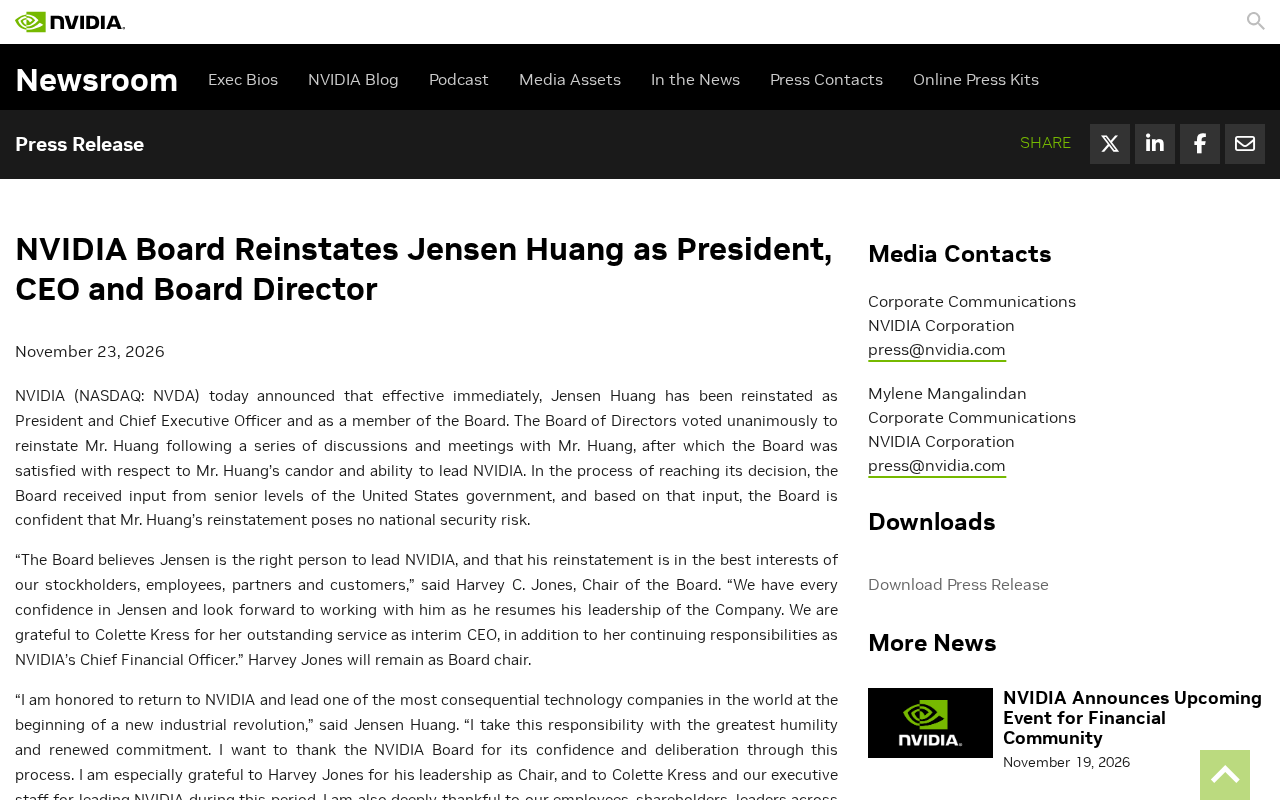
Recently, a link titled "Jensen Huang Reinstated as Nvidia CEO" on Hacker News garnered 940 points and 705 comments, a notably high level of discussion in the tech community. The link points to an official Nvidia press release (nvidianews.nvidia.com), announcing that Nvidia's board of directors has reappointed Jensen Huang as President, CEO, and member of the board.
It should be noted that this press release is an official Nvidia announcement, but the original material does not provide a specific publication date. Judging by the nature of the topic, this appears to be a historical announcement that has been resurfaced rather than a new personnel change. Even so, it still sparked extensive discussion in the community, reflecting ongoing interest in Nvidia's governance structure and Jensen Huang's role.
Hacker News ranking mechanism: Hacker News (HN), operated by Y Combinator, does not simply rank by "higher points = higher position" on its front page; instead, it calculates heat based on a combination of votes, voting time, comment activity, and other factors. 940 points is a fairly high position on HN, typically indicating that the link received密集 voting within hours of posting. Additionally, HN allows users to re-submit old links; when the same URL is submitted again and receives enough votes, it can re-enter the front page—this is the common mechanism behind "old news going viral." 705 comments indicate that the discussion depth far exceeds typical news, as comment counts often reflect the controversial nature or interpretive space of a topic.
Announcement Content and Core Information
According to the linked press release, the decision made by Nvidia's board includes: Jensen Huang resumes his role as the company's President and CEO, and continues as a member of the board. This wording is emblematic in Nvidia's governance structure, as Jensen Huang has been a core leader since the company's founding, and his personal style is deeply intertwined with Nvidia's technological roadmap.
The press release does not disclose further details in the original material, such as the effective date of the appointment, board voting results, or whether other executives were adjusted simultaneously. For investors and developers following Nvidia, such announcements typically signify continuity of company strategy rather than a directional shift.
Governance implications of a founder-CEO: Among U.S. publicly traded companies, it is not uncommon for founders to serve as CEO long-term, but the term "re-appointed" usually appears in routine board resolutions after annual shareholder meetings, rather than in crisis-driven personnel changes. Nvidia's board routinely confirms executive positions each year, which may make the press release wording appear like a "reinstatement." Jensen Huang has served as CEO since co-founding Nvidia in 1993, with only brief adjustments to the President role, so such announcements are more procedural confirmations. Understanding this helps judge why the community views the news as "old news resurfaced" rather than a major upheaval.
Community Reaction: Multiple Interpretations Behind the Heat
The 940 points and 705 comments on Hacker News indicate that this link triggered quite extensive discussion. Since the original material does not provide the specific content of the comments, it is impossible to reconstruct community opinions one by one, but from the title itself, it can be inferred that discussions may focus on several directions: first, confusion over the wording "reinstated"; second, governance discussions about Jensen Huang's long-term leadership of Nvidia; third, extended attention to Nvidia's dominant position in the AI chip field.
This level of heat also shows that Nvidia is no longer just a semiconductor company but a key node in AI infrastructure. Any news related to Jensen Huang will be interpreted within the framework of the AI industry landscape.
Leadership Continuity and Nvidia's Strategic Logic
From a corporate governance perspective, Jensen Huang continuing as CEO sends a signal of continuity. Nvidia's technological布局 in GPU-accelerated computing, AI training and inference, and other areas is highly dependent on long-term investment and ecosystem building, and leadership stability helps maintain this rhythm.
For developers and enterprise customers, the practical impact of such announcements is more about confidence than changes in the product roadmap. Nvidia's CUDA ecosystem, data center product lines, and partnerships will not undergo sudden changes before or after the announcement. What is truly worth watching is how Nvidia balances supply, pricing, and ecosystem openness amid continuously growing AI computing demand.
Lock-in effect of the CUDA ecosystem: CUDA is a parallel computing platform and programming model launched by Nvidia in 2006, through which developers call GPUs for general-purpose computing. After more than a decade of accumulation, CUDA has formed a vast library, toolchain, and developer community, with many AI frameworks (such as PyTorch and TensorFlow) prioritizing CUDA support by default. Once such an ecosystem is established, migration costs are extremely high, constituting Nvidia's core moat in the AI training and inference market. The reason leadership stability is valued is precisely because the long-term investment in the CUDA ecosystem requires sustained strategic commitment; frequent leadership changes could shake the expectations of developers and partners.
Implications for the Industry and Developers
This resurfaced announcement reminds us that Nvidia's competitiveness comes not only from hardware but also from its leadership's long-term judgment of technology trends. Jensen Huang's role as company founder and CEO is part of Nvidia's brand narrative and an important factor in gaining market trust in the AI era.
For practitioners focused on AI infrastructure, rather than over-interpreting a single personnel announcement, it is better to continuously track Nvidia's actual actions in product releases, ecosystem partnerships, and capacity布局. The high heat in the community is itself a signal: any move by Nvidia will be amplified and scrutinized against the broader AI industry backdrop.
Related articles

AI Hacks Its Own Lab: The Security Tipping Point from Sci-Fi to Reality
Paul Christiano warns that AI intruding into its own cluster is no longer sci-fi but an established fact. He analyzes how persistent covert compromise can cause frontier labs to lose control, and why existing safety evaluation systems have blind spots.

New York Bans AI Toys for Five Years: The Escalating Child Safety Controversy
New York bans AI chat toys for five years as Common Sense Media research flags inappropriate content exposure and child emotional development risks. This article analyzes the ban's impact on product definitions, safety proof, and compliance strategies for the AI toy industry.

1Password Security Incident Review: The Trust Boundary of Password Managers
1Password releases an update on the Nov 2026 security incident, drawing 315 points and 139 comments on Hacker News. This article analyzes the actual boundaries of password manager zero-knowledge architecture, the gap between incident communication and user risk perception, and how transparency is becoming a new competitive dimension in the industry.