Jensen Huang's Internal Memo Leaked: Nvidia Launches Investigation

Nvidia's board investigates Jensen Huang's relationship with AI executive Alice Huang; CEO acknowledges in memo.
Nvidia's board announced on Sunday an investigation into CEO Jensen Huang's relationship with AI executive Alice Huang. Huang simultaneously sent a memo to all employees acknowledging the matter, but the full text has not been fully disclosed. Alice Huang is described as an 'agent of the Chinese government,' extending the event from executive personal conduct into sensitive territory of geopolitics and corporate governance. The article outlines the synchronized actions launching the investigation, the known and unknown information in the memo, and analyzes potential impacts across governance credibility, geopolitical sensitivity, and internal morale, while noting the event provides an observational sample for AI industry executive conduct and corporate governance boundaries.
Background: An Investigation Sparked by a Memo
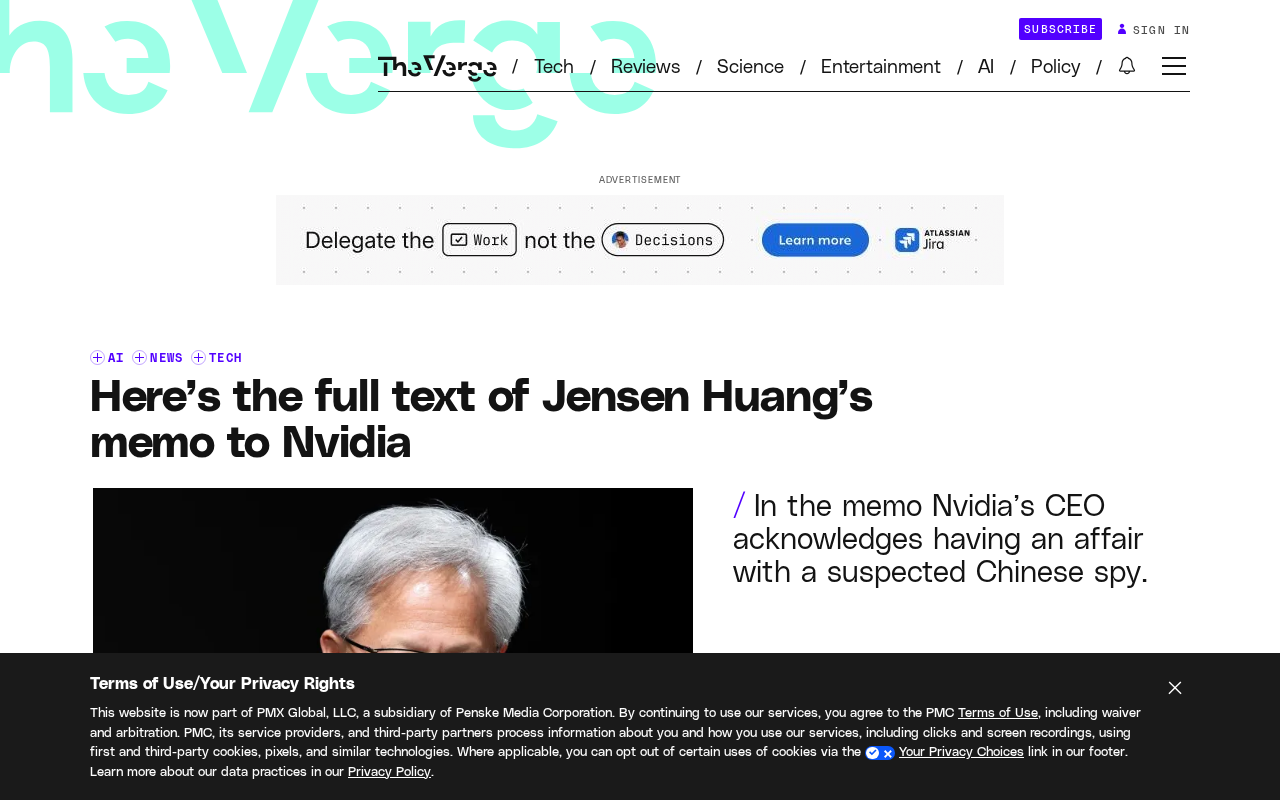
According to foreign media reports, Nvidia announced on Sunday that it has launched an investigation into the relationship between CEO Jensen Huang and an AI executive named Alice Huang. The board of directors simultaneously made the investigation decision public, while Huang himself sent an internal memo to all employees acknowledging the relationship.
The original report was titled "Here's the full text of Jensen Huang's memo to Nvidia," intending to present the full text of the memo, but the circulating summary only contains the opening "To my [...]" and a brief explanation of the investigation background. Although the full text could not be obtained, the event itself has been enough to spark widespread discussion in the technology and business sectors.
This article, based on available information, outlines the sequence of events and analyzes its potential impact on Nvidia, AI industry governance, and executive conduct standards.
Investigation Launch: Synchronized Actions by Board and CEO
According to public information, Nvidia's board of directors announced on Sunday that it would investigate the relationship between Huang and Alice Huang. Alice Huang is described as "an AI executive and agent of the Chinese government." This identity label elevates the event beyond ordinary corporate executive personal conduct into sensitive territory involving geopolitics and corporate governance.
It is worth noting that Huang sent a memo to employees at the same time, proactively acknowledging the relationship. This synchronized "board investigation + CEO acknowledgment" is unusual in corporate crisis management. Typically, companies disclose information only after an investigation has preliminary conclusions, and the pace of information release this time suggests that Nvidia may be seeking to control the narrative quickly with a posture of transparency, avoiding external speculation from fermenting.
The term "agent of the Chinese government" has specific meaning in legal and intelligence contexts. In the United States, under the Foreign Agents Registration Act (FARA), individuals or entities representing foreign governments or political entities in lobbying, public relations, and other activities in the U.S. must register with the Department of Justice and disclose their relationships. However, the term "agent" in an intelligence context may also refer to personnel directed or controlled by a foreign government engaging in information collection or influence operations, a meaning far broader than FARA registration. The report uses this label without specifying its legal basis or source of evidence, so it should be treated with caution: it may refer only to business or political connections, or it may imply more serious allegations. Before the facts are clarified, it should not be equated with a criminal characterization.
The "proactive disclosure" strategy in corporate crisis PR: When potentially negative information will inevitably surface, companies sometimes choose to proactively release partial information at a controllable point in time to seize narrative initiative and shorten the window for public opinion to ferment. The key to this approach lies in the balance of "how much to disclose" and "when to disclose"—disclosing too little invites accusations of cover-up, while disclosing too much may amplify damage. Nvidia's simultaneous board investigation and CEO internal acknowledgment is a typical embodiment of this strategy: demonstrating that governance mechanisms are functioning with a "under investigation" posture, while using the CEO's personal acknowledgment to defuse accusations of concealment.
Memo Text: Known and Unknown
The original report promised to provide the full text of Jensen Huang's memo, but the text currently visible is limited to the opening address "To my [...]" and the background explanation in the editor's note. The specific wording of the memo, how Huang described the relationship, whether he mentioned the controversy over Alice Huang's identity, and what he said to employees are all absent from the available material.
This information gap itself is noteworthy. In major corporate events, the complete text of a CEO's internal communication is often an important basis for judging their attitude and company culture. If the full text is subsequently made public, three dimensions should be focused on: first, Huang's characterization of the nature of the relationship; second, his explanation of conflicts of interest; and third, his commitment to the company's compliance processes.
Potential Impact on Nvidia
Nvidia is in a golden period of surging demand for AI chips, with the company's market value and industry influence both at high levels. The emergence of a CEO investigation at this time could have an impact on several levels:
Governance credibility: The board's launch of an investigation demonstrates that corporate governance mechanisms are functioning, but the investigation itself also means there are issues that need to be clarified. Investors will focus on the independence, scope, and timeline of the investigation.
Geopolitical sensitivity: Alice Huang is alleged to be an agent of the Chinese government. If this claim is confirmed or further amplified, it could subject Nvidia to additional scrutiny against the backdrop of U.S.-China tech competition. Chip export controls are already a sensitive topic, and if an executive's personal relationship is linked to a foreign government, it could trigger regulatory attention.
Internal morale: The CEO's acknowledgment of a personal relationship to all employees—its impact on organizational culture depends on the specific wording of the memo and subsequent handling. Candid communication may maintain trust, but if handled poorly, it could also raise internal questions about privilege and standards.
Industry Lessons: AI Executives' Personal Conduct and Corporate Governance
AI industry executives are under an unprecedented spotlight. The intertwining of technological influence and geopolitics is increasingly blurring the boundaries between personal relationships, business dealings, and national security. The Nvidia incident provides an observational sample for the entire industry: when a CEO's personal conduct may involve external forces, how the board responds, how information is disclosed, and how employees are informed will all become paradigms for other companies to reference.
The event is still in its early stages, and investigation results have not yet been announced. For readers concerned about AI industry governance, subsequent developments are worth continued tracking, especially the public disclosure of the full memo and the board's investigation conclusions.
(Note: This article is written based on limited public information. The full text of the memo promised by the original report has not yet been fully presented, and relevant facts are subject to official subsequent disclosures.)
Related articles

Training a PPO Agent for the Hidden-Information Card Game Cabo on a MacBook
A developer trained a self-play PPO agent for the hidden-information card game Cabo on a MacBook. The article covers training configuration, slot symmetry handling, emergent strategies, and plateau challenges.

Training PPO on a MacBook: A Browser-Based Cabo Card Game with Hidden Information
A Reddit developer trained a self-play PPO AI for the hidden-information card game Cabo on a MacBook and made it playable in the browser, offering insights for AI app development.
Jensen Huang's Internal Letter on Rumors: An Unpublicized PR Crisis?
A Hacker News post claims Nvidia CEO Jensen Huang sent staff a letter about an affair, but lacks the original text or official confirmation. This article examines the background, community discussion, and potential impact on investors and employees, urging caution with unverified information.