Jensen Huang Says AI Extinction Risk Is '0%' — Here's Why the Industry Isn't Buying It
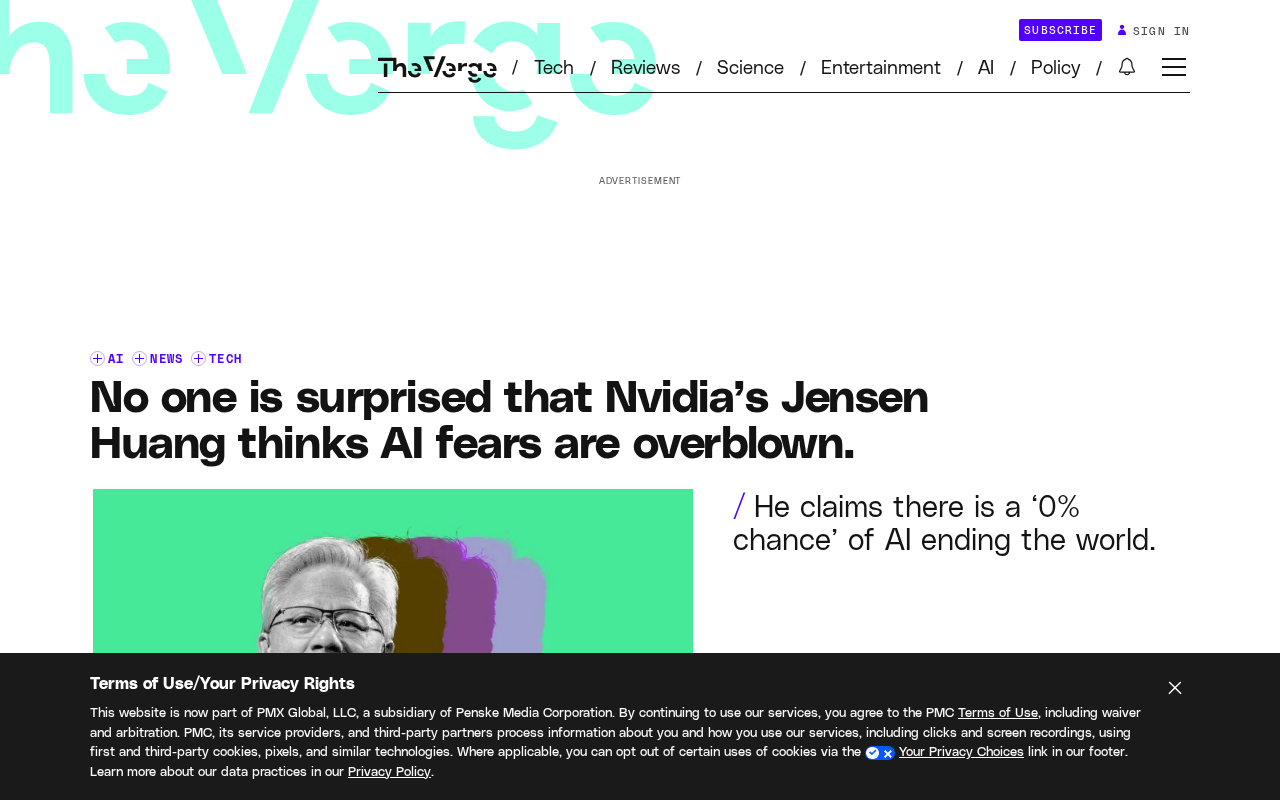
Jensen Huang's '0%' AI extinction claim draws skepticism over his obvious conflict of interest.
Nvidia CEO Jensen Huang declared on CBS that AI has a '0%' chance of causing human extinction — a claim quickly challenged for its absolutism and the speaker's enormous financial stake in AI's unchecked growth. Critics argue that as the biggest beneficiary of the AI chip boom, Huang's optimism cannot be treated as a neutral judgment. His stance stands in stark contrast to the cautious positions held by veteran AI researchers like Hinton and Bengio, whose concerns about alignment and loss-of-control risks cannot simply be dismissed by a business leader's round-number assertion.
Nvidia CEO Jensen Huang made a striking claim in a recent CBS Sunday Morning interview: he put the probability of AI causing human extinction at exactly "0%." As one of the biggest beneficiaries of the AI chip boom, his bullish stance quickly sparked controversy — many observers saw it less as a judgment grounded in rigorous research and more as a position statement from someone with enormous skin in the game.
The Problem With "0%"
Huang told the interviewer flatly that the odds of AI triggering human extinction were "0%." The issue isn't the optimism itself — it's the absolutism. In a domain where even the world's leading researchers cannot offer definitive answers, throwing out a number like "0%" reflects a lack of scientific humility, not confidence.
Critics have zeroed in on the core contradiction: the company Huang leads, Nvidia, is the single largest winner of this AI arms race. The explosion in GPU demand has sent its market cap surging, and any narrative about "slowing AI down" or "systemic AI risk" threatens that growth story. When someone's enormous personal wealth is deeply tied to the unchecked expansion of a technology, their assessment of that technology's risks can hardly be considered neutral.
A Sharp Divide With Long-Term Researchers
The contrast with researchers who have spent decades studying and building AI is telling. As the original commentary pointedly noted, Huang "seems to think he knows more than anyone — including researchers who have studied AI for decades."
This divide reflects a long-standing tension in AI discourse: industry leaders tend to emphasize opportunity and controllability, while a significant portion of the academic community focuses on alignment, loss-of-control risks, and fundamental uncertainty. Neither side holds a monopoly on truth — but when a business executive deploys an absolute figure like "0%" to wave away an entire body of academic concern, questions about his objectivity and the boundaries of his expertise are inevitable.
The so-called "alignment" problem refers to the challenge of ensuring that an AI system's goals and behaviors remain consistent with genuine human intentions. The core worry is that as AI systems grow more capable, even subtle misalignments between their optimization targets and human values could produce unpredictable — and potentially irreversible — consequences at scale. Turing Award winner Yoshua Bengio and "AI godfather" Geoffrey Hinton have both publicly voiced concern about AI existential risk in recent years. Some researchers place the probability of human-level catastrophic risk within this century as high as 10% to 50%. These estimates are themselves uncertain — but they come from researchers steeped in the technical details for decades. The cognitive gap between their assessments and Huang's "0%" is hard to ignore, and it is precisely this gap that calls his framing into question.
Why the Optimism Falls Flat
The public's muted reception to Huang's remarks is itself revealing — as the original headline observed, "nobody is surprised." People have grown accustomed to seeing tech leaders deliver heavily skewed conclusions on controversies that directly affect their own industries.
A genuinely productive conversation about AI risk requires probability ranges, stated assumptions, and falsifiable arguments — not an emotionally charged "0%." Compressing complex, long-horizon risks into a single absolute number neither helps the public understand the issue nor serves the cause of taking safety research seriously. For everyday readers, the healthiest response to techno-optimism from an interested party is probably neither blind trust nor panic — but measured skepticism.
To put Nvidia's stake in this boom in concrete terms: its flagship AI training chip, the H100, once carried a list price exceeding $30,000 per unit, with major tech companies routinely ordering tens of thousands — or hundreds of thousands — of cards. From fiscal year 2023 to 2024, Nvidia's data center revenue grew by more than 200% year-over-year, and the company's market cap briefly surpassed $3 trillion, placing it among the most valuable companies in the world. Against that backdrop, any narrative that triggers tighter AI regulation or slows compute expansion directly threatens the company's core business interests. That doesn't automatically mean Huang's assessment is wrong — but it does constitute a conflict of interest that warranted explicit disclosure, which was conspicuously absent from the interview.
Conclusion
Huang's remarks serve as a reminder that in the deeply uncertain world of AI, who is speaking — and what they stand to gain — matters just as much as what they say. Techno-optimism has real value, but when it arrives in the form of an absolute "0%" and positions itself against decades of carefully accumulated research caution, pushback is all but inevitable. The debate over AI risk is nowhere near the point where a single number can settle it.
Related articles

OpenAI Partners with Shield: How the Astra Agent Revolutionizes IT Troubleshooting
OpenAI and Shield launch the Astra agent, which autonomously logs into computers and legacy systems to fix IT issues in real time, 35-40% faster than traditional models, with humans involved only when judgment is needed.

iPhone Duo Battery Life Tested: One Charge a Day Is Unavoidable, and the Large Screen Is the Culprit
iPhone Duo battery test: heavy use needs at least one charge a day, and about 30% remains after 6.5 hours of screen-on time. How often the large screen is unfolded is key; a MagSafe battery pack helps, and long-term degradation is also worth watching.

Kimi K3.1 Pro Open-Sourced: 2.8 Trillion Parameters Close In on Opus
Moonshot releases the open-source MoE model Kimi K3.1 Pro, with 2.8T total parameters and 104B activated, trailing Opus 5.5 by under 1 point on Terminal Bench 4.0.