Jensen Huang Takes Trump's Call Live on Stage at All-In Summit: 'Robots Won't Rule the World'
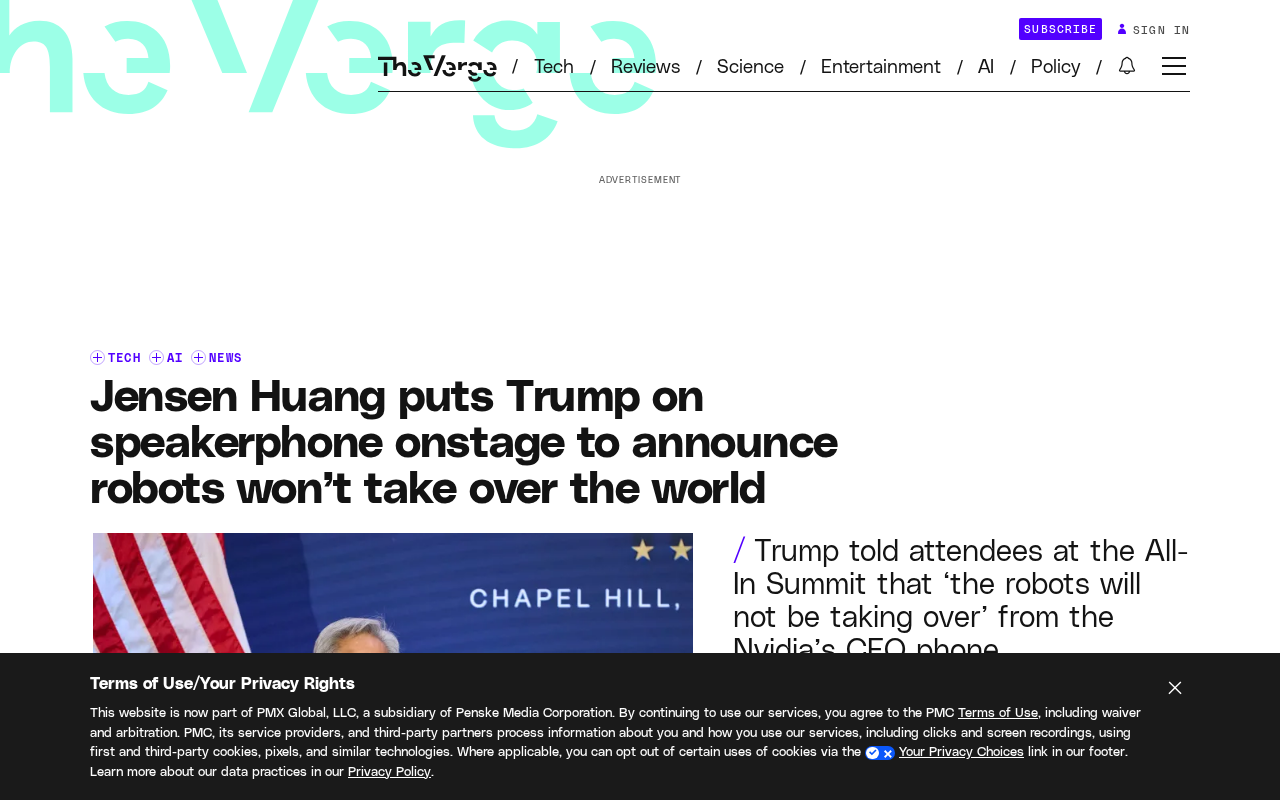
Jensen Huang broadcast Trump's live call at a tech summit, where Trump declared robots won't rule the world.
At the All-In Summit, NVIDIA CEO Jensen Huang answered a live call from President Trump and put it on speakerphone for the entire audience. Trump used the moment to publicly declare that "robots won't rule the world," directly addressing widespread public anxiety about AI going out of control. The significance runs deeper than the exchange itself: NVIDIA is the world's dominant AI compute supplier, Huang has long bet on robotics and Physical AI, and the company's chip exports and industrial positioning are tightly bound to government policy. A sitting president effectively endorsing the AI boom at a tech summit was both a signal to calm market nerves and a reflection of how AI has evolved from a technical topic into a core arena of national strategy and public politics.
An Unexpected Live Call on Stage
NVIDIA CEO Jensen Huang did something no one saw coming at Monday's All-In Summit — he took a call from President Donald Trump while on stage and immediately put it on speakerphone, letting the entire audience listen in on the impromptu conversation.
According to the original reports, this wasn't the first time Huang has received a presidential call during a work setting, but broadcasting it publicly in front of a live crowd was a first. The moment itself was inherently dramatic: one of the most powerful figures in global AI computing and the highest political official in the United States, interacting openly at a tech summit.
The Core Message: Robots Won't Spiral Out of Control
During the call, Trump addressed one of the most closely watched questions of our time — whether artificial intelligence and robots will "take over the world." The message was unambiguous: robots won't rule the world.
This statement carries real weight in the current context. As generative AI and embodied AI continue to advance rapidly, public anxiety about AI going rogue or robots displacing humanity has been steadily mounting. Having a political leader publicly signal "there's nothing to fear" at a tech summit serves, in some sense, as a form of reassurance — both for market sentiment and for the broader public psyche.
What makes this particularly noteworthy is that NVIDIA is the single most critical compute supplier powering this entire wave of AI and robotics. Huang has repeatedly emphasized in recent years that robotics and Physical AI represent the next trillion-dollar market, and the company has continued to double down on its robotics platform. Against that backdrop, this exchange carries both political undertones and clear significance as an industry bellwether.
The AI Narrative Behind the Political-Business Interaction
The reason this live call generated such attention isn't just its spontaneity and theatrics — it also reflects the increasingly tight relationship between the AI industry and political power.
As one of the highest-valued tech companies in the world, NVIDIA's chip supply chains, export controls, and industrial policy are deeply intertwined with government decisions. The existence of a direct communication channel between a CEO and the President speaks for itself: AI has become a core issue at the level of national strategy. When Huang chose to answer and broadcast that call in a public setting — whether by design or not — it reinforced NVIDIA's image as sitting at the very center of the AI narrative.
From a communications standpoint, the phrase "robots won't rule the world" simultaneously addresses public anxiety and provides a kind of quasi-official optimistic framing for the ongoing AI investment boom. For companies and investors operating in the AI space, signals like this tend to get parsed and re-parsed repeatedly.
A Symbolic Moment
Beyond the specific commercial and policy implications, this summit episode feels more like a snapshot of the AI era itself: tech leaders, political figures, and public opinion converging on the same stage.
It's a reminder that AI is no longer merely a technical question being debated in laboratories — it has become a public issue deeply embedded in politics, economics, and collective psychology. The reason a speakerphone call and a single statement about robots can become news is precisely because it touches the most sensitive nerves of this era.
It's worth noting that the original reporting on this event was fairly limited, and the specific details of the conversation and its downstream implications remain to be fleshed out. But as a window into the intersection of the AI industry and political power, this moment alone is more than enough to give one pause.
Related articles
RTX 5090 Stock Crisis: Why Third-Party Sellers Are Charging $9,500
NVIDIA's RTX 5090 has vanished from U.S. online retail, with third-party sellers asking up to $9,500. Here's how AI compute demand is driving GPU prices to extremes.
Apple Siri May Support Swapping in Claude and ChatGPT — Code Already Shows Signs
Leaked code shows Apple is developing third-party AI model integration for Siri, potentially allowing users to swap in Claude or ChatGPT under EU DMA pressure.
EPA Moves to Scrap Power Plant Greenhouse Gas Emission Standards Amid Surging AI Energy Demand
The EPA plans to eliminate all power plant greenhouse gas emission standards, just as AI, EVs, and manufacturing drive electricity demand higher — making U.S. power potentially far dirtier.