Jev Plays Pokémon Red: An Open-Source Experiment in AI Agents Tackling Complex Games

Developer open-sources AI agent Jev challenging Pokémon Red, live-streaming with real-time token and cost data.
Developer Christian Mat deployed AI agent Jev to tackle classic game Pokémon Red, open-sourcing all code and live-streaming the run — unusually including real-time token consumption and cost data. Pokémon was chosen as a test bed because its difficulty sits between Tetris and Doom: slow-paced but requiring long-term planning and state memory, which sits right at the edge of current AI agent capabilities. The transparent cost data lets observers grasp the economic reality of AI game-playing, while the open-source code lets the community reproduce, swap models, and optimize decision logic. The project earned 214 upvotes and 88 comments on Hacker News.
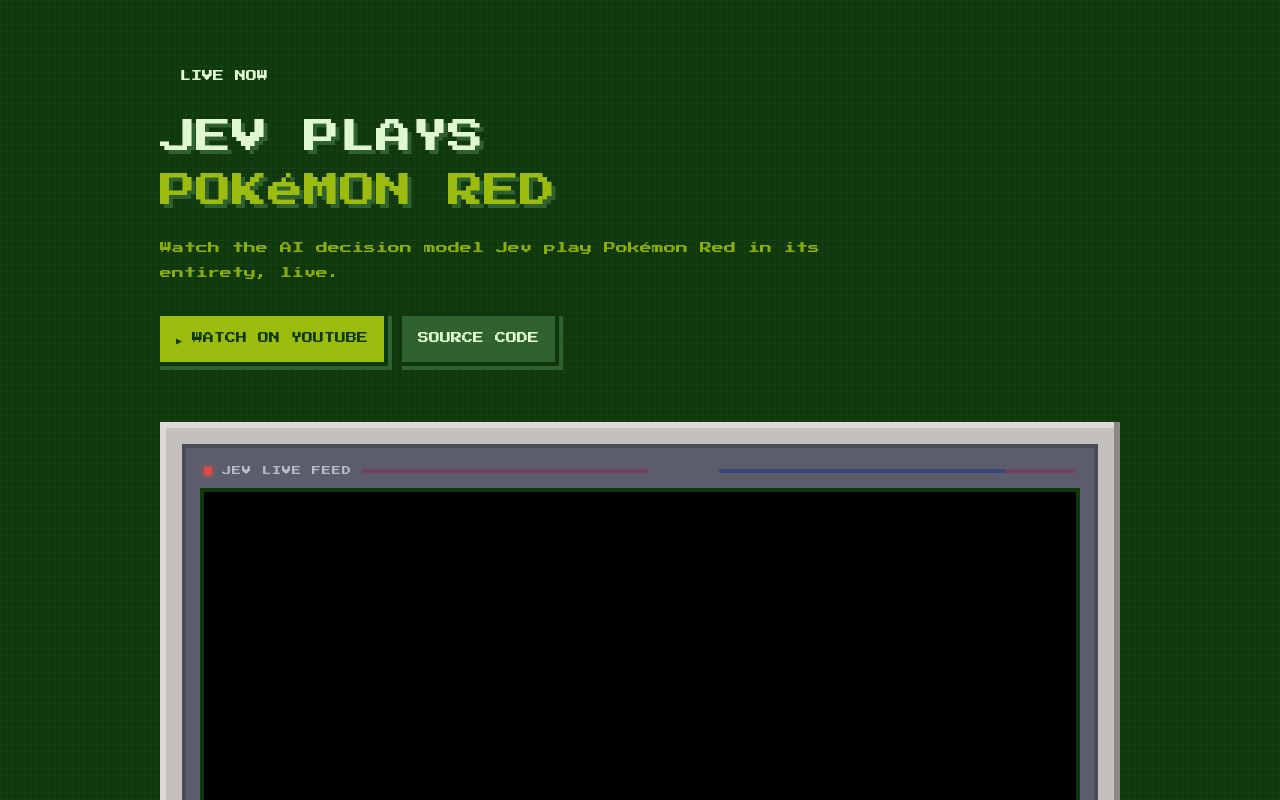
What happens when a fast-decision-making AI agent takes on Pokémon Red? Developer Christian Mat shared his side project on Hacker News — an AI system called Jev attempting to beat this classic handheld game — with all the code open-sourced and the entire playthrough live-streamed, including real-time token usage and cost data.
The project quickly gained 214 upvotes and 88 comments on HN, becoming a well-watched Show HN post. Its value isn't in showing off — it's a transparent window into the boundaries of AI decision-making.
From Tetris to Pokémon: A Leap in Difficulty
The developer noted that Jev makes decisions quickly — fast enough to play Tetris, but not quite fast enough for something like Doom, which demands near-instant real-time reactions. So he chose Pokémon Red as a challenge sitting somewhere between the two.
It's an interesting choice. Tetris has a relatively simple state space, clear rules, and immediate feedback. Doom is a first-person shooter requiring continuous millisecond-level inputs. Pokémon sits in the middle: it's slower-paced, but the game world is expansive, quest chains are complex, and it involves multiple decision types — exploring maps, managing your team, turn-based battles, item usage, and more.
For an AI agent, the difficulty in Pokémon isn't reaction speed — it's long-term planning and state memory. Players need to remember where they've been, what they need to do, and what their current goal is. This is precisely where today's AI agents tend to get stuck. The developer half-jokingly mentioned hoping not to get "stuck in a cave," which actually points to a classic challenge in this kind of project: agents in open environments tend to lose their way and fall into loops.
From an AI research perspective, the "long-term planning and state memory" problem has technical roots. Most mainstream LLM-driven agents maintain "memory" through a context window — during each inference pass, the model can only see a limited history of prior information. In a game like Pokémon, a player might need to remember decisions made dozens of steps ago (such as whether a key item has been picked up, or whether a path has already been explored). Once that information exceeds the context window, the agent effectively "forgets," leading to goal drift or repetitive looping behavior. Some projects address this using external memory modules (like vector databases storing summaries of historical states), but effectively compressing and retrieving game state remains an open challenge.
Transparent Experiment: Token Usage and Costs in Real Time
One of the project's standout features is the live stream that openly displays both token consumption and running costs alongside the gameplay. This kind of transparency is rare in AI application demos, yet it's enormously informative.
Having an AI play a game is essentially a process of continuously calling a model — each decision may correspond to an inference request. As gameplay accumulates, token consumption climbs steadily, and costs rise with it. Putting this data in plain sight lets viewers intuitively understand "how much does it actually cost for an AI to play a game?" — and indirectly surfaces the economic reality of agents running long-duration tasks.
For researchers and developers, this kind of transparent data is more meaningful than simply watching an AI complete a playthrough. It reveals a core tradeoff in real-world AI agent deployment: the balance between capability and cost.
Tokens are the basic unit of measurement for how large language models process text. Roughly speaking, about 4 characters of English correspond to 1 token, while Chinese characters are approximately 1–2 per token. Model API fees are typically charged separately for input and output tokens. In a game-playing agent scenario, each decision step often requires feeding the current game screen (or a structured description of game state), the history of past actions, and the current goal into the model — then receiving the next action as output. If inference is triggered every second or few seconds, the cumulative token count can be substantial. With a GPT-4-class model, several hours of continuous gameplay could generate API costs ranging from a few dollars to tens of dollars, making the "economic efficiency" of an agent a constraint that can't be ignored in real-world deployments.
Open Source: A Reproducible, Hackable Community Asset
The developer open-sourced all the code in a GitHub repository (christianmat/jev-pokemon), encouraging others to tinker with it. This move elevated the project from personal entertainment to a community-participable experimental platform.
In recent years, "having AI play games" has become a popular paradigm for testing agent capabilities. From early Atari reinforcement learning to recent attempts at large models playing Pokémon and Minecraft, games have always served as a natural testing ground for measuring AI planning, exploration, and decision-making. Pokémon is especially popular because it has clear completion goals (collecting badges, defeating gym leaders) while requiring coherent decision-making across a large open world.
Being open source means anyone can:
- Reproduce the entire experiment and verify the AI's performance
- Swap out the underlying model to compare different AI capabilities
- Optimize decision logic to tackle problems like getting "stuck in a cave"
- Extend the framework to other games
This openness is the essence of Show HN culture — share something that actually runs, and let the community improve it together.
The research trajectory of AI game-playing can be roughly divided into two generational paradigms. The first, exemplified by DeepMind's DQN (Deep Q-Network), used reinforcement learning to let models accumulate game experience from scratch through trial and error, with Atari games as the standard test bed. This approach required millions of self-play training steps, consumed enormous resources, and the trained results were difficult to transfer to new games. The second, more recent paradigm directly uses pre-trained large language models or multimodal models as the agent's "brain," relying on the model's existing common sense and reasoning abilities to understand game rules and develop strategies — no specialized training required. Jev playing Pokémon falls into the latter category: the advantages are a low development barrier and fast transferability; the disadvantages are high inference costs and the constraints of the model's context memory.
What This Kind of Project Signals
Beyond the entertainment value, the Jev-plays-Pokémon experiment touches on several real issues in AI agent research. Games provide a closed yet sufficiently complex environment for observing whether AI can complete tasks that require multi-step planning, long-term memory, and adaptive decision-making.
The developer candidly admitted he's not sure yet whether all the gym badges can be collected — and that honesty actually adds credibility to the experiment. The failure modes of AI agents in open-ended tasks — getting lost, repeating actions, drifting from goals — are themselves valuable research material. Transparently showing both successes and failures is worth far more than only showcasing highlight moments.
For casual viewers, this is an entertaining stream. For developers, it's a hands-on open-source project. For researchers, it's a low-cost sample for observing the decision-making limits of AI agents. These three layers of value stacked together are exactly why it captured high attention on HN.
Related articles

Should U.S. College Fraternities Be Banned? A Researcher's Incisive Observations
Why not just ban U.S. college fraternities? A researcher finds the key resistance comes from decision-makers' own fraternity identities and schools' "willful ignorance."

Microsoft Discovery: Accelerating Scientific Discovery with AI Agents
Microsoft's Discovery platform runs specialized AI agents to help researchers screen and prioritize the most promising compounds and experimental paths, reducing experiments and accelerating scientific discovery.

Cambridge Heavy Industries Secretly Develops Desktop-Scale Nuclear Fusion Device
Cambridge Heavy Industries is secretly developing a desktop-scale laser-driven nuclear fusion device, targeting the equipment supply market for fusion power plants. This article analyzes its miniaturization technology path, commercialization logic, and unique positioning in the fusion startup wave.