Jevtown: Test Your Content with 10,000 AI Readers Before You Publish

Jevtown uses 10,000 AI residents to simulate social content spread before you publish.
Jevtown is a pre-publication content testing tool that routes your posts, listings, or headlines through 10,000 AI-generated "virtual residents" using a tiered distribution model — content must satisfy an initial 600-reader cohort before reaching wider audiences, with weak content failing early. It delivers structured feedback including behavioral reactions, demographic breakdowns, buyer questions, and demand curves, all without requiring a login. The concept directly addresses the core challenge of not knowing how content will perform before publishing, though the accuracy of its synthetic audience predictions depends heavily on underlying model quality.
A Counterintuitive Idea: Let AI Readers Vote Before You Hit Publish
In content creation and marketing, the biggest pain point is rarely the writing itself — it's the uncertainty that follows. Will this post, this product copy, this headline actually resonate with your target audience? Most people just go with their gut and let the market deliver its verdict in real time.
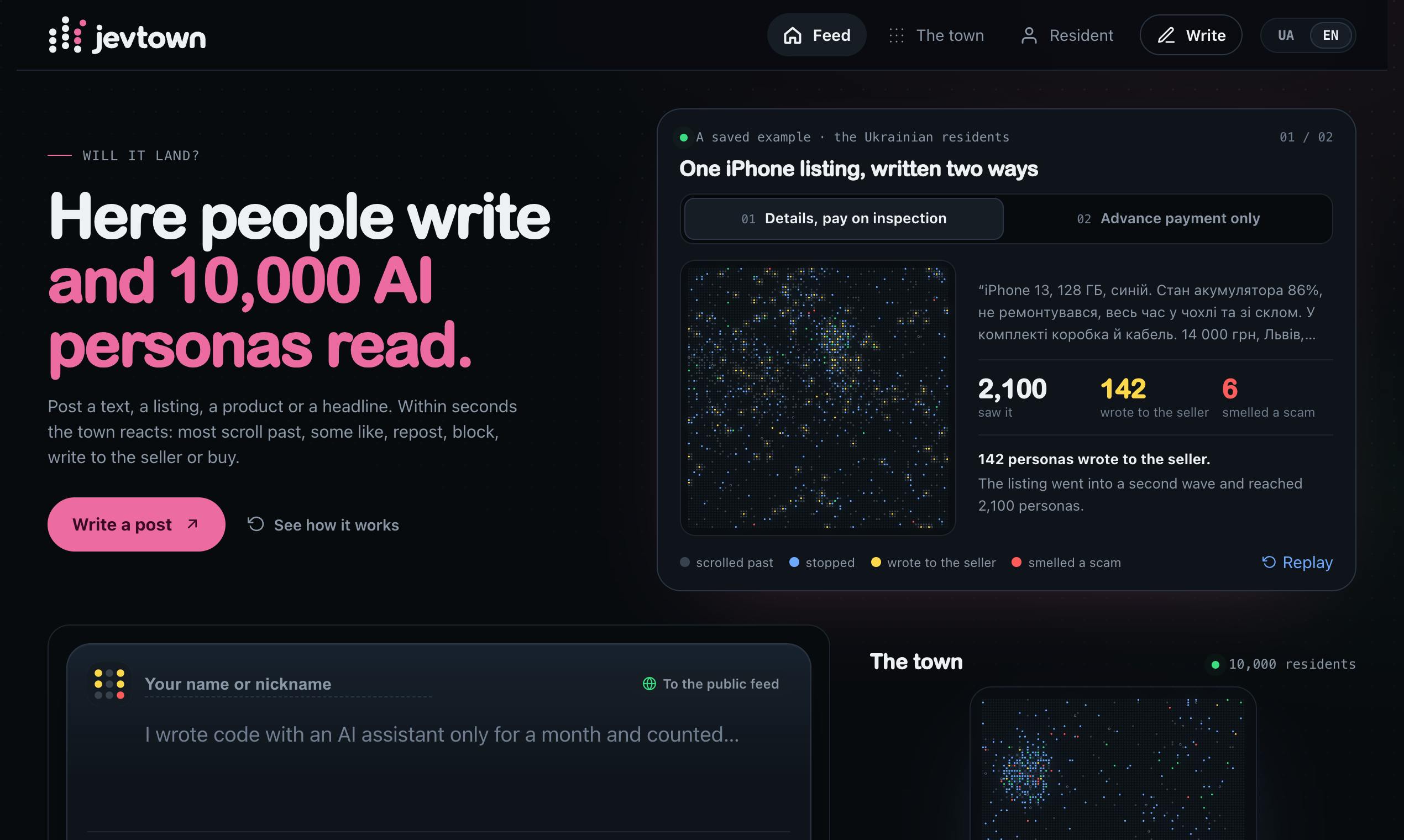
Jevtown, a new entry on Product Hunt, aims to move that reckoning earlier. Its core pitch is straightforward: before you publish anything, let 10,000 AI-generated "virtual residents" read your content and react to it. The product currently sits at #17 with 73 upvotes and 11 comments, built by Ivan Gabor.
A Tiered Distribution Model: Simulating How Content Actually Spreads
The most interesting design decision in Jevtown isn't the AI readers themselves — it's the propagation model.
According to the product description, when you submit a post, product listing, product description, or headline, the system first routes it to the 600 most relevant AI residents — the audience most likely to care about it. Only when satisfied readers outnumber turned-off ones does the content advance to the next wave of 1,500 readers.
This mirrors the algorithmic logic of real social platforms: weak content dies early, while strong content amplifies layer by layer until it reaches everyone. The numbers the team puts forward are striking — a weak piece of text fails after costing just half a cent, while a strong one reaches everyone in 14 seconds. That cost-and-speed contrast is the core value proposition versus real-world A/B testing.
The tiered distribution logic Jevtown simulates closely mirrors how real social platforms actually distribute content. Systems like TikTok and Instagram Reels typically push new content to a small "seed pool" first, then use early signals — completion rate, likes, shares — to decide whether to open the content up to larger audiences. This process is sometimes called "traffic racing" or "small pool testing." Twitter/X uses similar logic to weight content for further distribution based on early engagement quality. Jevtown transplants this logic into a simulated AI environment. The underlying premise: if AI residents can accurately predict real users' early reactions, you can forecast how a platform's algorithm would treat your content before you ever post it. Whether that premise holds depends entirely on how accurately the synthetic audience models real human behavior.
What Data You Actually Get
Jevtown doesn't just hand you a thumbs up or thumbs down. It surfaces a structured set of audience and behavioral signals:
- Behavioral reactions: Who paused to read, liked, reshared — or blocked outright
- Demographic breakdowns: Reactions segmented by interests, profession, age, city, and budget
- Buyer questions: The first things a potential buyer would ask when they see a product listing
- Demand curve: A price-sensitivity curve showing how demand shifts across different price points
For marketers and e-commerce sellers, the last two are especially useful. Knowing what questions buyers will have — and how demand responds to pricing — before a listing goes live is the kind of insight that traditionally requires real ad spend to uncover. The product also advertises no sign-in required, lowering the barrier to try it.
A Few Reasons to Stay Grounded
Conceptually, Jevtown takes the idea of a "synthetic audience" — a direction that's been widely discussed in AI circles recently — and turns it into a concrete, focused product. The logic is clean and the pain point is real. Low-cost, high-speed simulated feedback as a substitute for expensive real-world testing has obvious appeal for early-stage creators and small sellers.
That said, a few questions are worth holding onto. First, the AI residents' reactions are fundamentally a predictive model of real human behavior — their accuracy depends entirely on the quality of the underlying model, and systematic gaps with actual market behavior are possible. Second, figures like "10,000 AI readers" and "14 seconds to reach everyone" read more as marketing narrative than validated performance benchmarks; real predictive validity still needs to be verified against actual post-publication results. Third, the specific thresholds in the propagation model (600 → 1,500) and how those cutoffs are calculated remain opaque based on current information.
For content creators, treating Jevtown as a pre-publication reference rather than a final verdict is probably the right posture. Its real value lies in surfacing obvious problems early — like a headline almost nobody would stop for — rather than replacing real-world feedback.
Synthetic audiences have emerged as a research and commercial direction propelled by advances in large language models. The core idea is using AI to simulate the attitudes, preferences, and behaviors of specific groups — as a substitute for traditional focus groups or surveys. Academic research on using models like GPT to simulate survey respondents has produced mixed results: some studies find strong alignment with real samples on political attitudes and consumer preferences, while others identify significant "WEIRD bias" (over-representing Western, educated, affluent, English-speaking perspectives), with notable prediction failures for cross-cultural contexts, niche groups, or highly situational scenarios. This means synthetic audience tools are only as reliable as the overlap between your target audience and the model's training data — content testing aimed at North American tech workers is likely far more reliable than testing aimed at non-English-speaking or lower-tier market audiences.
Bottom Line
Jevtown represents a category of AI applications gaining traction: using simulated audiences to rehearse content and product launches before they go live. It packages tiered social propagation logic, multi-dimensional audience profiling, and demand curves into a no-login tool with a clear, practical focus. Whether it becomes a genuine daily tool for creators and marketers will depend on how closely its predictions track real market outcomes — the central test that every synthetic audience product ultimately has to pass.
Related articles

Gemini 4 Argon Hands-On: AI Builds Board Games, Constructs Temples, and Trains Robots Autonomously
Gemini 4 Argon hands-on roundup: AI autonomously builds a desk racetrack and temple in Blender, writes a ray tracing engine, trains a humanoid robot to sink 7 shots, plus API pricing and developer access.

The Magic Octagonal Coin: Why Only 9% of People Can Predict Its Flip?
Only 9% of people can correctly predict the Magic Octagon coin flip. This article explains its spatial rotation mechanism, common cognitive pitfalls, and a new hypothesis based on Relevance Theory, exploring the limits of human spatial reasoning.

Sam Altman: AI Is Entering the Era of Scientific Discovery — Math Breakthroughs Will Replicate in Biology and Energy
Sam Altman says AI is entering the era of scientific discovery — math breakthroughs will replicate in biology, materials science, and energy to help develop new drugs and energy sources.