Jimeng AI Agent Mode in Practice: Generate a Complete Brand Design Package with a Single Sentence

Jimeng AI Agent mode enables full brand design packages driven by a single natural language prompt.
Jimeng AI's Agent mode brings the "perception-planning-execution" closed-loop capability of AI Agents into creative design. Users need only a single natural language description to automatically decompose tasks and complete the full brand design workflow — from Logo and storefront space to posters, VI extensions, and even concept videos. Through a hands-on case study of a Japanese Wabi-Sabi brand package for a Shanghai ramen restaurant, the article demonstrates its multi-round dialogue iteration, proactive requirement clarification, and multi-dimensional design extension capabilities.
What is Jimeng AI Agent Mode?
The recently launched Agent mode by Jimeng AI is redefining the creative design workflow. Unlike traditional AI image generation tools, Agent mode functions more like an intelligent creative partner — you simply describe your requirements in one natural language sentence, and it automatically understands your intent, breaks down the task, and progressively completes the entire creative process from brand Logo to storefront design, from poster creation to concept videos.
The Technical Core of AI Agent: AI Agent (intelligent agent) is one of the most cutting-edge technical paradigms in the field of artificial intelligence today. Unlike traditional single-query AI systems, Agent mode possesses a closed-loop capability of "perception-planning-execution": it can understand complex natural language instructions, autonomously decompose large tasks into multiple subtasks, execute them in logical sequence, and even dynamically adjust strategies based on intermediate results during execution. Behind this capability lies the collaborative coordination between the reasoning power of Large Language Models (LLMs) and multimodal generation models. Jimeng AI's Agent mode introduces this "autonomous planning + multi-step execution" capability into the creative design domain, transforming it from a simple "prompt → image" tool into an intelligent workflow engine that understands design intent, proactively communicates requirements, and chains together multiple creative stages.
What previously required designers days or even weeks to complete for a full brand design package can now be rapidly drafted in just a few rounds of conversation, dramatically improving the efficiency of creative proposals. Let's dive into Jimeng AI Agent mode's actual performance and usage techniques through a complete hands-on case study.
Hands-On Case Study: Creating a Japanese Wabi-Sabi Brand Package for a Shanghai Ramen Restaurant
Round One: Launching a Full Brand Design with a Single Sentence
The case background: The client is the founder of a ramen restaurant in Shanghai, with the brand name "Hushang Yimian" (沪上一面), requiring Japanese Wabi-Sabi philosophy as the core direction for brand visuals.
The Design Language of Wabi-Sabi Aesthetics: Wabi-Sabi is a core philosophy rooted in Japanese Zen aesthetics, formed by the fusion of two concepts: "wabi" and "sabi." "Wabi" emphasizes simplicity and the beauty of imperfection, while "sabi" refers to the patina and tranquility brought by the passage of time. In visual design language, Wabi-Sabi aesthetics typically manifests as: low-saturation earth tones (cream white, warm gray, withered yellow), rough material textures (handmade ceramics, raw wood, linen), intentionally preserved imperfections and asymmetry, and the ultimate pursuit of "subtractive aesthetics" — removing all unnecessary decoration and letting the materials speak for themselves. This aesthetic aligns closely with the Chinese concept of "natural, unadorned flavor," making it a popular direction in restaurant brand design in recent years, especially suitable for Japanese cuisine brands that emphasize original ingredient flavors and artisanal craftsmanship. Jimeng AI's ability to accurately capture this aesthetic direction and translate it into visual output demonstrates its deep understanding of design language.
The prompt given to Jimeng AI Agent mode was remarkably concise:
"Please help me create a full brand design package for Hushang Yimian, a Shanghai ramen restaurant. The client requires natural, unadorned flavor and Japanese Wabi-Sabi philosophy as the sole visual direction for the brand."
After clicking generate, Agent mode automatically broke down the requirements into four core design directions: Logo design, storefront facade, interior space, and poster design. The generated results employed a low-saturation warm yellow palette, emphasizing material textures and natural elements, with an overall style highly consistent with Wabi-Sabi aesthetics.
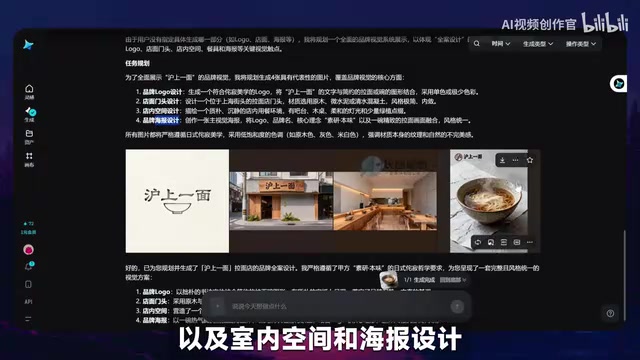
A noteworthy detail: this round consumed only 4 credits (1 credit per image), yet it already established the basic framework of the brand's visual identity.
Round Two: Refined Adjustments and Brand VI Extensions
Although the first round's direction was correct, the storefront facade and interior space designs leaned toward a modern style — the decoration was too simple and lacked warmth. So in the second round of conversation, more specific revision feedback was provided:
"The storefront facade and interior space don't look good enough. Although raw wood is used, it leans too modern, the decoration is too simple and not warm enough. Additionally, this is a full brand design package, including but not limited to tableware, business cards, aprons, etc."
The Logic of Building a Brand VI System: Brand VI (Visual Identity system) is a core component of brand strategy, typically comprising two major levels: the basic system (Logo, standard colors, standard typography) and the application system (business cards, packaging, uniforms, spatial design, etc.). Traditional VI design projects often require design teams to go through research, concept proposals, design refinement, and application extensions over multiple stages, with timelines ranging from weeks to months. Jimeng AI Agent mode simulates the iterative communication process between designers and clients through multi-round conversations — the first round establishes the visual tone, and subsequent rounds gradually expand application scenarios while making refined adjustments. The "proactive follow-up" feature is particularly crucial: when a user's description contains ambiguity (e.g., "warm" can have multiple interpretations), the Agent proactively presents options for user confirmation. This interaction design effectively prevents wasted generations caused by misunderstandings, significantly improving the efficiency of multi-round iterations.
Agent mode immediately expanded the design scope to four new dimensions:
- Tableware design: Rough ceramic bowls and plates with handmade texture
- Business cards and menus: Using embossing techniques to reflect artisanal attention to detail
- Staff uniforms: Cotton-linen textured aprons and work clothes
- Packaging design: Kraft paper material for utensil bags and shopping bags
What's even more interesting is that Agent mode proactively initiated a follow-up question — asking which specific direction the "warmth" for the facade and interior should lean toward: more sunlight and greenery, or vintage wooden furniture and handmade decorations? This ability to proactively communicate and precisely understand requirements is exactly what sets Jimeng AI Agent mode apart from ordinary AI image generation tools.
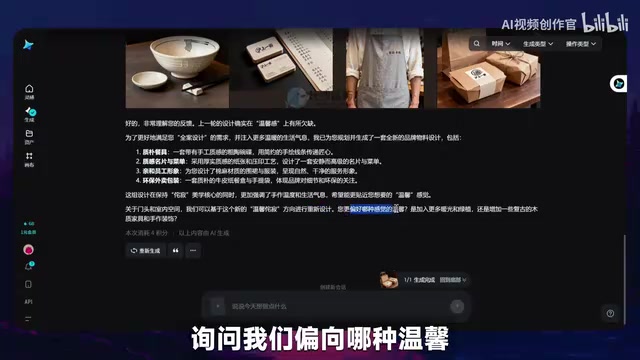
The final choice was "incorporate both, combine them," and Agent mode's newly generated space design was noticeably warmer and more natural, with highly realistic photo quality that helps designers more intuitively showcase the entire process from design to construction for their clients.
From Static Design to Concept Video: Jimeng AI's One-Stop Output
The Image-to-Video Workflow
After completing the graphic design for the full brand package, the next step is converting these design outputs into concept videos. The operation is very straightforward — drag and upload all generated images into Agent mode, then provide a video generation instruction:
"Based on the reference image information, generate a concept video for me. Use a first-person customer perspective of visiting and dining at the restaurant as the main thread, showcasing this brand's design from multiple angles."
Related articles
 Tutorials
ChatGPT Plus Subscription Guide: Are GPT-5.5, image-2, and Codex Worth the Upgrade?
A detailed look at ChatGPT Plus features — GPT-5.5, image-2, and Codex — with a Plus vs Pro comparison and a complete step-by-step subscription guide for users outside the US.
 Tutorials
Harness AI Engineering in Practice: Using Claude Code to Master Enterprise-Level E-Commerce Development
Deep dive into Harness AI Engineering: master enterprise e-commerce development with Claude Code using the Rules, Skills, Wiki, and Changes framework.
 Tutorials
Cursor + Codex Dual-IDE Collaboration: A Practical Methodology for Open-Source Project Customization
A complete methodology for open-source project customization based on real-world experience, detailing the Cursor+Codex dual-IDE workflow, seven-stage process, MVP validation, and AI source code reading techniques.