Jonathan Haidt Warns: AI Is Education's "Neutron Bomb"

Haidt warns AI may keep education's structure intact while silently hollowing out genuine learning.
Social psychologist Jonathan Haidt compares AI to a "neutron bomb" for education — a weapon that preserves physical structures while killing what's inside. Just as schools, assignments, and grades may continue to look normal, AI could quietly eliminate the cognitive friction that drives real learning. The hidden danger: traditional metrics stay impressive, masking the problem until independent thinking deficits surface in the real world. Optimists counter with the calculator analogy; Haidt's camp argues the parallel is asymmetric, since AI replaces the very processes education aims to develop. Implications for educators include process-based assessment, deliberate cognitive struggle, and building students' metacognitive awareness.
A Striking Metaphor
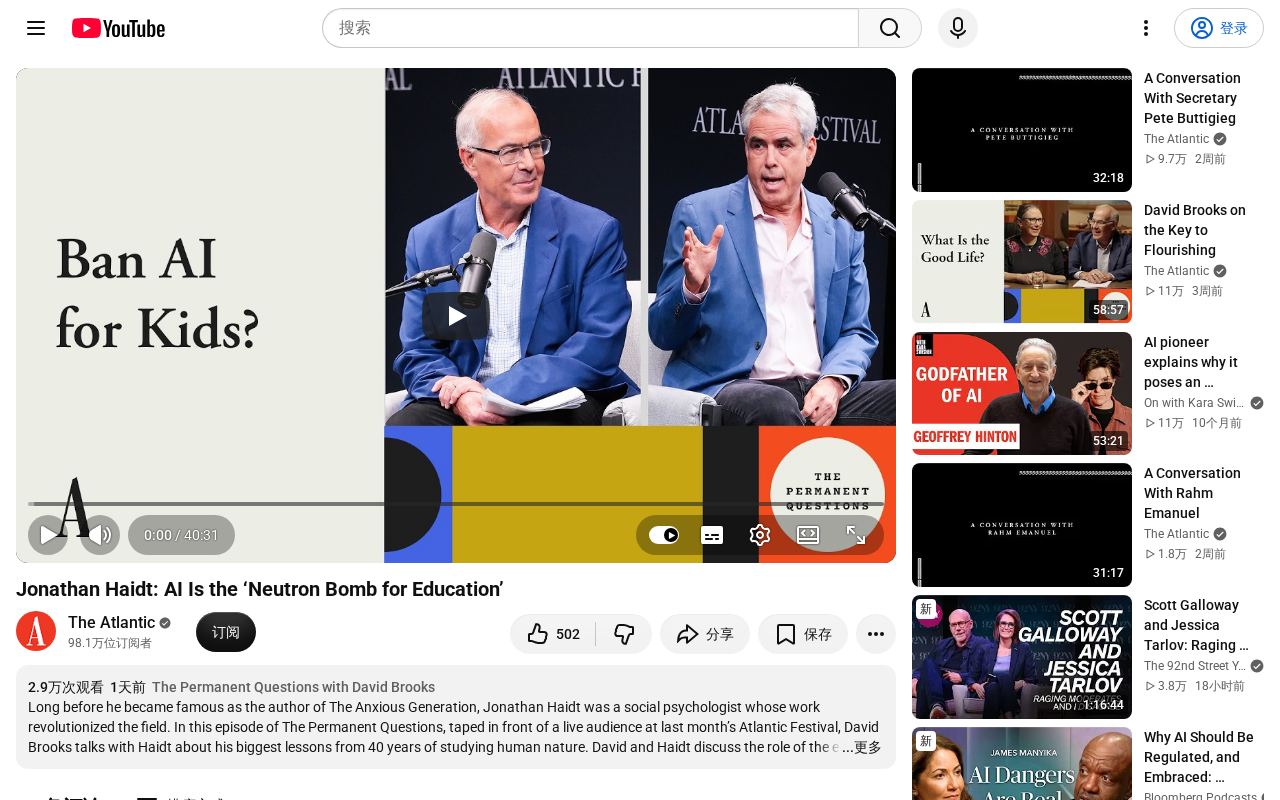
Social psychologist Jonathan Haidt — author of The Coddling of the American Mind and The Anxious Generation — used a powerful metaphor in a video interview to describe AI's potential impact on education: AI is a "neutron bomb" for learning.
The metaphor itself is worth unpacking. A neutron bomb is designed to preserve physical structures — buildings, infrastructure — while delivering lethal damage to the people inside. Haidt borrows this image to express a core concern: AI may allow the shell of education (schools, classrooms, assignments, exams, diplomas) to remain fully intact, while quietly hollowing out its substance — genuine learning and the development of critical thinking.
A quick note: this article is based on a low-engagement video post on Hacker News (7 upvotes, 7 comments), so original source material is quite limited. What follows is an extended interpretation built around Haidt's consistent views and this particular metaphor.
Why a "Neutron Bomb" Rather Than an Ordinary Bomb
Haidt has long focused on the relationship between adolescent mental health and technology. In The Anxious Generation, he argued in detail how smartphones and social media have reshaped the environment in which young people grow up. Calling AI a "neutron bomb" for education is a natural extension of his ongoing concern about technology eroding core human capacities.
The Structure Survives, but the Soul Is Gone
A conventional bomb destroys everything, making the problem immediately obvious — if schools shut down and classrooms disappear, society notices the crisis and responds. But "neutron bomb"-style damage is far more insidious: students still sit in classrooms, still turn in assignments on time, still earn impressive grades and degrees. On the surface, the education system appears to be functioning normally.
The real danger is that when students use AI to write their essays, solve their problems, and do their thinking for them, they obtain the output while skipping the process. Yet the value of education lies precisely in the process — the confusion that comes with reading, the struggle of writing, the back-and-forth of reasoning. These moments of "cognitive friction" are where the mind is actually trained. AI smooths that friction away, and with it, the growth.
Cognitive science research on "cognitive friction" supports Haidt's intuition. Psychologists call this phenomenon "desirable difficulties" — researchers like Robert Bjork have found that obstacles, spacing, and retrieval practice during learning, though seemingly inefficient, are precisely what promote long-term memory consolidation and the development of transferable skills. When AI eliminates the struggle of drafting an argument or working through a problem by trial and error, students gain a sense of fluency — but fluency is often an inverse indicator of learning depth. Neuroscience points to the same issue: the prefrontal cortex, responsible for planning, reasoning, and delayed gratification, requires repeated practice to develop. If external tools consistently take over these functions, the relevant neural circuits may weaken from lack of activation. This is not alarmism; it's the well-documented "use it or lose it" principle from learning science, now arriving in an AI-shaped form.
The Distortion of Measurable Metrics
This metaphor also highlights an assessment problem: if traditional metrics like grades and completion rates continue to look impressive, educators and parents may be slow to notice anything is wrong. By the time the next generation enters the workforce and reveals deficits in independent thinking, deep reading, and sustained focus, the damage may already be very difficult to reverse.
The Debate This View Has Sparked
Haidt's argument is not without its critics. From the perspective of technological optimists, AI looks more like the printing press or the calculator — every major tool revolution has triggered fears that it would "ruin learning," yet humans have always managed to redefine the boundaries of learning and redirect freed-up cognitive resources toward higher-order creativity.
Those who push back against the "neutron bomb" framing argue that the tool itself isn't the issue — what matters is how it's used. If education systems can adapt in time — by redesigning assessments, treating AI as a collaborator rather than a replacement, and emphasizing the judgment and creativity that can't be outsourced to machines — then AI could easily become a force that enhances learning rather than destroys it.
Supporters of Haidt's view counter that this kind of adaptation requires proactive, systemic change, and educational institutions are notoriously slow to respond. In the meantime, "cognitive outsourcing" is already quietly happening among hundreds of millions of students.
The calculator analogy is the most frequently cited historical case among technological optimists, but it has limits worth examining. Calculators replaced mechanical computation steps, whereas the core goals of mathematics education — number sense, logical reasoning, problem modeling — don't actually reside in those steps. By contrast, the writing, argumentation, and analysis that AI replaces overlap heavily with education's core objectives: critical thinking, language organization, and constructing arguments are not merely instrumental obstacles on the way to some higher goal — they are the abilities education aims to develop. This asymmetry means the "AI equals a new calculator" analogy doesn't hold up symmetrically in logic. That doesn't necessarily mean the optimists are wrong, but it does suggest that historical examples of technological change cannot be applied uncritically to judgments about AI's impact on education.
Implications for Educators and Parents
Stripping away the rhetorical flair of the metaphor, what Haidt is really pointing to is a question that deserves serious attention: when completing a task becomes effortless, how do we protect the value of the learning process itself?
Some possible directions include:
- Redefine assignments and assessments: Shift the focus from evaluating outcomes to evaluating process — oral defenses, in-class writing, think-alouds, and process portfolios.
- Build metacognitive awareness: Help students understand when to use AI and when they need to think things through on their own.
- Preserve "cognitive friction": In specific training contexts, deliberately avoid AI so the brain undergoes necessary struggle.
- Treat AI as a tool, not a crutch: Guide students to use AI to expand their thinking, not to replace it.
Haidt's "neutron bomb" metaphor may skew pessimistic, but its value lies in sounding an alarm: technology's impact on education can be silent and delayed — and precisely because of that, it demands early vigilance and proactive response.
Conclusion
The debate over AI and education is far from settled. Whether Haidt's metaphor holds depends largely on whether educational systems can reinvent themselves before their structure is hollowed out. Whether you agree with him or not, the question deserves serious thought from every educator, parent, and learner — because what's at stake is the next generation's capacity to think for themselves.
Related articles

Trump's Request to Rename the Atlantic Rejected by Google; 1Password Lets AI Agents Log In Securely
The Vergecast roundup: Trump's request to rename the Atlantic the 'Trump Ocean' was politely declined by Google's CEO; 1Password's new feature lets AI agents log into accounts without touching passwords; OPPO launches the world's first 200-megapixel phone, the Find X10 Pro Max. All three point to the boundaries of tech authorization and trust.

The Truth About American College Party Culture: The Risks Schools Won't Admit
Behind American college party culture, the administration's "don't ask, don't tell" attitude is amplifying freshman risks. This article analyzes how the pandemic strengthened Greek dominance, freshmen's difficulty accessing safety information, and the chain reactions caused by a culture of denial.

OpenAI Reportedly Raising $30B at $1.25T Valuation Ahead of IPO
OpenAI is planning a $30B funding round at a possible $1.25T valuation, paving the way for an IPO. If completed, it would set a private company valuation record. This article analyzes the funding size, pre-IPO logic, and industry signals.