Jules MCP Server: Using the MCP Protocol to Let Claude Orchestrate Google Jules for Autonomous Coding

Open-source jules-mcp-server lets Claude orchestrate Google Jules for autonomous coding via MCP protocol.
jules-mcp-server is a community open-source project that provides a production-grade MCP server for the Google Jules API, enabling AI assistants like Claude and Cursor to directly dispatch Jules for autonomous coding tasks through the standardized MCP protocol, achieving an "AI directing AI" collaboration model. The project reflects the trend toward specialization in AI coding tools and signals that multi-Agent collaborative programming will become the norm in the future.
Project Overview
As AI programming tools rapidly evolve, enabling different AI assistants to collaborate has become a focal point for the developer community. Recently, an open-source project called jules-mcp-server appeared on GitHub, providing a production-grade Model Context Protocol (MCP) server for the Google Jules API. This allows AI assistants like Claude and Cursor to directly dispatch Jules to perform autonomous coding tasks.
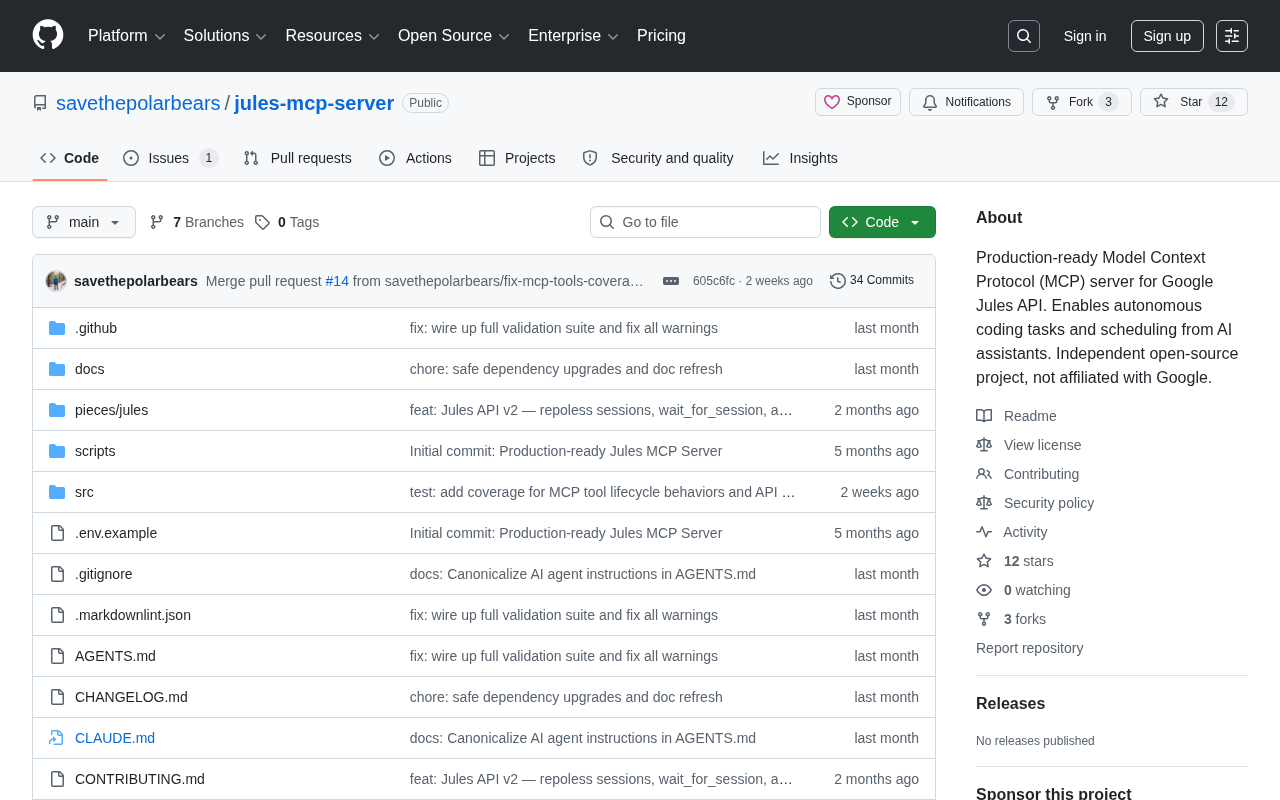
The project is maintained by developer savethepolarbears, written in TypeScript, and has garnered 12 Stars so far. While the project is still small in scale, the technical direction it represents — breaking down barriers between different AI coding tools through the MCP protocol — carries significant forward-looking implications. It's important to note that this is an independent community open-source project with no affiliation to Google.
What Is the MCP Protocol?
The Origins of Model Context Protocol
Model Context Protocol (MCP) is an open protocol officially open-sourced by Anthropic in November 2024, aimed at standardizing how AI models interact with external tools and data sources. You can think of MCP as the "USB port" of the AI world — it defines a unified communication specification that allows different AI assistants to invoke external services in a standardized way.
From a technical architecture perspective, MCP adopts the classic client-server model: AI assistants (like Claude) act as MCP clients, while external tools and services expose their capabilities through MCP servers. Communication between them is based on the JSON-RPC 2.0 protocol, supporting two transport methods: stdio (standard input/output) and SSE (Server-Sent Events). The MCP protocol defines three core primitives — Tools, Resources, and Prompts — corresponding to executable operations, readable data, and reusable interaction templates, respectively. This design enables AI models to not only call external functions but also dynamically discover and understand the available toolset, achieving true "plug-and-play" capability.
Before MCP emerged, integrating AI tools with external services primarily relied on custom plugin systems (like ChatGPT Plugins) or direct REST API calls. The problem with these approaches was the lack of a unified standard — each AI platform had its own plugin specification, forcing developers to repeatedly build adaptation layers for different platforms. MCP's emergence is similar to how the USB standard once unified peripheral interfaces, fundamentally solving the fragmentation problem in the AI tool ecosystem.
Why the MCP Protocol Matters
Before MCP, every AI tool needed to write dedicated integration code for every external service, leading to massive duplication of effort and compatibility issues. With M AI clients and N external services, the traditional approach required M×N integration adapters, while MCP reduces this complexity to M+N — each client only needs to implement the MCP client protocol once, and each service only needs to implement the MCP server protocol once. The emergence of the MCP protocol fundamentally changes this landscape:
- Standardized interfaces: Any MCP-compatible AI client can invoke tools provided by any MCP server
- Plug-and-play: Developers only need to configure the MCP server address without writing additional integration code
- Extensible ecosystem: A single MCP server can simultaneously serve multiple AI clients including Claude, Cursor, Windsurf, and others
As of mid-2025, the MCP ecosystem has shown explosive growth. On the client side, beyond Anthropic's own Claude Desktop, mainstream AI programming tools including Cursor, Windsurf, Cline, Continue, and Zed all support the MCP protocol. On the server side, the community has produced hundreds of MCP servers covering a wide range of domains from database operations (PostgreSQL, MongoDB), cloud service management (AWS, GCP), development tools (GitHub, GitLab, Jira) to search engines (Brave Search) and file systems. Anthropic also maintains an official MCP server directory to help developers discover and use existing MCP services.
Core Features of Jules MCP Server
Autonomous Coding Task Scheduling
The core value of jules-mcp-server lies in exposing Google Jules's autonomous coding capabilities as standard MCP tools. Google Jules is an AI Coding Agent built by Google based on its Gemini series of large language models. It first debuted in late 2024 and was officially opened to a broader developer audience at the 2025 Google I/O conference. Unlike traditional code completion tools, Jules is positioned as an asynchronous autonomous coding agent — it can run independently in the background, autonomously completing complex tasks such as code writing, bug fixing, code refactoring, and test writing without requiring real-time developer supervision.
Jules's workflow is deeply integrated with GitHub: users can assign a GitHub Issue or a task description to Jules, and it will automatically clone the repository, analyze the codebase, formulate a modification plan, write code, and ultimately submit results as a Pull Request for human review. This "deliver PRs rather than code snippets" model makes Jules more akin to a junior developer than a simple code generation tool.
Through jules-mcp-server, users can initiate Jules coding tasks directly from AI assistants like Claude or Cursor without switching to Jules's native interface. Here's a practical scenario: while conversing with Claude, you can say "Help me use Jules to fix this bug in this repository," and Claude can invoke the Jules API through the MCP protocol to execute the task — all without leaving your current working environment. This effectively enables an "AI directing AI" workflow — Claude, as the high-level reasoning and conversational AI, handles understanding user intent and decomposing tasks, while Jules, as the execution-layer AI, handles the actual code modifications.
Scheduled Tasks and Batch Management
The project description specifically mentions "scheduling" functionality, meaning this MCP server not only supports immediate task execution but may also support scheduled tasks and batch task management. For scenarios requiring code maintenance at specific times, automated testing, and similar use cases, this feature has practical engineering value. For example, teams could set up Jules to automatically scan the codebase for dependency updates every night, or automatically trigger Jules to diagnose and attempt to fix bugs after each CI/CD pipeline failure. This ability to incorporate AI coding agents into automated workflows is a key step in evolving from "manually triggering AI" to "systematic AI collaboration."
Production-Grade Engineering Quality
The project claims to be "Production-ready," meaning it has implemented production-level engineering practices for error handling, logging, connection management, and more — rather than being merely a proof-of-concept prototype. The project is written in TypeScript, a choice that is not accidental — Anthropic's official MCP TypeScript SDK (@modelcontextprotocol/sdk) is currently the most mature MCP development toolkit, providing a complete server and client implementation framework including request routing, protocol version negotiation, capability declaration, and other low-level details. TypeScript's static type system is particularly important for MCP server development because the MCP protocol involves extensive structured data exchange (tool parameter definitions, return value schemas, etc.), and type safety can catch protocol mismatch errors at compile time, significantly reducing the risk of runtime failures.
Technical Architecture and Ecosystem Positioning
Its Role in the AI Coding Toolchain
jules-mcp-server occupies a unique ecological niche: it serves as a bridge between different AI assistants. The current AI coding landscape features multiple strong players — Claude excels at conversation and reasoning, Jules focuses on autonomous coding, and Cursor is deeply integrated into IDE workflows. The emergence of Jules MCP Server means these tools are no longer information silos but can work together as an organic whole.
From a broader perspective, this project is actually a microcosm of the "specialization and division of labor" trend in AI toolchains. Just as microservices architecture in software engineering splits monolithic applications into purpose-specific services, the AI coding domain is also moving toward specialization: some AIs excel at understanding requirements and high-level planning (like Claude), some excel at autonomously executing coding tasks (like Jules), and some are deeply integrated in IDEs to provide real-time assistance (like AI features in Cursor). The role MCP plays in this division-of-labor system is analogous to API gateways and service discovery mechanisms in microservices architecture — it enables different "AI microservices" to be discovered, invoked, and composed.
Community-Driven Open Source Innovation
It's worth noting that this project doesn't come from Google officially but is the independent work of a community developer. This precisely demonstrates the irreplaceable role of the open-source community in building the AI tool ecosystem — even when official integration solutions haven't been provided, community developers have already forged ahead leveraging MCP's openness. This pattern recurs throughout technology history: the abundance of third-party images and tools in the Docker ecosystem, and the Operator pattern in the Kubernetes ecosystem, are all classic examples of community leading and officials following. MCP's open design is precisely intended to encourage this kind of community innovation — anyone can build an MCP server for any service without needing official authorization from the service provider.
Future Outlook for Multi-Agent Collaboration
The "multi-Agent collaboration" pattern embodied by jules-mcp-server actually touches on a deeper technical paradigm in AI — Multi-Agent Systems (MAS). This concept has decades of research history in academia, but it's only with the capability breakthroughs of large language models that it has become truly viable for engineering implementation. In multi-Agent systems, core challenges include task decomposition and allocation (how to break complex goals into subtasks and assign them to appropriate Agents), communication and coordination (how Agents exchange information and synchronize state), and conflict resolution (how to arbitrate when multiple Agents' actions contradict each other). MCP currently primarily addresses standardization at the communication layer, while higher-level challenges like task orchestration and conflict resolution still await more mature frameworks and protocols.
As the MCP protocol is adopted by more and more AI tools, "glue projects" like jules-mcp-server will become increasingly important. We can foresee the following trends:
- Multi-Agent collaboration becomes the norm: Different AI agents collaborate through the MCP protocol, each fulfilling their specialized role. Future development workflows might look like this: an "Architect Agent" handles system design, a "Coding Agent" (like Jules) handles implementation, a "Testing Agent" handles quality assurance, a "Security Agent" handles vulnerability scanning, all coordinating through MCP while human developers review and make decisions at key checkpoints.
- Deeper workflow automation: Users only need to define high-level goals, and multiple AI tools automatically coordinate to complete complex tasks.
- Accelerated MCP ecosystem growth: More third-party services will provide MCP interfaces, continuously expanding the capability boundaries of AI assistants. Notably, Google itself is also actively embracing Agent interoperability — Google DeepMind launched the Agent2Agent (A2A) protocol in 2025, aimed at solving direct communication between different AI agents. A2A and MCP are not competitors but complementary: MCP solves the problem of "how AI calls tools," while A2A solves the problem of "how AI talks to AI." Their co-evolution will provide more complete infrastructure for multi-Agent collaboration.
For developers following the evolution of AI programming tools, while jules-mcp-server is currently small in scale, the direction it represents — "AI tool interconnectivity" — is worth ongoing attention. If you're already using Google Jules and an MCP-compatible AI client, consider trying this project to experience the multi-Agent collaborative programming workflow.
Related articles
 Tutorials
ChatGPT Plus Subscription Guide: Are GPT-5.5, image-2, and Codex Worth the Upgrade?
A detailed look at ChatGPT Plus features — GPT-5.5, image-2, and Codex — with a Plus vs Pro comparison and a complete step-by-step subscription guide for users outside the US.
 Tutorials
Harness AI Engineering in Practice: Using Claude Code to Master Enterprise-Level E-Commerce Development
Deep dive into Harness AI Engineering: master enterprise e-commerce development with Claude Code using the Rules, Skills, Wiki, and Changes framework.
 Tutorials
Cursor + Codex Dual-IDE Collaboration: A Practical Methodology for Open-Source Project Customization
A complete methodology for open-source project customization based on real-world experience, detailing the Cursor+Codex dual-IDE workflow, seven-stage process, MVP validation, and AI source code reading techniques.