Kaiku: A Task Tracker Built for AI Agents

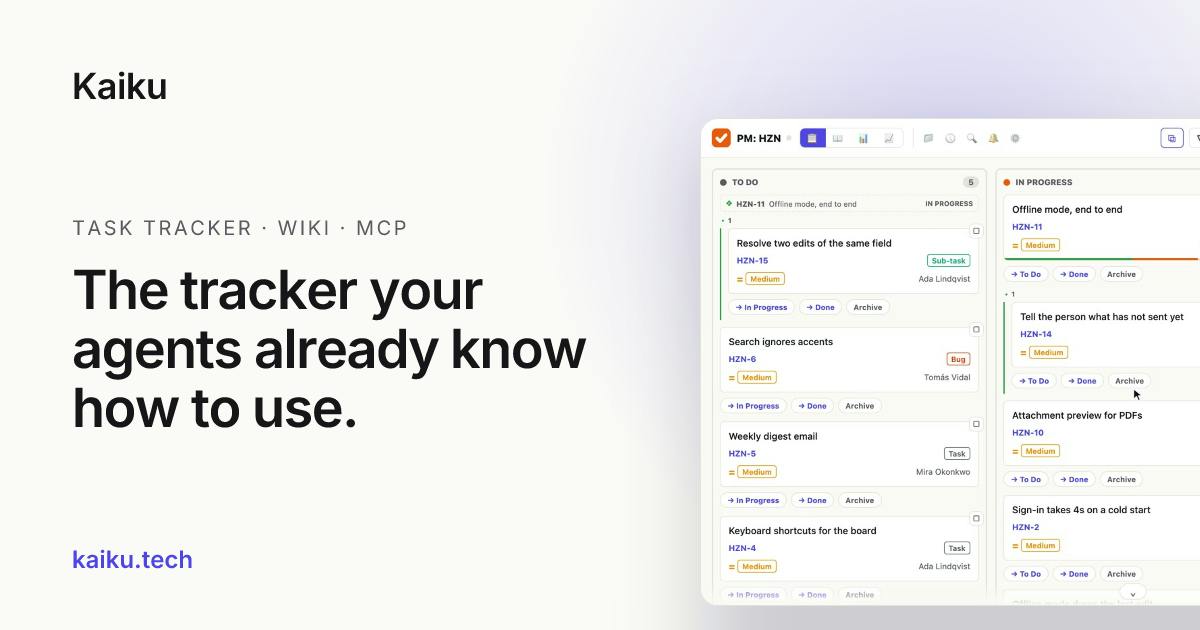
Kaiku is a task tracker and Wiki built for AI Agent collaboration, with native MCP support and zero-migration API compatibility.
Kaiku is a task tracker and Wiki tool designed for the AI Agent collaboration era, with engineering choices that prioritize machine-friendliness. It maintains compatibility with mainstream tracker APIs so existing MCP servers need no changes, ships with a built-in MCP server for Claude Code and Cursor, enforces a "propose but never decide" human-in-the-loop model, and logs every Agent run's cost to its specific issue for granular AI spend transparency.
When Task Management Meets the AI Agent Era
As more and more teams hand off everyday development work to AI Agents, traditional task tracking tools are showing their limitations — they were designed for humans, not machine collaboration. Kaiku, a newcomer on Product Hunt, targets exactly this gap: a task tracker and Wiki tool built specifically for teams "whose work is increasingly done by AI Agents."
Its positioning is refreshingly direct: "The task tracker your AI Agent already knows how to use." Behind that tagline lies a clever product strategy — not reinventing the wheel, but letting machines seamlessly plug into existing workflows.
Compatible with Existing APIs, MCP Server Ready Out of the Box
Kaiku's core design philosophy is to reuse the tracker APIs that most companies are already running. In other words, it "speaks the language" of the APIs used by mainstream trackers on the market. This means teams' existing MCP (Model Context Protocol) servers can keep working without any modifications.
This is a significant value proposition for development teams. Switching tools has traditionally meant extensive integration rework and adaptation costs. By maintaining compatibility at the protocol level, Kaiku minimizes the migration barrier. You don't need to retrain your Agents or rewrite integration scripts — your existing automation pipelines can be carried over directly.
For teams that have already deployed AI Agents in production, the promise of "zero-modification onboarding" is often more appealing than any flashy new feature.
What is MCP? MCP (Model Context Protocol) is an open standard released by Anthropic in late 2024, designed to establish a unified communication spec between AI models and external tools and data sources. Before MCP, every AI tool required individually developed integration interfaces for each external service, leading to an "M×N" integration explosion. MCP simplifies this to "M+N" — as long as a tool implements an MCP server, any MCP-compatible AI client can call it directly. Kaiku's claim of compatibility with mainstream tracker APIs is essentially an adaptation layer at the protocol level, allowing MCP server scripts originally written for tools like Jira or Linear to point to Kaiku without modification — the most direct and effective engineering strategy for reducing migration costs.
Built-in MCP Server with Native Support for Claude Code and Cursor
Kaiku ships with a built-in MCP server that natively supports Claude Code and Cursor, two of today's most popular AI coding tools. This means developers can let Agents read and operate on tasks and documents in Kaiku directly from their familiar coding environment, without constantly switching between tools.
As MCP rapidly becomes a standardized protocol and the connective tissue of the AI tools ecosystem, Kaiku's decision to natively support MCP — rather than building a closed proprietary interface — reflects a bet on the open ecosystem. Enabling Agents to access task data in a unified way is a key step toward building scalable AI collaboration workflows.
Agents "Propose" — They Never Decide
Kaiku features a thoughtfully restrained design choice: you can "@mention" Agents in comments, but those Agents only make suggestions and never make final decisions.
This "propose but never decide" mechanism is a pragmatic response to the current state of AI collaboration. Fully autonomous Agent decision-making carries too much risk and unpredictability; treating Agents as purely read-only tools wastes their capabilities. Kaiku's middle path lets Agents handle the heavy lifting of analysis and drafting, while keeping final judgment firmly in human hands.
This "human-in-the-loop" design philosophy is precisely the safety boundary that most enterprise AI deployments prioritize. It unlocks Agent productivity while preserving the necessary layer of human review.
What is Human-in-the-Loop? Human-in-the-Loop (HITL) is a core concept in AI system safety, referring to the mandatory introduction of human review and confirmation steps at critical nodes in an automated process. Its theoretical foundation comes from cybernetics and risk management: when the cost of system errors is high, or model confidence isn't sufficient to support fully autonomous decision-making, human intervention serves as an error-correction buffer. In enterprise software, HITL takes many forms — approval flows, two-step "suggest + confirm" operations, or manual review of operation logs. Kaiku's approach of having Agents post suggestions only in comments is a lightweight HITL implementation: it preserves the Agent's full analytical and drafting capabilities, while naturally restricting "execution" authority to the human side through interface design (comments rather than direct operations) — achieving a safety boundary without complex permission controls.
Every Agent Run's Cost Is on the Record
Kaiku also includes a notably practical feature: the cost incurred by each Agent run is logged directly on the issue it worked on.
As teams grow more dependent on AI Agents, cost transparency is becoming a real pain point. Calling large language models costs money, and those expenses tend to be scattered and hard to track. By binding costs directly to specific task items, Kaiku gives teams clear visibility into "how much AI budget each task consumed" — providing quantifiable data for cost accounting and resource allocation.
For teams that need to demonstrate AI ROI to management, this level of granular cost tracking is essentially a must-have.
Takeaway: A Tool Built for the Future of Work
Kaiku currently has 63 upvotes and ranks 19th on Product Hunt, appearing in categories related to Vercel Day, and was built by Stanislav. While still a relatively early-stage product, the direction it targets — providing native support for teams where AI Agents are deeply involved in collaboration — is clearly aligned with where the industry is heading.
Its product logic is coherent: API compatibility reduces migration costs, built-in MCP connects to mainstream tools, the "propose but never decide" model holds the safety boundary, and cost logging provides transparency. None of these features are complicated on their own, but together they paint a concrete picture of "humans and Agents collaborating effectively."
As AI Agents gradually evolve from assistive tools into full team members, products like Kaiku that build infrastructure specifically tailored for them are well worth keeping an eye on.
Related articles

Benny Blanco on Failure: 95% of His Work Goes in the Trash
Hitmaker Benny Blanco breaks down fear of failure at Google: 95% of his work goes in the trash, a No. 1 single was rejected by every artist, and he fell apart at 20 from overwork. He offers a practical framework for escaping shame.

DeepSeek V4.1 Pro Enters Testing, Gemini 4 Pro Benchmark Leaked
DeepSeek V4.1 Pro enters early per-account testing and is hidden from the public selector; MiniMax M3.1 Flash preview hits TokenPlan; Gemini 4 Pro benchmarks leak with 2M token context and pricing.

Qwen 4 First Test Leaks: Performance Rivals Opus 5.5, DeepSeek V4 Series Surfaces
Early Qwen 4 test outputs leak, with front-end generation said to rival Opus 5.5; DeepSeek V4 Mini, Flash, and Pro names appear in a code repo; Ant Group's Ling-3.1-flash surfaces too. Here's the latest on model tiering and on-device lightweight models.