KawaiiGPT: An Open-Source LLM Gateway for Key-Free Access to DeepSeek/Gemini/Kimi-K2

KawaiiGPT enables key-free access to major LLMs via reverse engineering, but carries compliance and stability risks.
KawaiiGPT is an open-source LLM gateway that reverse engineers the Pollinations API to provide API-key-free access to DeepSeek, Gemini, Kimi-K2, and other mainstream large models. Supporting Termux and Linux with built-in prompt injection security research features, it offers lightweight deployment. However, its reverse engineering approach poses compliance, stability, and ethical risks, making it unsuitable for production use. Its unusually high Fork/Star ratio also raises questions about its true community impact.
Project Overview
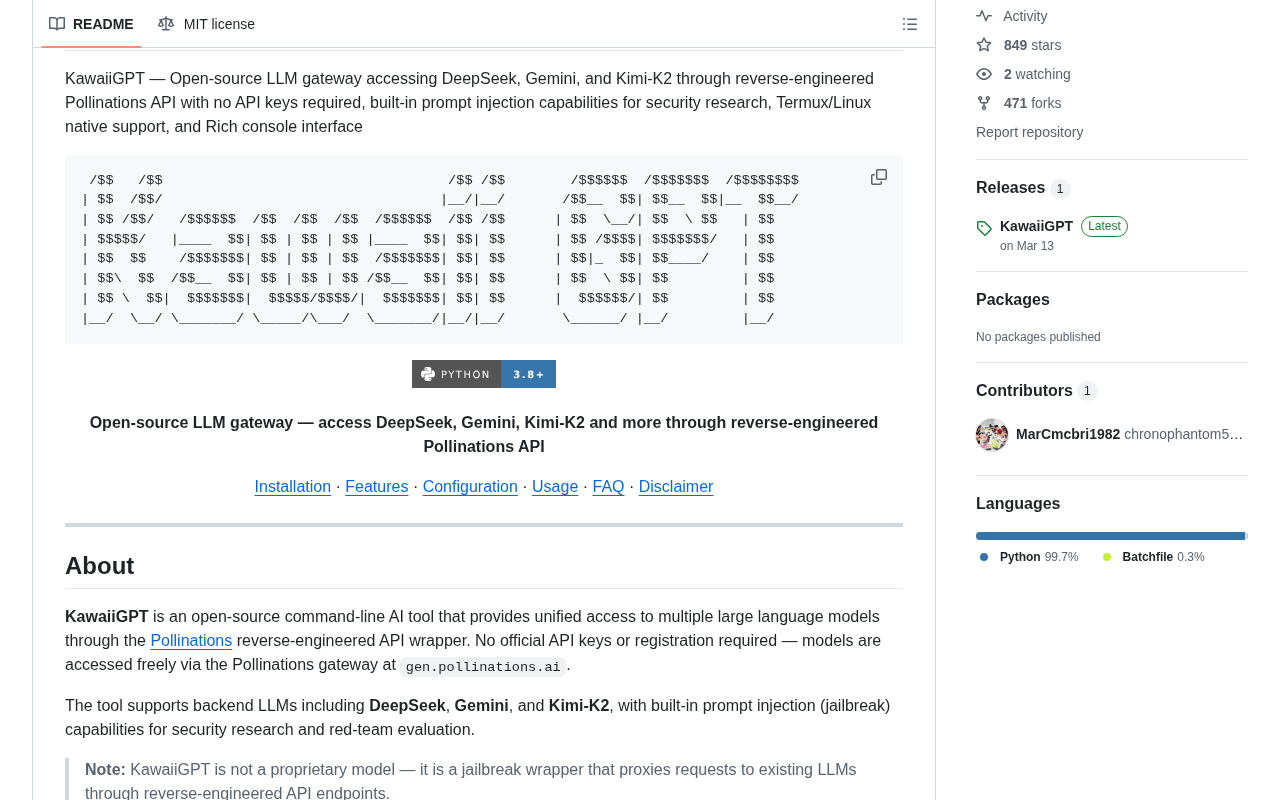
Recently, an open-source project called KawaiiGPT has been gaining attention on GitHub, quickly accumulating 844 Stars and 471 Forks. The project positions itself as an open-source LLM (Large Language Model) gateway that enables API-key-free access to mainstream large models including DeepSeekAd, Gemini, and Kimi-K2 through reverse engineering the Pollinations API.
LLM Gateways are a class of middleware architecture that has emerged in recent years alongside the fragmentation of the large model ecosystem. With numerous LLM providers on the market—OpenAI, Google, Anthropic, DeepSeek, Moonshot, and others—each with different API formats, authentication methods, and billing models, developers face enormous integration costs in multi-model scenarios. The core value of an LLM gateway lies in providing a unified API interface layer that encapsulates the differences across multiple downstream models, allowing upstream applications to switch between models through a single entry point. Well-known compliant LLM gateway solutions in the industry include LiteLLM, OneAPI, and enterprise-grade Portkey, which typically achieve legitimate multi-model routing by having users configure their own API keys for each platform. KawaiiGPT differs in that it bypasses key authentication through reverse engineering a third-party platform—technically an unauthorized access path.
The project is written in Python, supports both Termux and native Linux runtime environments, and features a Rich console interface, providing users with a lightweight yet fully-featured multi-model access solution.
Core Features Analysis
Key-Free Multi-Model Access
KawaiiGPT's most compelling selling point is zero API keys needed to call multiple mainstream large models. Normally, using models like DeepSeek, Google Gemini, or Kimi-K2 requires account registration, API key application, and in some cases payment. KawaiiGPT bypasses these restrictions through reverse engineering the Pollinations API, unifying access to multiple models through a single gateway entry point.
This key-free access approach offers clear convenience for rapid prototyping, model comparison testing, and similar scenarios—developers can switch between different large models within the same interface without registering accounts on each platform individually.
The Technical Approach: Reverse Engineering Pollinations API
Pollinations is an open platform providing AI model access, and KawaiiGPT builds a proxy gateway layer by reverse engineering its API. This technical approach is not uncommon in the open-source community—similar projects have previously achieved free access to ChatGPT, Claude, and other models through reverse engineering.
Specifically, Pollinations is an open AI platform headquartered in Europe whose core philosophy is lowering the barrier to AI model access, providing creators and developers with free or low-cost AI capabilities. The platform aggregates multiple open-source and commercial large models, offering text generation, image generation, and other API services—some interfaces don't even require API keys to call. It's precisely this relatively open design that makes it a common target for reverse engineering projects. Pollinations' business model relies primarily on sponsorship and enterprise partnerships rather than strict pay-per-use billing, which explains why its API protection mechanisms are relatively lenient. However, open doesn't mean unlimited—Pollinations' terms of service typically include rate limits and prohibitions on automated large-scale calls, and reverse engineering its interfaces to build proxy gateways likely violates these restrictions.
That said, this approach carries stability and compliance risks. Once the upstream API changes or strengthens its protective measures, the project could become non-functional at any time. Additionally, reverse engineering third-party APIs may violate relevant terms of service, and users need to assess legal risks on their own.
Built-in Prompt Injection Security Research Functionality
The project explicitly labels its built-in Prompt Injection capability and positions it for security research purposes. Prompt injection is one of the core topics in LLM security today, where attackers use carefully crafted prompts to bypass a model's safety restrictions and obtain improper outputs.
From a technical principle standpoint, the root cause of prompt injection is that LLMs fundamentally cannot distinguish between "system instructions" and "user input"—both appear to the model as parts of a text sequence. This security threat category was first systematically articulated by security researcher Simon Willison in 2022. Prompt injection is primarily divided into two types: Direct Injection, where users directly input malicious instructions in conversation; and Indirect Injection, where malicious instructions are planted through external data sources (such as web pages or documents) that the model might read. OWASP has listed prompt injection as the number one security risk for LLM applications. Current industry defenses include input filtering, output detection, instruction hierarchy isolation (such as Anthropic's system prompt hardening), and safety alignment through fine-tuning, but no solution can completely eliminate such attacks—which is why security research tools continue to be needed.
KawaiiGPT integrates this capability into the tool, providing security researchers with a convenient testing platform. Researchers can use the tool to comparatively test the security defense mechanisms of different models, evaluating each model's robustness against prompt injection attacks.
However, this is a double-edged sword—the same capability, if misused, could become a tool for bypassing model safety restrictions. This feature of the project deserves careful ethical consideration.
Terminal-Friendly Lightweight Runtime Environment
The project natively supports Termux (Android terminal emulator) and Linux systems, and uses the Python Rich library to build an attractive console interface. This means users can even run the tool on their phones via Termux, interacting with multiple large models anytime, anywhere.
Termux is a powerful terminal emulator and Linux environment application on Android that can run a complete Linux command-line toolchain on phones without root access, including Python, Node.js, Git, and other development tools. Termux has a broad user base in the security research community, and many penetration testing tools (such as Nmap, partial components of Metasploit) can run in Termux. Python's Rich library is a modern terminal formatting output library supporting tables, Markdown rendering, syntax highlighting, progress bars, and other rich terminal UI elements, dramatically improving the user experience of command-line tools to near-GUI readability.
For developers and security researchers accustomed to command-line operations, this lightweight deployment approach is far more efficient than setting up a full web service.
Technical Architecture Analysis
Based on the project description, KawaiiGPT's overall architecture is relatively straightforward:
- Frontend Layer: Terminal UI based on the Rich library, providing formatted output and interactive experience
- Gateway Layer: Core proxy logic that forwards user requests to the Pollinations API
- Model Layer: Indirect access to DeepSeek, Gemini, Kimi-K2, and other large models through Pollinations
- Security Research Module: Built-in prompt injection testing toolkit
The advantage of this architecture is simple deployment with minimal dependencies, but the disadvantage is equally obvious—it's entirely dependent on the availability of a third-party API, lacks local inference capability, and if Pollinations service is interrupted or adjusts its policies, the entire gateway will cease to function.
Risks and Controversies: What You Must Know Before Using
Despite the project's considerable popularity, the following aspects deserve close attention:
- Compliance Risk: Reverse engineering a third-party API may violate Pollinations' terms of service, with potential for being banned
- Stability Issues: Upstream API changes could render the project unusable at any time, making it unsuitable for scenarios with strong dependency requirements
- Security Ethics: While the built-in prompt injection feature is labeled for security research, there's risk of misuse
- Data Privacy: User conversation data passes through third-party intermediaries, creating uncertainty around privacy protection
On the compliance front, the legal status of reverse engineering third-party APIs varies significantly worldwide. In the United States, the Computer Fraud and Abuse Act (CFAA) and the Digital Millennium Copyright Act (DMCA) place clear legal constraints on unauthorized access to computer systems and circumvention of technical protection measures. While the 2022 Van Buren v. United States Supreme Court decision narrowed the scope of CFAA, bypassing API authentication mechanisms through reverse engineering may still constitute a violation. In the EU, the Digital Services Act (DSA) and GDPR impose strict requirements on data relay and user privacy. Furthermore, virtually all mainstream AI platforms' Terms of Service (ToS) explicitly prohibit reverse engineering, automated scraping, and unauthorized API proxy behavior. While ToS violations are typically civil disputes rather than criminal offenses, platforms reserve the right to ban accounts, block IPs, and even pursue legal action. For open-source projects, even if the code itself is legally published, guiding users toward behavior that may violate third-party ToS carries potential liability risks.
Additionally, the project's Fork count (471) to Star count (844) ratio is unusually high (approximately 56%), which is uncommon for normal open-source projects and may suggest some degree of artificial inflation. The community should maintain rational judgment when assessing the project's true influence. In a healthy open-source ecosystem, GitHub projects typically have a Fork/Star ratio between 10%-30%. Stars represent user attention and recognition, while Forks usually indicate developers' intent to build upon the project or contribute code. When the Fork/Star ratio exceeds 50%, several possibilities exist: the project has extremely high secondary development value (such as framework projects), artificial inflation exists (through automated scripts mass-creating Stars and Forks), or the project is heavily used in educational or assignment contexts. Multiple tools in the open-source community (such as StarTrack, Astral, etc.) can analyze a project's Star growth curve—if a steep linear growth appears in a short time rather than natural stepped growth, artificial inflation is more likely. When evaluating an open-source project's true influence, beyond Star counts, one should also examine Issue activity, PR merge frequency, contributor diversity, and actual community discussion intensity.
Conclusion: The Tension Between Hacker Spirit and Compliance Boundaries
KawaiiGPT represents a typical "hacker spirit" project in the open-source community—breaking access barriers through reverse engineering to lower the threshold for using large models. It provides developers and security researchers with a convenient tool for rapid multi-model access, but carries non-negligible risks in terms of compliance, stability, and ethics.
For security researchers, KawaiiGPT is a prompt injection testing tool worth understanding; however, for production environments, it's strongly recommended to obtain API access through the official channels of DeepSeek, Google Gemini, Kimi-K2, and other platforms to ensure service stability and compliance.
Key Takeaways
- KawaiiGPT enables key-free access to mainstream large models including DeepSeek, Gemini, and Kimi-K2 through reverse engineering the Pollinations API
- Built-in prompt injection functionality positioned as an LLM security research tool, but carries ethical risks of misuse
- Supports Termux and native Linux, features a Rich console interface, with lightweight and convenient deployment
- Reverse engineering third-party APIs poses compliance and stability risks, making it unsuitable for production environments
- The project's unusually high Fork/Star ratio warrants rational judgment from the community when assessing its true impact
Related articles
 Tech Frontiers
A Rare Quiet Day in AI: Recursive Self-Improvement Stirs Beneath the Surface
A rare quiet day in AI sees multiple sources go silent simultaneously. Behind the calm, Recursive Self-Improvement (RSI) research continues. What this means for the industry.
 Tech Frontiers
Reve 2 vs. Ideogram 4: A Deep Dive into Layout Control in AI Image Generation
A deep comparison of Reve 2 and Ideogram 4's layout control capabilities, covering technical approaches, real-world use cases, and industry trends for designers and creators.
 Tech Frontiers
In the Weights: Check Your Influence Score in the AI World
In the Weights is an AI influence search engine that quantifies your presence in the AI world with a score. Explore how it evaluates practitioners and what it means for digital identity.