KiHub: Hardware Code Review and Collaboration Platform Built for KiCad

KiHub brings GitHub-style pull request reviews to KiCad hardware design with visual diffs and collaboration tools.
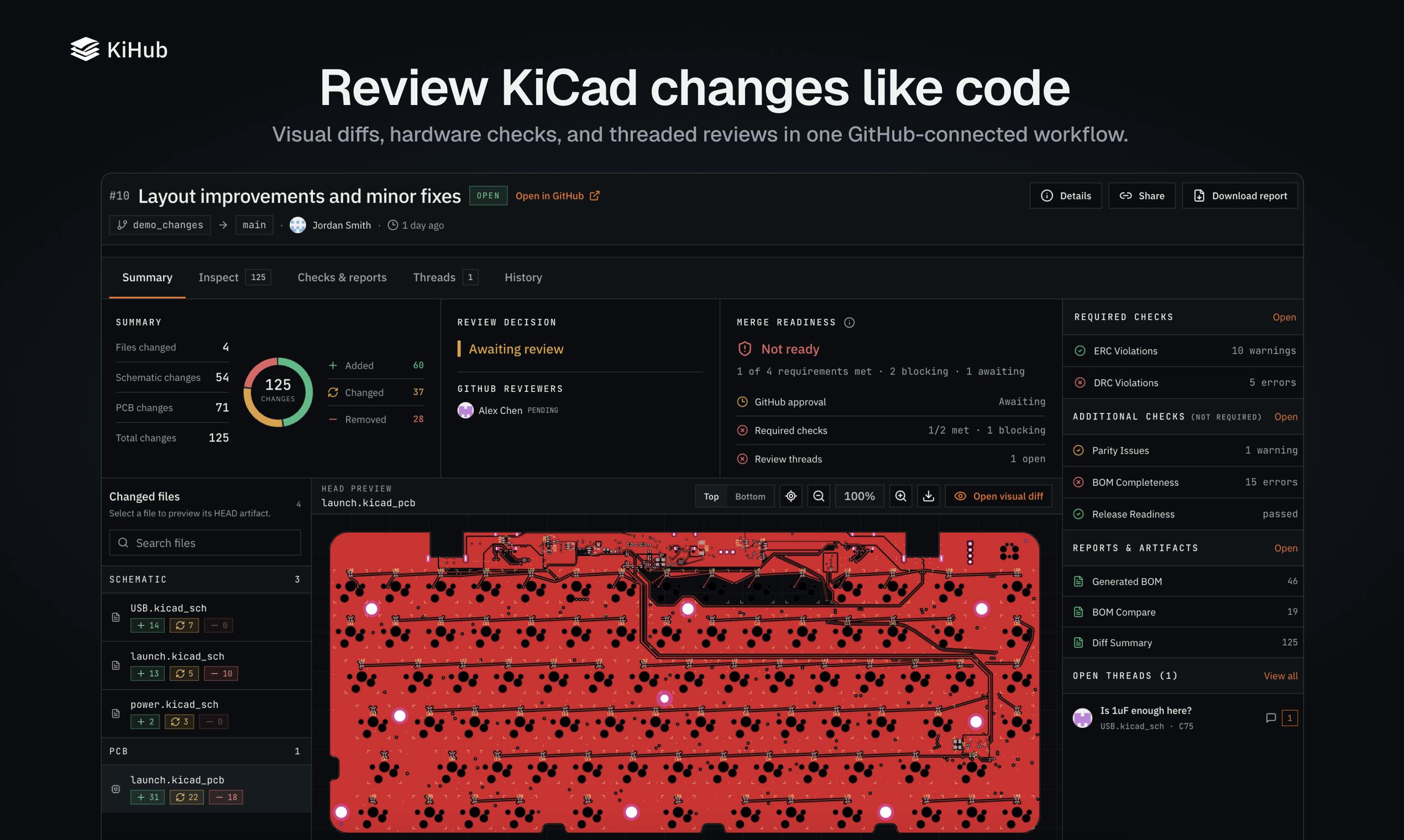
KiHub is a hardware review platform designed for KiCad projects, addressing the long-standing lack of standardized review tools in hardware design. It provides visual version comparison for schematics and PCBs, precise location-anchored comments, automated DRC/ERC checks, and approval workflows—all while seamlessly integrating with existing Git workflows.
In software development, GitHub's Pull Request review mechanism has long been the standard for team collaboration. Pull Requests (PRs), introduced by GitHub in 2008, embody a core principle: ensure change quality through structured review processes before merging code into the main branch. The value of PR reviews goes beyond catching defects—it enables knowledge sharing, design decision documentation, and collective team understanding of changes. However, in hardware design, especially for teams using open-source EDA tools like KiCad, there has been a persistent lack of standardized review tools. KiHub, recently launched on Product Hunt, aims to fill this gap—it's a hardware review platform designed specifically for KiCad projects.
KiCad is an open-source Electronic Design Automation (EDA) software suite dating back to 1992, initially developed by French engineer Jean-Pierre Charras and later significantly enhanced with funding from CERN (European Organization for Nuclear Research). It covers a complete circuit design toolchain including schematic editor, PCB layout editor, 3D viewer, and Gerber file generation. Unlike commercial EDA tools (such as Altium Designer, Cadence OrCAD) with licensing fees reaching tens of thousands of dollars, KiCad is completely free and open-source, giving it a massive user base in the open-source hardware community, educational institutions, and small-to-medium hardware teams.
Core Pain Points in Hardware Design Review
Software engineers can review code changes line-by-line on GitHub, leave comments, and approve merges—the entire process is clear and traceable. Research shows code review can reduce defect rates by 60-90%. But hardware engineers face schematics and PCB layout files stored in binary or complex text formats, making meaningful comparison difficult with traditional text diff methods.
Unlike plain-text software source code, hardware design files have traditionally been stored in binary formats (such as early KiCad versions and most commercial EDA tools' proprietary formats), making it difficult for text-based version control systems like Git to leverage their core strengths. Even though newer KiCad versions (like KiCad 8.0 released in 2023) have moved to S-expression-based text formats, the abundance of coordinate data, netlist references, and component attributes in schematics and PCB files still makes it hard for human engineers to quickly understand design intent from pure text diffs. A simple component move might generate hundreds of lines of text changes, while a critical electrical connection modification might manifest as just a few character changes—the two have completely imbalanced "visual weight" in text diffs.
When teams need to review circuit changes, they often resort to exporting PDFs, annotating screenshots, and discussing back-and-forth in email or chat tools. This approach is inefficient, lacks structured records, and makes it difficult to maintain traceable approval history. For hardware projects requiring strict quality control, this is an obvious weakness—a PCB design error that reaches manufacturing can cost tens or even hundreds of times more to fix than a software bug (board respins, material waste, project delays), making rigorous review of hardware designs before merging into the main version economically valuable and engineering-critical.
KiHub's Core Features and Capabilities
KiHub's positioning is crystal clear: bring software-grade review experience to KiCad projects. According to its Product Hunt listing, it offers several key features:
Visual Version Comparison for Schematics and PCBs
KiHub allows users to directly compare different revisions of schematics and PCBs. This means reviewers no longer need to manually export files for comparison, but can intuitively see differences between versions within the platform—which components were modified, which traces changed, all at a glance. This is the most critical capability in hardware review, translating text-level changes into visual graphical differences, solving the fundamental problem of traditional text diffs "failing" when facing hardware design files.
Precise Location-Anchored Comments and Discussion
The platform supports pinned comments, allowing reviewers to precisely associate discussions with specific locations in the design. This mirrors GitHub's line-specific code comments, making communication more focused and avoiding inefficient back-and-forth like "which resistor are you talking about?" In complex PCB designs where a board might contain thousands of components distributed across dozens of layers, precise location-anchored comments are critical for effective communication.
Automated Checks and Approval Workflow Management
KiHub includes automated checks capabilities that can run rule validation during the review process. In the hardware design context, such automated validation has rich implications: DRC (Design Rule Check) verifies trace spacing, via sizes, copper clearances meet manufacturing requirements; ERC (Electrical Rule Check) detects floating pins, power shorts, unconnected nets in schematics; BOM (Bill of Materials) consistency checks ensure components in schematics match actual procurement lists. Integrating these checks into the review workflow—similar to automated testing in software CI/CD—can execute automatically when design changes are submitted, catching obvious design defects before human review.
KiHub also provides approval management mechanisms, allowing teams to sign off on design changes according to established processes while maintaining complete, traceable review history. This is particularly important for hardware projects needing to meet compliance requirements (such as ISO 13485 medical device design controls, IEC 61508 functional safety standards).
Seamless Compatibility with Existing Git Workflows
A noteworthy design principle of KiHub: it doesn't require teams to change their existing Git workflows.
More and more hardware teams have started using Git to manage KiCad project files, bringing version control concepts into hardware design. KiHub chooses to build incrementally on this foundation rather than requiring users to migrate to an entirely new platform or process. This "non-invasive" integration approach significantly lowers the adoption barrier for teams—engineers continue committing as usual, while KiHub provides additional visualization and collaboration value at the review stage.
This is particularly important for the open-source hardware community. KiCad itself represents open-source EDA, and its user base has high expectations for tool openness and compatibility. The open-source hardware movement—including the RISC-V open instruction set architecture, certification systems promoted by the Open Source Hardware Association (OSHWA)—is spawning more and more distributed hardware collaboration projects that naturally rely on Git for version management and multi-person collaboration. KiHub's alignment with this Git-centric working style makes it more easily accepted by this community.
Market Significance in the Hardware DevOps Trend
From a broader perspective, KiHub reflects the ongoing evolution of Hardware DevOps. Hardware DevOps extends software DevOps principles (continuous integration, continuous delivery, automated testing, infrastructure as code) into hardware development. This trend is driven by multiple forces: hardware design complexity continues to climb, with modern PCBs potentially containing thousands of components and dozens of routing layers, making pure manual management unsustainable; hardware product iteration cycles are shortening, with IoT devices, consumer electronics demanding faster design-validation-production rhythms; simultaneously, the open-source hardware movement requires better collaboration tools to support globally distributed team development.
Over the past decade, software CI/CD, code review, and collaboration tools have matured highly, while hardware toolchains are rapidly catching up. In this trend, products like Flux (cloud-based PCB design collaboration platform), Allspice (Git hosting and review platform built for hardware design), and Horizon EDA (another open-source EDA tool) have emerged. KiHub chooses to focus on the review segment within the KiCad ecosystem, taking a vertical specialization approach. Migrating software engineering best practices to hardware design—version control, automated checks, structured review—is becoming a clear direction.
KiHub received 85 votes on Product Hunt, ranking 13th, with categories including Hardware, Developer Tools, and GitHub. While the data scale isn't blockbuster, for a tool vertical to the KiCad ecosystem, attracting attention itself demonstrates the real existence of this niche demand.
Of course, as a newly launched platform, KiHub still needs to validate several key questions in actual use: How accurate is the diff for complex PCB designs—especially involving multilayer boards, dense BGA fanouts, high-speed differential pairs and other advanced design scenarios? How broad is the automated check coverage, and can it extend beyond basic DRC/ERC to more advanced design rules? And can it seamlessly integrate with mainstream KiCad versions (KiCad 7.x and 8.x have file format differences) and Git hosting services (GitHub, GitLab, Gitea, etc.)? These will determine whether it can truly enter hardware teams' daily workflows.
Conclusion: A New Option for KiCad Ecosystem Collaboration Infrastructure
KiHub's emergence is a microcosm of hardware design collaboration tools maturing. For teams using KiCad—whether open-source hardware projects or enterprise R&D teams—a review platform that can visualize comparisons, structure discussions, and maintain complete approval records can undoubtedly significantly improve collaboration quality and design reliability. If it continues refining its core comparison and checking capabilities, KiHub has the potential to become important collaboration infrastructure in the KiCad ecosystem.
Related articles

Cross-App Access for AI Agents: Three Identity Vendors Converge on the Same Architecture Pattern in 8 Days
Okta, Auth0, and Descope all shipped Cross App Access within 8 days. This article breaks down the two-layer access pattern behind AI Agent identity management.

Dense Models Too Slow to Run Locally? How MoE Architecture Breaks Through the Performance Bottleneck
Dense models are slow on local hardware due to memory bandwidth limits. Learn how MoE sparse activation architecture dramatically boosts local inference speed and the future of local AI deployment.

Storm Summoner: A MIDI Controller Built Specifically for Guitar Effects Pedals
A deep dive into the Storm Summoner open-source MIDI controller for guitar effects pedals—covering design philosophy, technical architecture, and how it compares to commercial solutions.