Kimi-K2.5 Goes Open Source: Moonshot AI's Most Powerful Model Arrives, GitHub Stars Soaring

Moonshot AI open-sources its flagship Kimi-K2.5 model, joining China's competitive open-source LLM landscape.
Moonshot AI has open-sourced its most powerful model, Kimi-K2.5, on GitHub, quickly amassing nearly 2,000 Stars—signaling a strategic shift from closed API services to an open ecosystem. Built on MoE architecture that balances model capacity with inference efficiency, and leveraging its core strength in long-text processing, Kimi-K2.5 joins DeepSeek, Qwen, and GLM in a diverse competitive landscape, offering developers a compelling new foundation model option.
Overview
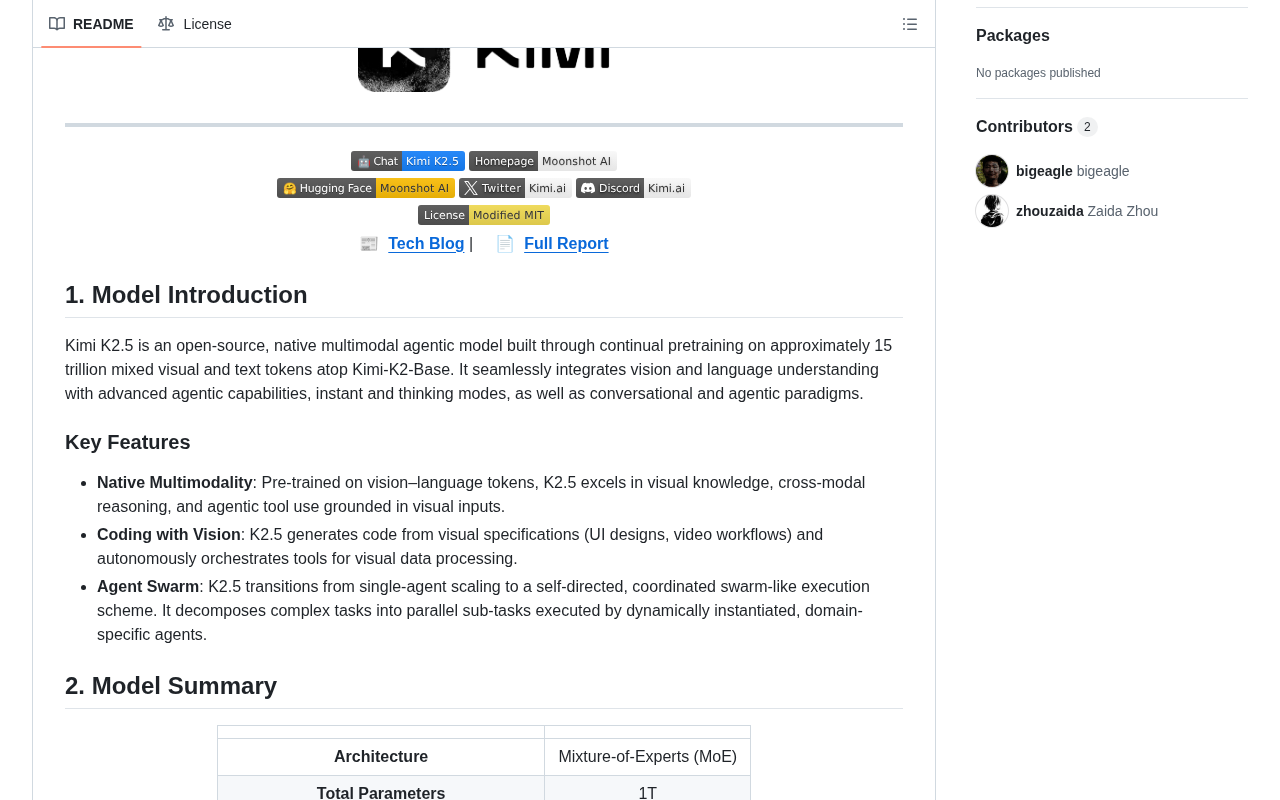
Moonshot AI recently open-sourced its flagship model Kimi-K2.5 on GitHub, officially positioning it as "Moonshot's most powerful model." The project's popularity surged rapidly after launch, accumulating over 1,900 Stars and 240 Forks in a short period—an impressive showing among Chinese open-source LLMs.
The Strategic Significance of Kimi-K2.5 Going Open Source
Why Moonshot AI Chose the Open-Source Route
Moonshot AI is one of the leading players in China's AI large model space. Previously, the company primarily served consumers through its Kimi intelligent assistant. Kimi built a large loyal user base in the Chinese market thanks to its outstanding long-text processing capabilities. Open-sourcing Kimi-K2.5 signals a significant strategic shift for Moonshot AI—moving from closed API services toward an open model ecosystem.
Moonshot AI was founded in 2023 by Yang Zhilin, a former Tsinghua University professor. The company name is inspired by Pink Floyd's iconic album The Dark Side of the Moon, symbolizing the exploration of the unknown. Yang has deep academic expertise in natural language processing and contributed to the development of important models like Transformer-XL and XLNet—models that made pioneering contributions to long-sequence text processing, laying the technical foundation for Kimi's later advantages in handling long texts. After its founding, the company quickly attracted capital market attention, with its valuation exceeding $3 billion at one point, making it a Chinese AI unicorn. Its core product, the Kimi intelligent assistant, initially entered the market with support for 200,000-character ultra-long text input—far exceeding the context window limitations of competitors like ChatGPT at the time—precisely addressing high-frequency user needs such as reading long documents and analyzing academic papers.
This move aligns closely with the global AI industry's open-source trend. The open-source movement for AI large models can be traced back to Meta's release of the Llama series in 2023. Before that, top models like OpenAI's GPT series and Google's PaLM all adopted closed-source strategies, offering services only through APIs. Meta's open-source initiative broke this pattern, proving that open-source models could approach or even match closed-source models in performance. The business logic behind open-source strategies is: attract a large number of developers to use and improve the model by freely releasing model weights, forming an ecosystem around one's own technology stack, and then monetizing through cloud services, enterprise solutions, technical consulting, and other avenues. This "openness in exchange for ecosystem" approach has mature precedents in the software industry, such as the Linux operating system and the Android mobile platform.
Meta's Llama series, Alibaba's Qwen series, DeepSeekAd, and other leading teams are all expanding their technical influence and attracting developers through open-source strategies. Moonshot AI's decision to release its "most powerful model" at this juncture has a clear objective: to claim its position on the open-source LLM map.
From K2 to K2.5: More Than a Minor Version Upgrade
"K2" is named after the code for K2 (Qogir), the world's second-highest peak, symbolizing the ascent of technological summits. The ".5" version number in the industry typically represents a significant enhancement in architecture or core capabilities, rather than simple parameter tuning. Based on the naming logic, Kimi-K2.5 should represent a substantial capability leap compared to its predecessor.
From a technical architecture perspective, the Kimi-K2 series adopts a Mixture of Experts (MoE) architecture, one of the most important technical trends in the current large model field. The core idea of MoE is to divide model parameters into multiple "expert" sub-networks, activating only a subset of experts to process the input during each inference pass, rather than having all parameters participate in computation. This means the model can have an extremely large total parameter count (providing strong knowledge capacity) while the actual inference cost is far lower than a dense model of equivalent parameter scale. For example, a trillion-parameter-level MoE model might only activate tens of billions of parameters during each inference pass. Google's Switch Transformer was an early representative of the MoE architecture, while Mixtral, DeepSeek-V3, and other models have pushed this architecture toward practical deployment. Kimi-K2.5 further optimizes on K2's MoE foundation, promising to achieve a better balance between model capacity and inference efficiency.
Community Response and GitHub Data
What the Star Growth Rate Tells Us
As of now, Kimi-K2.5's key GitHub metrics are:
- 1,935 Stars: Reflecting the developer community's high level of interest in this model
- 240 Forks: Indicating that many developers have already begun secondary development and experimentation based on this model
This growth rate is quite remarkable among Chinese open-source LLM projects, driven by both Moonshot AI's brand appeal and the model's inherent capabilities.
Kimi-K2.5 vs DeepSeek vs Qwen: How to Choose Among Chinese Open-Source LLMs
The current competition in China's open-source LLM space is fierce, and Kimi-K2.5's entry makes the landscape even more diverse:
| Model | Core Strengths | Best Use Cases |
|---|---|---|
| DeepSeek | High cost-effectiveness, strong reasoning capabilities; V3 and R1 series have significant community influence | Reasoning-intensive tasks, cost-sensitive deployments |
| Qwen (Tongyi Qianwen) | Continuous iteration by Alibaba, mature toolchain and ecosystem | Enterprise applications, multimodal scenarios |
| GLM (Zhipu AI) | Tsinghua University background, deep academic foundations | Academic research, Chinese language understanding |
| Kimi-K2.5 | Excels at long-text processing, MoE architecture balances capacity and efficiency, established Kimi brand recognition | Long document analysis, content generation |
Each model has unique technical characteristics, and developers can choose the most suitable foundation model based on their actual needs.
How Developers Can Get Started with Kimi-K2.5
Practical Value of Open Source
Kimi-K2.5's open-source release provides developers with a new high-quality foundation model option. Specifically:
- More flexible model selection: Run benchmarks and do side-by-side comparisons across a broader set of candidate models
- Fine-tuning and domain adaptation: Fine-tune Kimi-K2.5 for specific industries or tasks
- Private deployment: Meet data security and compliance requirements with local deployment
What to Focus on When Evaluating Kimi-K2.5
If you plan to try Kimi-K2.5, here are the key areas to investigate:
-
Parameter scale and architecture design: Directly impacts deployment costs and inference speed. For models using MoE architecture, you need to distinguish between total parameter count and active parameter count—the former determines GPU memory usage when loading the model, while the latter determines actual computational overhead during inference.
-
Context window length: Moonshot AI has long-standing technical expertise in long-text processing, and this is likely K2.5's core selling point. Long-context capabilities depend on position encoding extrapolation (such as RoPE frequency adjustment) and efficient attention mechanism design, but longer contexts also mean that KV Cache memory usage grows linearly during inference.
-
Performance on mainstream benchmarks: MMLU (Massive Multitask Language Understanding) covers multiple-choice questions across 57 subject areas, from high school math to professional law and medical knowledge, measuring a model's broad knowledge reserves and reasoning ability, with a maximum score of 100 and current top models scoring above 90. HumanEval focuses specifically on code generation evaluation, containing 164 Python programming problems that require models to generate correct code implementations based on function signatures and docstrings. Beyond these, the industry also commonly uses MATH (mathematical reasoning), GSM8K (grade school math word problems), ARC (scientific reasoning), BBH (complex reasoning), and other benchmarks for comprehensive model evaluation. It's worth noting that scores on any single benchmark cannot fully reflect a model's real-world usage experience—developers should conduct targeted testing based on their own business scenarios when making selection decisions.
-
Inference efficiency and memory requirements: These determine the hardware threshold for actual deployment. Private deployment of large models faces significant hardware challenges—using current mainstream models as an example, a 7-billion parameter model at FP16 precision requires approximately 14GB of GPU memory just to load the model weights, while KV Cache (key-value cache, used to store intermediate computation results of the attention mechanism to accelerate autoregressive generation) during inference occupies substantial additional memory, growing particularly significantly in long-context scenarios. For models at the tens-of-billions or even hundreds-of-billions parameter scale, multiple high-end GPUs (such as NVIDIA A100/H100) typically need to work together through tensor parallelism or pipeline parallelism techniques. To lower the deployment barrier, the industry widely adopts quantization techniques (such as GPTQ, AWQ, GGUF formats), compressing model weights from FP16 to INT8 or even INT4 precision, which can reduce memory requirements by 2-4x but may introduce some accuracy loss. Inference frameworks like vLLM and TensorRT-LLM optimize memory management and throughput through technologies like PagedAttention.
-
Open-source license and commercial terms: These determine whether the model can be used in commercial projects. A large model's open-source license directly defines the usage boundaries for developers and enterprises. Currently, common licenses in the industry differ significantly: Apache 2.0 is one of the most permissive licenses, allowing free use, modification, and commercialization—the Qwen series and some DeepSeek models use this license; Meta's Llama series uses a custom Llama Community License with additional restrictions for companies with over 700 million monthly active users; some models use non-commercial licenses that only permit academic research. Still others adopt a "community license" model where free users face certain restrictions and commercial use requires separate authorization. When evaluating Kimi-K2.5, developers should carefully read its LICENSE file to confirm whether commercial use is permitted, whether there are parameter scale or revenue threshold limitations, and whether attribution or open-sourcing of derivative works is required.
Conclusion
Kimi-K2.5's open-source release is a pivotal step in Moonshot AI's technology openness strategy. In the current white-hot competition among Chinese LLMs, open-sourcing serves both as a demonstration of technical strength and as a core means of building a developer ecosystem. As the community conducts in-depth evaluations and more technical details are disclosed, Kimi-K2.5's true positioning in the open-source LLM landscape will gradually become clear.
For developers, the emergence of more high-quality open-source models means more choices and lower barriers to entry. Whether or not you ultimately adopt Kimi-K2.5, its arrival is pushing the entire industry toward a more open and accessible future.
Related articles
 Tech Frontiers
A Rare Quiet Day in AI: Recursive Self-Improvement Stirs Beneath the Surface
A rare quiet day in AI sees multiple sources go silent simultaneously. Behind the calm, Recursive Self-Improvement (RSI) research continues. What this means for the industry.
 Tech Frontiers
Reve 2 vs. Ideogram 4: A Deep Dive into Layout Control in AI Image Generation
A deep comparison of Reve 2 and Ideogram 4's layout control capabilities, covering technical approaches, real-world use cases, and industry trends for designers and creators.
 Tech Frontiers
In the Weights: Check Your Influence Score in the AI World
In the Weights is an AI influence search engine that quantifies your presence in the AI world with a score. Explore how it evaluates practitioners and what it means for digital identity.