Kimi K3.1 Pro Open-Sourced: Testing a 3-Trillion-Parameter Model with a Hard Drive as Memory
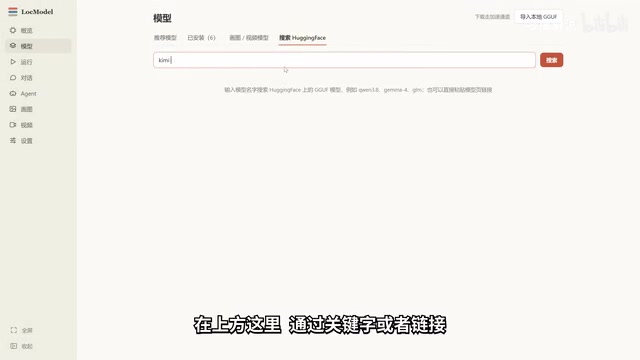
Kimi K3.1 Pro open-sourced at 3T parameters; tested to run with a hard-drive fallback and generate smoothly via API.
Kimi K3.1 Pro is officially open-sourced with roughly 3 trillion total parameters, positioned as a natively multimodal agent model and ranking in the top tier of open-source models for coding, 3D creation, and game development. A Bilibili creator tested local deployment with the Local Model tool: downloading a 550+ GB quantized model (14 shards) and, with insufficient VRAM and RAM, layering the model onto a hard drive — generating only about 0.1 tokens per second but still producing output. After switching to API access, output speed reached 140+ tokens per second, completing complex tasks such as an animated self-introduction, an interactive microscopic-world webpage, a 3D billiards game, and a turbofan engine disassembly model. The platform also supports open-source image, video, and speech models, all usable offline. The article argues this shows the complete closed loop of the open-source ecosystem, from open weights to an offline toolchain.
Title
Kimi K3.1 Pro Open-Sourced: Testing a 3-Trillion-Parameter Model with a Hard Drive as Memory
Meta Description
Kimi K3.1 Pro is officially open-sourced with roughly 3 trillion total parameters — a natively multimodal agent model. Bilibili creator "零度解说" tested local deployment: when VRAM and RAM run out, a hard drive picks up the slack, loading a 550G quantized model layer by layer. Slow, but it runs. This article covers the deployment process, API access, and test results including an animated self-introduction, a microscopic-world webpage, 3D games, and a turbofan engine model.
Article Content
The official open-sourcing of Kimi K3.1 Pro has pushed the parameter scale of open-source large models to an entirely new order of magnitude — roughly 3 trillion total parameters, officially positioned as a natively multimodal agent model. Bilibili creator "零度解说" wasted no time running a local deployment test, managing to get the model running on a machine with insufficient VRAM and RAM. This article draws on his hands-on testing to discuss what this open-sourcing really means and how ordinary users can get started with it today.
What Makes a 3-Trillion-Parameter Open-Source Model So Strong
According to 零度解说, Kimi K3.1 Pro is one of the most powerful open-source large models to date. Built on a native multimodal architecture, it ranks in the top tier of open-source models for coding, 3D creation, financial research, game development, and other agent tasks.
The two qualifiers — "natively multimodal" and "agent model" — deserve a closer look. The former means the model integrated multiple modalities from the training stage rather than bolting them on afterward; the latter means it is designed to call tools and execute multi-step tasks. In testing, the creator had it invoke an Agent to create game projects locally, generate a 3D billiards game and a turbofan engine model — a direct demonstration of exactly these capabilities.
For the open-source community, 3 trillion parameters means more than just "big." It shows that the parameter gap between top closed-source and open-source models is rapidly narrowing, and open weights mean enterprises and researchers can fine-tune and deploy privately in their own environments — something API access simply cannot provide.
The MoE (Mixture of Experts) architecture is key to understanding the "3 trillion parameters" figure. Traditional dense models activate all parameters for every token during inference, whereas MoE splits the model into many "expert" subnetworks paired with a routing network, so each token activates only a few experts. Thus 3 trillion total parameters does not mean 3 trillion computations per inference — the actual compute is far smaller than the total parameter count. This is also why the model can be "forcibly layered onto a hard drive" as described later: MoE's activation sparsity makes it possible to run ultra-large models on limited hardware. That said, MoE still places high demands on VRAM/RAM, because the weights of all experts must be loadable — they just don't all participate in computation at once.
Local Deployment Test: Not Enough VRAM? Bring in the Hard Drive
The most interesting part of this test is the "reckless" local deployment. The creator used the free Local Model local model downloader, which supports Windows, Mac, and Linux. After installation, it automatically installs the appropriate inference engine based on GPU type (NVIDIA, AMD, Intel), saving the hassle of manual environment configuration.
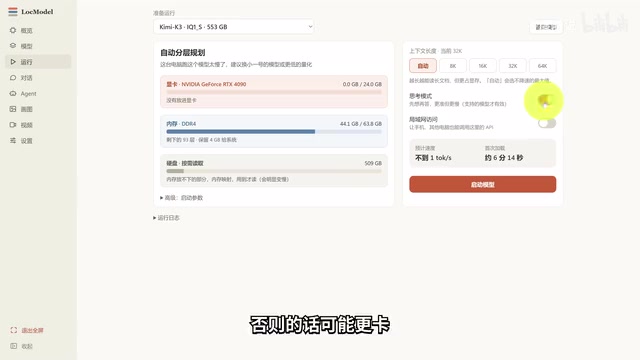
The tool recommends a configuration based on your hardware: it prioritizes loading the model into GPU VRAM, falls back to RAM if VRAM is insufficient, and uses the hard drive as a last resort when RAM also falls short. The creator downloaded the 550+ GB quantized version of Kimi K3, comprising 14 model shard files. After downloading all of them into a single folder, he loaded them via the "Import local GGUF format model" feature.
Because neither VRAM nor RAM could hold a MoE mixture-of-experts model of this scale, the model was forcibly layered onto the hard drive. A 1TB drive had enough capacity, but speed became the bottleneck — the creator described loading speed as "probably less than 1TB per second," with generation at roughly 0.1 tokens per second, slow enough that characters dribbled out one at a time.
Even so, the model eventually produced a complete self-introduction: "Hello, I'm Kimi, an AI assistant developed by Moonshot AI." In the creator's words, as long as it can spit out a single character, that counts as a win. The practical significance of this result: the barrier to ultra-large models is no longer dictated by VRAM, and machines with large enough hard drives can run them too — at the cost of speed.
GGUF is a model file format introduced by the llama.cpp project, designed specifically for efficient inference on consumer-grade hardware. Its core features: support for multiple quantization precisions (such as Q4, Q5, Q8) that compress model weights to smaller sizes; and bundling of model metadata, tokenizer information, and weights into a single file for easy distribution and loading. The "550+ GB quantized version" and "14 model shard files" mentioned in the article are the products of GGUF quantization by precision and splitting. GGUF also supports loading weights layer by layer, which makes the layered inference strategy of "put it in RAM if VRAM is insufficient, put it on the hard drive if RAM is insufficient" possible — during inference, individual layers are paged in from slow storage on demand, at the cost of a drastic speed drop. This explains the 0.1 tokens per second generation speed in the test.
Quantization is the technique of converting model weights from high-precision floating point (such as FP16/BF16) to lower-precision representations (such as INT4, INT8). Take FP16: each parameter occupies 2 bytes; 3 trillion parameters at full precision would require about 6TB. After 4-bit quantization, each parameter takes about 0.5 bytes, compressing the size to roughly a quarter of the original — which is exactly where the "550+ GB" quantized version comes from. The cost of quantization is precision loss and some degradation in model capability, but this is usually far smaller than the size reduction ratio, so it is widely adopted in local deployment scenarios. The "14 model shard files" mentioned in the article exist because a single file would be too large to download and load conveniently, so it is split into fixed-size chunks.
API Access Is the Everyday Way to Use It: Generation Test Results
Running it locally on brute force only verifies feasibility; the truly practical path is API integration. In the Local Model settings, add the Kimi provider and enter your API Key to get the model list including Kimi K3.1 Pro. After switching to API mode, output speed reaches 140+ tokens per second — a completely different experience from local running.

In API mode, the creator ran several tests:
- Animated self-introduction: Asked the model to introduce itself in animated form. Output speed was about 140+ tokens per second, completing in about two minutes. The result had a launch-event-style visual presentation covering four capability expressions: understanding, reasoning, creation, and programming.
- Webpage microscopic world: A single prompt generated an interactive microscopic-world webpage — drag with the mouse to switch views, scroll to zoom, and click the water surface to send out ripples. The water animation and interactive feedback were quite refined. The creator noted that generating via Agent mode produces better results but consumes more resources.
- 3D game development: Had the model call tools to create game projects locally. After authorization, the model automatically wrote files, generating a first-person parkour game and a 3D billiards game with smooth controls. The billiards game supports pressing E to crouch and aim and left-click to charge the shot.
- Industrial-grade 3D model: Built a turbofan engine model in code, with fan blades, compressor, combustion chamber, and turbine components all finely reproduced. It supports free rotation and zoom, and can be disassembled to show the structure of each internal part.
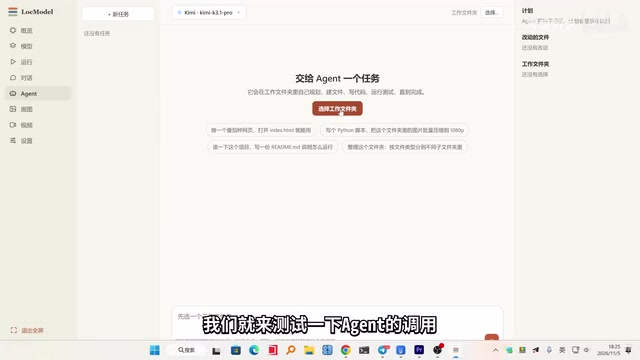
What these tests have in common is "done in one shot" — from prompt to runnable result with no manual code patching in between. The engine disassembly model in particular goes beyond ordinary 3D generation, closer to an interactive digital industrial model.
More Than Chat: The Full Offline Multimodal Toolkit
Beyond text and code, the Local Model platform also supports creating images with free open-source models, generating videos with open-source video models (such as the MiniMax series), and importing open-source speech models. All capabilities can be used offline with no network connection and without call-count limits.
This is valuable for specific scenarios: organizations whose data cannot leave the intranet, creators who need to generate large volumes of content, and developers who want to study model behavior can all find a fit in this combination. At the end of the video, the creator said download links for all materials used were placed below the video.
From 3-trillion-parameter open weights, to the extreme deployment scheme with a hard-drive fallback, to the offline multimodal toolchain, this test demonstrates not just the capability of a single model but the complete closed loop the open-source ecosystem is forming. Slow speed is a fact of the current stage, but the fact that it runs at all is where change begins.
One-line Summary
Kimi K3.1 Pro open-sourced with 3 trillion parameters; tested to run with a hard-drive fallback and generate smoothly in API mode.
Paragraph Summary
Kimi K3.1 Pro is officially open-sourced with roughly 3 trillion total parameters, positioned as a natively multimodal agent model and ranking in the top tier of open-source models for coding, 3D creation, and game development. Bilibili creator "零度解说" tested local deployment with the Local Model tool: downloading a 550+ GB quantized model (14 shards) and, with insufficient VRAM and RAM, layering the model onto a hard drive — generating only about 0.1 tokens per second but still producing output. After switching to API access, output speed reached 140+ tokens per second, completing complex tasks such as an animated self-introduction, an interactive microscopic-world webpage, a 3D billiards game, and a turbofan engine disassembly model. The platform also supports open-source image, video, and speech models, all usable offline. The article argues this shows the complete closed loop of the open-source ecosystem, from open weights to an offline toolchain.
Related articles
 Tech Frontiers
Edge AI on Microcontrollers: When Is It Actually Worth Deploying?
Drawing on Reddit discussions and Arm case studies, this article analyzes the real-world use cases for edge AI on microcontrollers: when each device needs independent inference, when a gateway or cloud is more reasonable, and the costs and boundaries of specialized hardware.
 Tech Frontiers
Pushing the Limits of Extreme Sudoku on a 16GB GPU: Insights from Depth and Flow Matching
A researcher trained a 16.54M-parameter model on a 16GB GPU to solve extreme Sudoku, finding effective depth breaks the 60% plateau and flow matching with improved sampling pushes accuracy past 99% with ~50× lower layer-evaluation budget.
 Tech Frontiers
AI Agent Approval Workflows: Why Human Confirmations Always Get Mindlessly Clicked
Why do AI agent approval workflows always get mindlessly clicked? A Reddit discussion shows that separating rules from keys, low-frequency high-risk approvals, and GitHub Environments-style gates are the keys to effective approvals.