Kimi K3.1 Pro Released: Open Weights Coming Soon

Kimi K3.1 Pro promises open weights as the community debates capability filtering, delivery, and deployment barriers.
Moonshot AI announced Kimi K3.1 Pro on Reddit under the banner "Advancing Open Intelligence," promising full model weights by November 4. But discussion quickly turned to questioning the word "full." Top comments suggest cybersecurity capabilities may be deliberately weakened, sparking debate between those who see filtering as mere compliance and those who argue defenders need equivalent offensive tools. The release date also faces a trust deficit: users complain about past delays while still supporting the open-source direction. Hardware jokes reflect real VRAM and storage barriers under the MoE architecture. The article argues that capability-filtering scope, delivery consistency, and local deployment difficulty are the key variables shaping this release's reception.
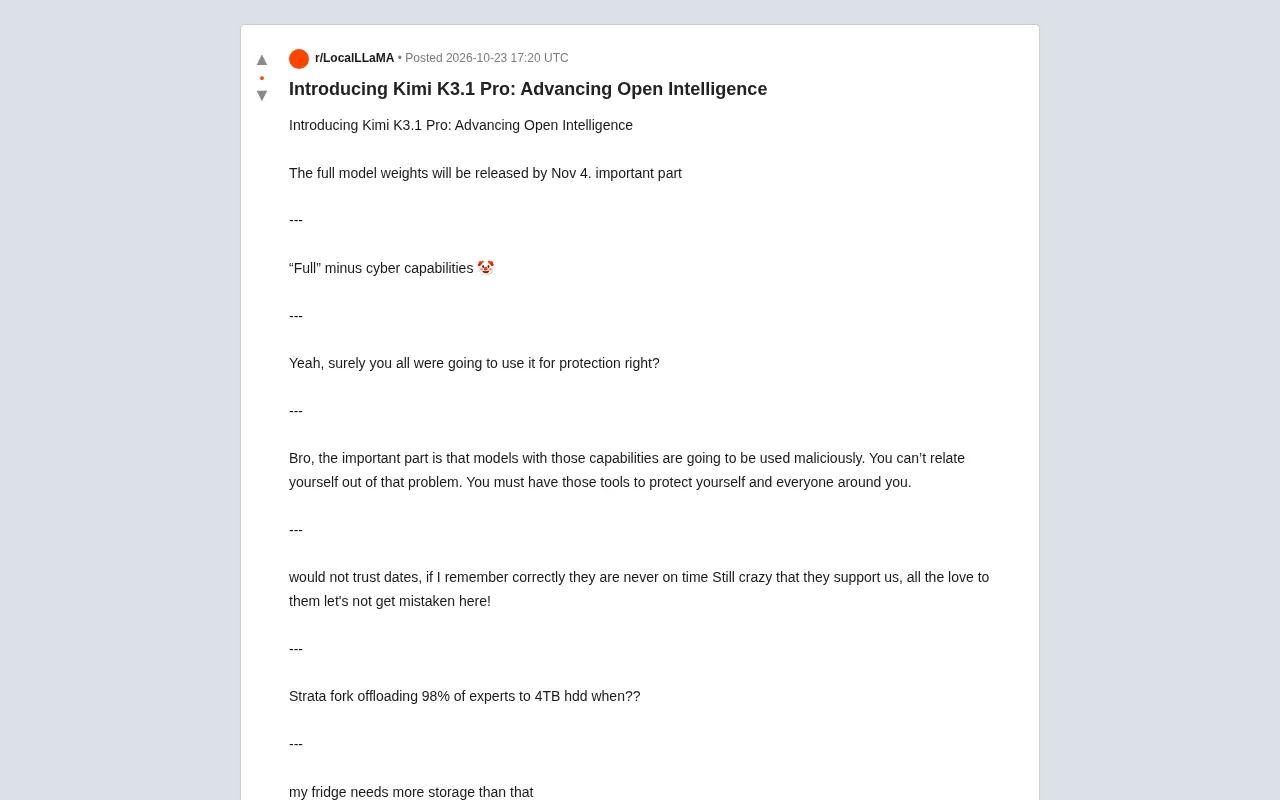
Moonshot AI has announced Kimi K3.1 Pro on Reddit under the banner "Advancing Open Intelligence," promising to release the full model weights by November 4. The news quickly sparked discussion in the open-source community—but the comment section didn't dwell on the usual performance praise. Instead, it zeroed in on the word "full" with some rather pointed back-and-forth.
Where exactly is "Full" full?
The official wording is "full model weights," but the first highly upvoted reply added a footnote: "Full minus cyber capabilities 🤡." This points to an increasingly common practice in open-weight model releases: the weights are open, but certain capability dimensions (especially cybersecurity-related offensive and defensive abilities) are deliberately weakened or filtered.
This kind of "selective open-sourcing" is not unique to Kimi. For some time now, multiple labs have applied alignment treatments to high-risk capabilities when releasing open-weight models, citing the need to prevent malicious use. But judging from community reaction, users don't have much faith in that rationale.
"Open weights" and "open source" are not the same concept. Open weights typically means only that the model's parameter files can be downloaded and used, while training data, training code, and data recipes are often not disclosed. The open source AI definition proposed by the OSI in 2024, by contrast, requires disclosure of data information, complete code, and parameters. This distinction is the premise for understanding the comment section's skepticism: when a lab claims "full weights," it is only promising availability at the parameter level, not unconditional availability at the capability level.
"Cybersecurity capability filtering" falls under the broader category of "high-risk capability alignment." Common approaches include refusal fine-tuning during the post-training stage targeting tasks like vulnerability discovery, malicious code generation, and penetration testing, or interception via system prompts and classifiers. The problem is that such filtering can usually only reduce a model's performance under specific prompts; it is difficult to completely erase knowledge already acquired during pre-training. That's why the community suspects it's more of a "compliance posture" than "substantive protection."
The community's core disagreement: does defense require offensive capability?
The comment section quickly split into two camps. One side argued that removing so-called "cyber capabilities" is just cosmetic: "You're all just using it for defense anyway, right?"—this barbed rhetorical question represents a widespread suspicion that capability filtering is more about compliance posture than substantive protection.
The other side's logic is more direct: "The point is, models with these capabilities are going to be used maliciously anyway. You can't exempt yourself from this problem. You have to have these tools to protect yourself and those around you." This is a classic capability-parity argument—if defenders don't have equivalent tools, security is impossible.
Both sides have a point, but the deeper issue this debate exposes is that the security boundaries of open-weight models still lack community consensus.
Release date: trust deficit
aaThe community's reaction to the November 4 date is also interesting. One user said bluntly, "Don't trust that date too much—if I remember correctly, they've never been on time," then immediately added, "But the fact that they're willing to support us is crazy—give them all the love, don't get that twisted."
This mixed attitude—complaining about delays while thanking them for open-sourcing—actually paints a fairly accurate picture of the current relationship between open model releasers and the community: users have expectations that delivery timelines will slip, but they hold strong identification with the open-source direction itself. For a Chinese lab to release open weights on a platform dominated by the Western community, this supportive attitude is itself noteworthy.
The real anxiety behind the hardware jokes
Another topic that kept getting picked up in the comment section was hardware. Someone asked, "When is the Strata fork going to offload 98% of the experts to a 4TB HDD?" and someone below replied, "My fridge needs more storage than that."
These jokes point to the reality of the MoE architecture: the number of experts in K3.1 Pro means local deployment has fairly high VRAM and storage requirements. "Putting 98% of experts on an HDD" is an extreme exaggeration, but behind it is real deployment anxiety—the weights are out, but can ordinary people actually run them? This discussion comes up after almost every open-weight large model release, and it's the eternal gap between "open source" and "usable."
The MoE (Mixture of Experts) architecture is currently the mainstream approach to scaling up large models' parameter counts: the model contains a large number of parallel "expert" subnetworks, and during each forward pass a routing gating network activates only a few of them, keeping per-inference computation relatively low despite a very large total parameter count. But this "sparse activation" only reduces compute overhead, not storage overhead—all expert weights must be fully loaded in VRAM or memory and kept on standby. This is exactly where the comment section's hardware jokes come from: the more experts there are, the larger the weight files, and the harder it is for consumer-grade GPUs' VRAM to accommodate them. Even with CPU offloading (moving some experts to memory or even disk), the only result is sacrificing inference speed.
Weight offloading refers to moving some of a model's layers or experts from VRAM to slower storage tiers such as memory or NVMe drives, swapping them in on demand at runtime. The comment about "offloading 98% of the experts to a 4TB HDD" is exactly an exaggerated joke about this technique: the random read latency of a mechanical hard drive is tens of thousands of times that of VRAM, and if you really put the vast majority of experts on an HDD, inference speed would be too slow to be of any practical value. The core of this meme is that open weights don't mean out-of-the-box usability—hardware requirements remain the real barrier to local deployment.
The next step for open intelligence
Based on the information available so far, the focus of the Kimi K3.1 Pro release is on "openness" rather than pure performance numbers. But the community's reaction shows that simply announcing open weights is no longer enough to win unconditional trust: the scope of capability filtering, consistency of delivery timelines, and the barrier to local deployment are the key variables that will determine the actual reception of this release.
Whether November 4 is honored on schedule, and whether the community can successfully get things running after the weights are released, will say more about this than the release post itself.
One-line Summary
Kimi K3.1 Pro promises open weights, while the community focuses its debate on capability filtering, delivery, and deployment barriers.
Paragraph Summary
Moonshot AI announced Kimi K3.1 Pro on Reddit under the banner "Advancing Open Intelligence," promising to release the full model weights by November 4. But community discussion quickly shifted from performance to questioning the word "full." Highly upvoted comments pointed out that cybersecurity capabilities may have been deliberately weakened, sparking a two-sided debate: one side argues that capability filtering is just a compliance posture, while the other insists that defenders must have equivalent offensive tools to protect themselves. The release date also ran into a trust deficit, with users complaining about a history of delays while still expressing support for the open-source direction. Hardware jokes reflect the real VRAM and storage barriers under the MoE architecture. The article argues that the scope of capability filtering, delivery consistency, and local deployment difficulty are the key variables determining the reception of this release.
Related articles
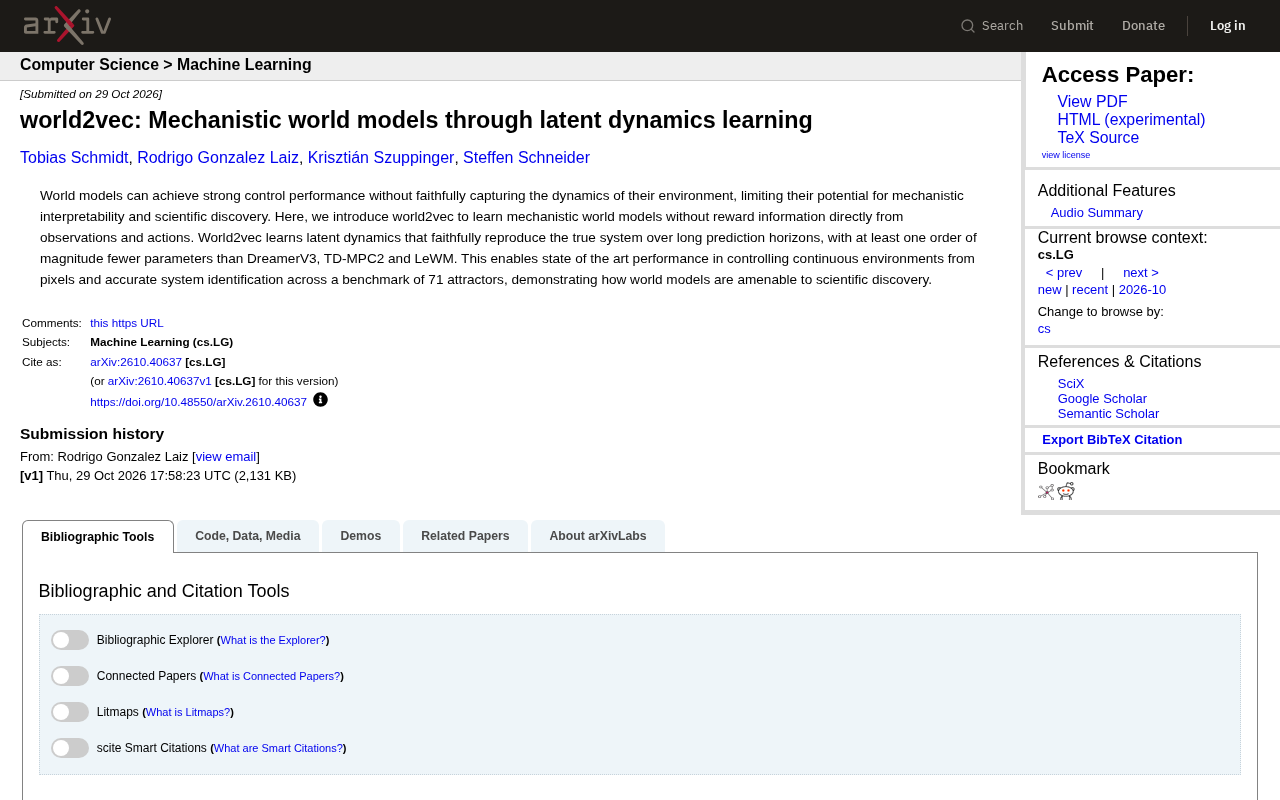
world2vec: Building Mechanistic World Models with Latent Dynamics Learning
world2vec proposes a reward-free method for learning mechanistic world models via latent dynamics, faithfully reproducing systems over long horizons with at least an order of magnitude fewer parameters than DreamerV3, TD-MPC2, and LeWM, and achieving accurate system identification on 71 attractor benchmarks.

A New KL-DRO Paradigm: Adaptive Scenario Generation Around a Learned Density Model
KL-DRO research proposes centering the KL ball on a learned density model instead of the empirical distribution, with adaptive scenario generation guiding sampling toward the worst case. Experiments show lower cost under distribution shift when records are scarce and the model can extrapolate, with comparable in-distribution cost.

ODE Samplers for Discrete Diffusion Models: Exponential Residual Flows Accelerate Generation
Discrete diffusion models lack deterministic ODE sampling? This article introduces Exponential Residual Flows (ERFs), which introduce continuous residual variables per token to construct piecewise ODEs for deterministic sampling and support consistency distillation acceleration. Superior to prior methods on code and text generation tasks.