Kippy AI: The Language Learning AI Partner That Won't Cater to You

Kippy AI uses a "non-catering" self-centered character to simulate real conversational pressure, helping learners overcome the barrier to speaking.
Kippy AI is an AI language learning product ranked #10 on Product Hunt, featuring a "non-catering" AI speaking partner. Unlike typical sycophantic AI tutors, its character has an independent personality and cares more about its own topics than accommodating the learner, simulating real conversational social pressure. The article argues this "slight discomfort" forces learners to call upon existing knowledge for real-time output, bridging the gap from "understanding" to "speaking." Currently in early stages with 79 votes and 5 comments, it focuses on a single speaking scenario. Its positioning reflects the strategic divergence in AI language learning: super tutor vs. conversation partner routes.
The pain point of language learning was never memorizing vocabulary—it's speaking up. Traditional AI tutors often play the role of an infinitely patient, perfect teacher, but in real conversations, the other person won't always accommodate your pace and mistakes. Kippy AI, ranked #10 on Product Hunt, proposes a counterintuitive approach: making the AI character more "self-centered" actually helps you adapt to real communication faster.
Why "Not Catering" Is Actually a Better Way to Learn Languages
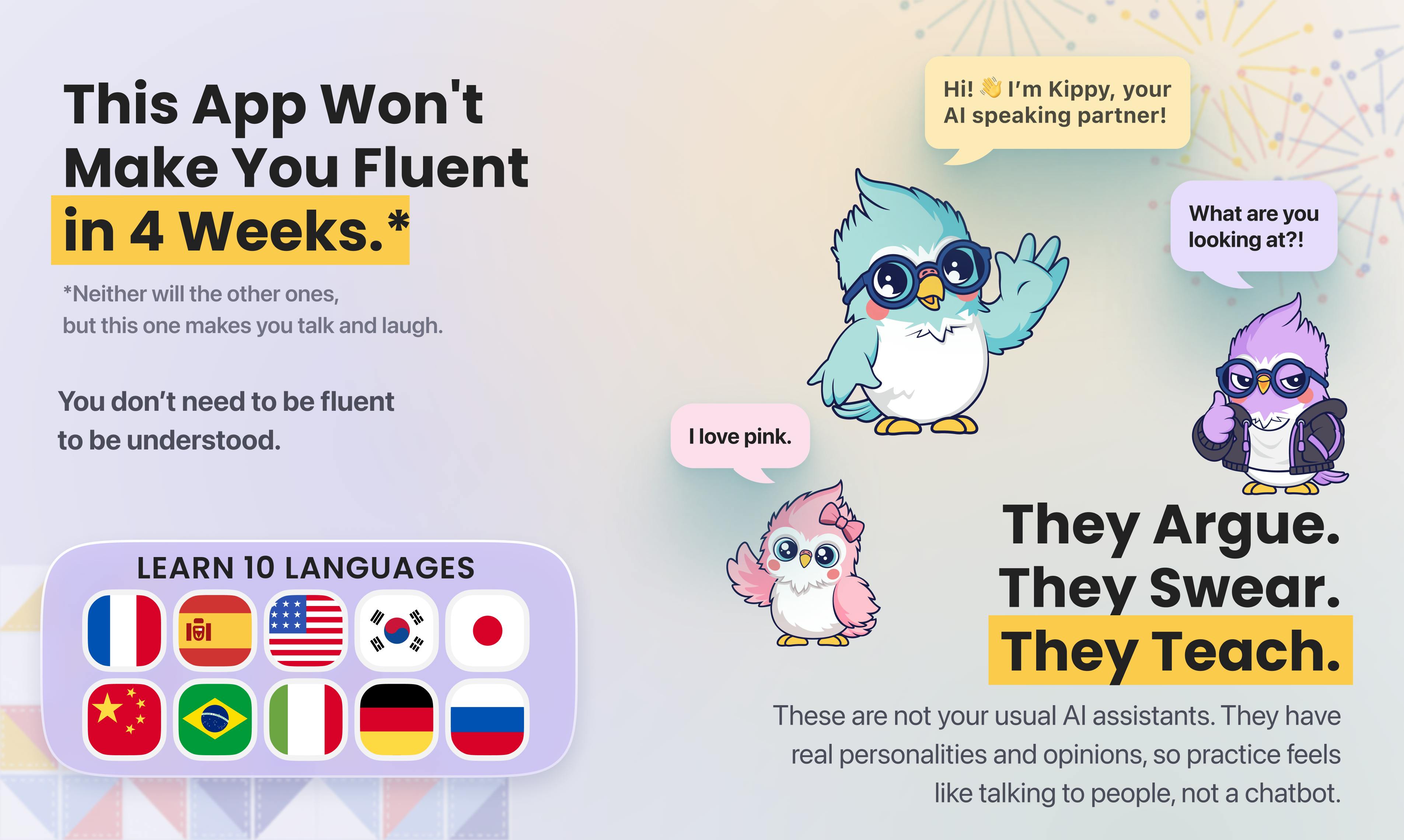
Kippy AI's official description gets straight to the point: "Fluency is hard, being understood is easier." Its positioning isn't that of an "AI sycophant tutor"—the kind of flattering mentor that always praises you and goes along with everything you say—but rather a conversational character with an independent personality that cares more about itself than about the learner.
There's clear learning logic behind this design. When you converse with an AI that always accommodates you, you're actually practicing a kind of "greenhouse language"—the other party slows down, tolerates grammatical errors, and responds with simple vocabulary. But real-world conversations are full of unpredictability: people have emotions, preferences, and topics they want to talk about. Kippy's character setup forces learners to organize their language under social pressure that's closer to reality, and this "slight discomfort" is precisely the catalyst for language ability growth.
From a product categorization standpoint, Kippy is classified under Education, Languages, and Artificial Intelligence, but it's essentially an AI application rather than a traditional educational tool. Its differentiation lies not in curriculum structure or vocabulary size, but in the personified design of the conversational experience.
Comprehensible Input and the Output Hypothesis
Kippy's design logic forms an interesting contrast with two classic hypotheses in second language acquisition research. Krashen's "Comprehensible Input Hypothesis" emphasizes that learners acquire language through input slightly above their current level (i+1); while Swain's "Output Hypothesis" points out that only by forcing learners to produce language can they discover their own expression gaps and drive grammatical processing. Kippy's "self-centered AI character" essentially creates output pressure: when the conversation partner doesn't proactively simplify language or fill your silences, learners are forced to call upon their existing vocabulary and syntax for real-time assembly—precisely the learning mechanism described by the Output Hypothesis.
The Affective Filter and the Boundary of "Slight Discomfort"
Krashen also proposed the "Affective Filter Hypothesis," suggesting that negative emotions such as anxiety and lack of confidence create a psychological barrier that hinders language absorption. This explains the subtlety of Kippy's strategy: moderate social pressure can activate output, but excessive pressure raises the affective filter and causes learners to withdraw. The key to the product's success lies in keeping "not catering" within the zone of "challenging but achievable."
Product Form and Target Users
Currently, Kippy AI has received 79 votes on Product Hunt, ranking #10 with 5 comments. The maker is Steve Olesansky. Judging from the official website link and description, the product is still in its early stages, with core functionality focused on the single scenario of "AI speaking partner."
Its target audience is clear: learners who already have some language foundation but lack real conversation opportunities. If you're still at the stage of memorizing basic vocabulary, Kippy's "self-centered personality" might make you feel frustrated; but if you can understand most content and just can't speak up, this slightly challenging conversational environment perfectly fills the gap from "understanding" to "speaking."
One detail worth mentioning: Kippy emphasizes "Learn languages while having fun," but its "fun" isn't achieved through gamified reward mechanisms—it comes from the inherent enjoyment of character interaction. When you're conversing with an AI character that has an attitude, every exchange carries uncertainty, and this freshness is something traditional quiz-style learning struggles to provide.
Diverging Product Approaches in the AI Language Learning Space
Kippy's emergence reflects that AI language learning products are undergoing a round of strategic divergence. One category takes the "super tutor" route, emphasizing correction accuracy, pronunciation scoring, and personalized curriculum paths; the other, like Kippy, takes the "conversation partner" route, downplaying teaching attributes and strengthening social simulation.
Both routes have their trade-offs. The tutor route suits structured learning and can clearly tell learners "where you went wrong"; the partner route is better suited for output training, letting learners call upon existing knowledge under real pressure. The risk of Kippy choosing the latter is that the lack of clear feedback may leave some users feeling lost—the conversation ends, but they don't know how well they did.
However, judging from the Product Hunt ranking and vote count, this "anti-sycophancy" positioning has indeed struck a chord with some users' genuine needs. At a time when AI tutors are generally trending toward "the more thoughtful the better," Kippy's differentiated strategy is itself a valuable product experiment.
The Technical Foundation of AI Language Partners: Character Personification and Conversational Memory
The technical implementation of "conversation partner" products like Kippy typically relies on persona prompting of large language models and multi-turn conversational memory mechanisms. Persona prompting constrains the AI's tone, stance, and topic preferences through system prompts, enabling it to exhibit a personality "with attitude"; conversational memory allows the AI to maintain character consistency across turns, preventing each exchange from reverting to a generic assistant voice. Compared to the "super tutor" route, the partner route relies less on specialized models for pronunciation scoring and grammar error detection, but demands more in terms of character consistency and conversational naturalness—which also explains why Kippy currently focuses on a single speaking partner scenario rather than rapidly expanding into a curriculum system.
AI Sycophancy: Why the Flattery Tendency Becomes a Problem
"AI sycophant tutor" is not an empty label. Large models trained with reinforcement learning from human feedback generally exhibit sycophantic tendencies: they lean toward agreeing with users, giving positive evaluations, and avoiding correction or conflict. In language learning, this tendency manifests as excessive tolerance of grammatical errors and false praise of expression levels, thereby weakening learners' error-correction signals. Kippy's "anti-sycophancy" positioning is precisely a targeted product response to this model behavior characteristic.
Observations and Expectations for an Early-Stage Product
As an early-stage project on Product Hunt, Kippy AI currently has limited publicly available information. 79 votes and 5 comments indicate it has attracted small-scale attention, but it's still a ways from validating product-market fit.
Points worth tracking include: how the "self-centered" degree of the AI character is calibrated—too strong will deter beginners, too weak will revert to an ordinary tutor; how the conversation correction mechanism is designed—a delicate balance is needed between no correction at all and excessive correction; and the coverage scope of multilingual support.
For learners who want to practice speaking but struggle to find conversation partners, Kippy offers a new option worth trying. Its core value proposition is simple: rather than practicing in the greenhouse of a perfect AI, learn to be understood in front of an AI with personality.
One-line Summary
Kippy AI uses a "non-catering" self-centered character to simulate real conversational pressure, helping learners break through the barrier to speaking up.
Paragraph Summary
Kippy AI is an AI language learning product ranked #10 on Product Hunt, featuring a "non-catering" AI speaking partner. Unlike typical sycophantic AI tutors, its character has an independent personality and cares more about its own topics than accommodating the learner, thereby simulating the social pressure of real conversations. The article argues that this "slight discomfort" forces learners to call upon existing knowledge for real-time output, bridging the gap from "understanding" to "speaking." The product is currently in its early stages with 79 votes and 5 comments, focusing on a single speaking conversation scenario. Its positioning reflects the strategic divergence in the AI language learning space: the super tutor route emphasizes correction and curriculum, while the conversation partner route emphasizes social simulation. Kippy chooses the latter, with potential challenges including balancing the degree of character self-centeredness, designing the correction mechanism, and multilingual coverage scope.
Related articles

Gemini 4 Neon Leak: A Potential Strong Contender Against Opus 5.5
A Hacker News thread suggests Gemini 4 Neon looks like an Opus 5.5 competitor. This article unpacks the product positioning behind this community signal, shifts in the top-model competitive landscape, and what it means for developers' model selection strategy.

Claude Fable 5.2's Self-Authored Short Film 'Fable' Sparks Discussion
A short film 'Fable,' credited to Claude Fable 5.2 for script, visuals, and directing, appears on Hacker News. This article analyzes the significance of full-pipeline AI creation, community reactions, and what it means for content creators.

Anthropic IPO Pricing: A Signal of AI Giants Going Public
Anthropic's IPO pricing draws attention. This article analyzes its potential impact on AI industry valuation, commercialization paths, and the competitive landscape, and highlights public-market expectations and challenges for AI companies.