Kiro Crew: An Open-Source Agentic Development Workspace with Persistent Memory

An open-source agentic workspace with persistent memory that eliminates AI coding cold starts.
Kiro Crew is an open-source agentic development workspace that tackles the cold start problem plaguing AI coding assistants. By maintaining persistent memory across sessions—including project context, lessons learned, and reusable skills—it enables AI to accumulate experience like a real team member. It supports building multi-agent collaborative teams and packaging repetitive tasks into one-click Apps, all while being self-hostable for data privacy.
Goodbye "Cold Start": The Memory Challenge of AI Development Tools
If you frequently use AI coding assistants, you've surely encountered this scenario: every time you start a new session, you have to re-explain the project background, tech stack conventions, historical decisions, and even repeatedly correct mistakes the AI already made last time. This "cold start" not only wastes time but also prevents AI from truly accumulating experience and developing a deep understanding of your project.
The Cold Start problem originally comes from the recommendation systems domain, referring to the dilemma where a system cannot provide personalized services without historical user data. In the AI coding assistant context, this problem is particularly acute: current mainstream large language models (such as GPT-4, Claude, etc.) use stateless session mechanisms, starting each conversation in a blank context window. Even though context windows have expanded to 128K or even longer token counts, this information is not retained once the session ends. Developers are forced to rebuild the project's "mental model" in every new session—including the historical reasons behind architectural decisions, the details of team coding conventions, and constraints of specific business logic—all forms of tacit knowledge that are difficult to fully convey through simple system prompts.
Recently launched on Product Hunt, Kiro Crew targets precisely this pain point. It's an open-source agentic development workspace whose core selling point is persistent memory—remembering your context, lessons learned, and skills, so that every time you return, you're picking up where you left off rather than starting from scratch. After launch, it quickly gained 117 upvotes, ranking 6th in the Developer Tools category for the day.
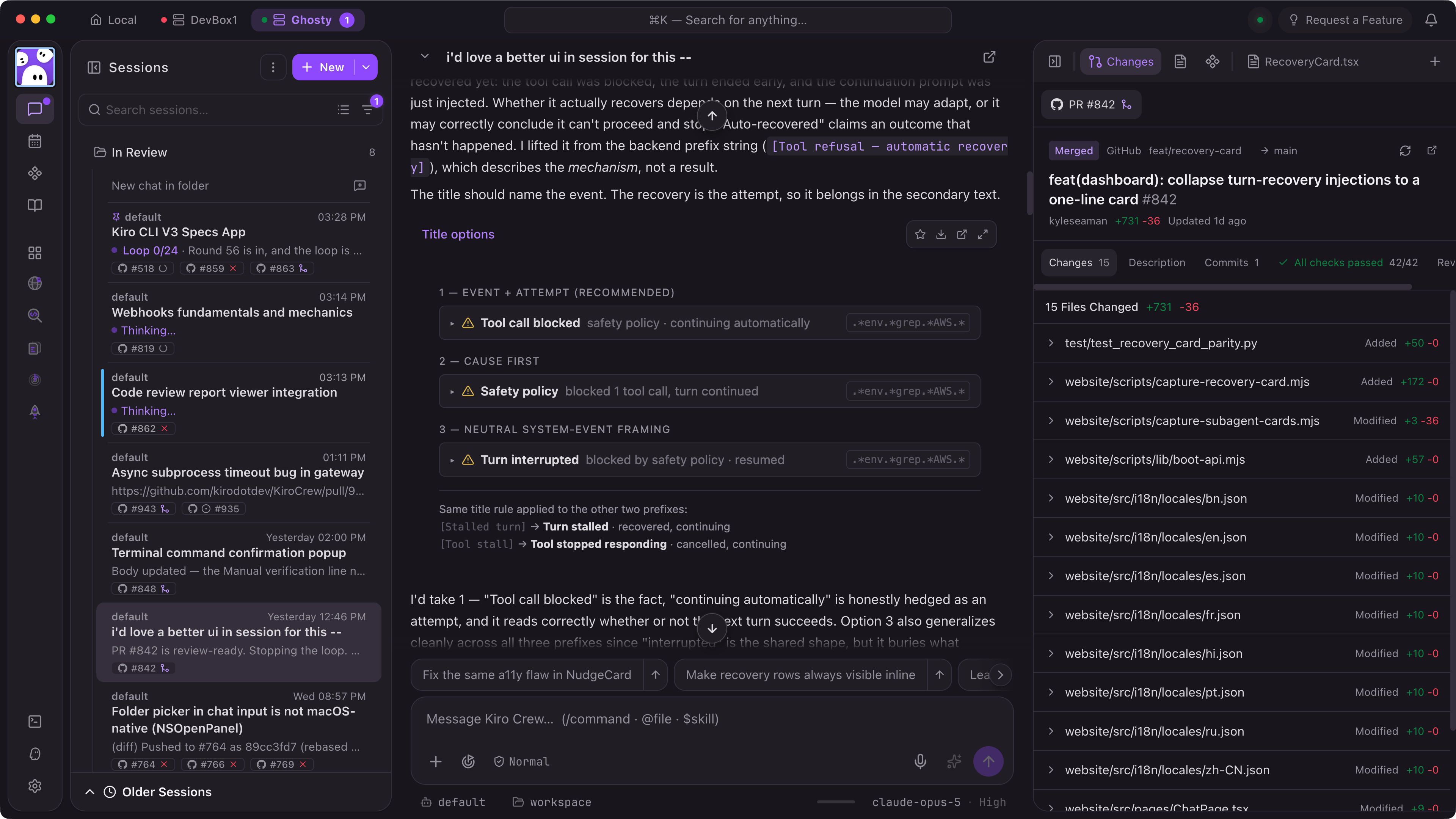
Core Features of Kiro Crew
Based on the official description, Kiro Crew's positioning can be broken down into three keywords: persistent workspace, agent crew, and purpose-built Apps.
Persistent Workspace: Cross-Session Memory
Traditional AI assistants are mostly "stateless"—when the session ends, memory resets to zero. Kiro Crew emphasizes that it is a persistent workspace that retains three types of information across sessions:
- Context: Project structure, dependencies, current progress, etc.
- Lessons: Pitfall records and best practices accumulated from past interactions
- Skills: Reusable capability modules
This means the AI can "get smarter the more you use it" like a genuine project team member, rather than needing to be retrained every time. This design philosophy is highly aligned with the recently discussed "AI memory layer" trend in the industry.
From a technical implementation perspective, persistent memory typically involves several key components: vector databases (such as Pinecone, Weaviate, ChromaDB) for storing and retrieving semanticized historical interaction data; RAG (Retrieval-Augmented Generation) pipelines for dynamically loading relevant context when a new session begins; and a metadata management layer for tracking information timeliness and reliability. Unlike simple conversation history storage, truly effective persistent memory requires information compression, tiering, and forgetting mechanisms—simulating the process of short-term memory converting to long-term memory in human cognition. The industry has significantly increased investment in this direction recently. OpenAI's Memory feature and Anthropic's Projects feature are attempts at different levels, but they mostly remain at the level of "remembering user preferences" without reaching the granularity of "remembering project engineering context."
Multi-Agent Collaboration: Build Your AI Development Team
The "Crew" in the name highlights its other core concept: not a single Agent, but building a cross-tool collaborative team of agents. These Agents can work across the tool chains you're already using, rather than requiring you to migrate to an entirely new closed ecosystem—this is crucial for compatibility with developers' actual workflows.
Multi-Agent Collaboration is one of the frontier directions in current AI engineering. Its core idea is to decompose complex tasks among multiple specialized Agents, achieving overall goals through coordination mechanisms. Typical frameworks include Microsoft's AutoGen, Stanford's Generative Agents, and open-source projects like CrewAI. Compared to a single Agent, the advantages of multi-agent architecture include: each Agent can use different models or prompt strategies to optimize specific subtasks; Agents can verify and correct each other (similar to peer review in code reviews); and the system is more scalable—adding new capabilities only requires adding new Agents rather than restructuring the entire system. However, challenges are also apparent: communication overhead between Agents, conflict resolution mechanisms, and predictability of overall behavior are engineering challenges that remain unsolved.
Purpose-Built Apps: Packaging Repetitive Tasks for One-Click Invocation
Kiro Crew encapsulates agent capabilities into purpose-built Apps designed for specific repetitive work. For tasks you perform repeatedly (such as code review, test generation, documentation updates), you can solidify them into dedicated applications for one-click invocation, reducing the cost of manual orchestration each time. This design philosophy is similar to Unix's pipe philosophy—combining small, specialized tools into powerful workflows, except here the "tools" are AI-capable agent modules.
Advantages of Being Open Source
In the current landscape where most AI development tools take the closed-source SaaS route, Kiro Crew's open-source nature means:
- Self-hostable with data control: For teams that prioritize code privacy and compliance, the workspace can be deployed in their own environment, preventing sensitive project context from leaking.
- Extensible and customizable: Developers can customize Agent behavior and integrate internal tools according to their team's actual workflow.
- Community co-creation: Its categorization also tags GitHub, suggesting it deeply relies on the developer community to contribute skill modules and Apps.
In the AI development tools space, the open-source vs. closed-source debate reflects a deeper industry dynamic. Closed-source SaaS products (such as GitHub Copilot, Cursor, etc.) provide convenient experiences through cloud services, but code passes through third-party servers, raising data security and intellectual property concerns—particularly for regulated industries like finance, healthcare, and defense. Open-source solutions allow enterprises to run all components in private environments, meeting compliance requirements like SOC 2 and GDPR. Additionally, open source means audit transparency—teams can precisely understand how AI tools process their code and data, avoiding "black box" risks. The recent rise of open-source AI coding tools like Continue.dev and Tabby demonstrates that the market segment of developers sensitive to data sovereignty is significant.
This open strategy often builds stronger trust among developer communities and better aligns with the product philosophy of "tools should serve my existing workflow."
Real Development Pain Points Kiro Crew Addresses
Placing Kiro Crew in the broader industry context, it responds to several key directions in the evolution of AI coding tools:
From "conversation" to "workspace." Early AI coding was chat-based Q&A. Now, more and more products are evolving toward "environment-based" approaches—where AI is deeply embedded in your development environment with state, memory, and proactivity. Kiro Crew's workspace positioning embodies this trend.
AI coding tools are undergoing a paradigm shift from "conversational interfaces" to "workspace interfaces." Chat-based interaction is suitable for exploratory questions and one-off tasks, but it is fundamentally linear and stateless, struggling to handle the multi-dimensional information of complex engineering. The Workspace paradigm borrows from IDE design philosophy—providing a persistent, structured environment containing the project's global view, task queues, history, and tool integrations. This transition is similar to the evolution from command line to graphical IDEs: instead of making developers adapt to the tool's interaction mode, the tool adapts to developers' working methods. Replit Agent, Devin, and various Agentic IDEs (such as Windsurf) are all driving this transition to varying degrees.
From "single point" to "team." A single general-purpose Agent struggles with complex multi-step engineering tasks, while multi-agent collaboration is considered one path to improving reliability. Kiro Crew's Crew model aligns with this approach.
From "repetitive labor" to "capability accumulation." By remembering lessons learned and encapsulating purpose-built Apps, it attempts to transform the orchestration costs developers repeatedly invest into reusable assets.
Current Limitations and Observations
It should be objectively noted that Kiro Crew is still in its early stages. With only 1 comment on Product Hunt, real user feedback is still insufficient. The following questions are worth ongoing attention:
- Memory quality and controllability: Persistent memory is a double-edged sword. If the AI remembers incorrect "experiences" or outdated context, it may introduce hard-to-diagnose biases. Therefore, mechanisms for editing, cleaning, and tracing memory are crucial.
Quality control of persistent memory is a technical challenge that hasn't been fully solved, known in academia as "Memory Pollution" or "Knowledge Drift." When AI systems accumulate experience over long periods, several risks may emerge: outdated information conflicting with new information (e.g., old API usage being recommended after framework version upgrades); incorrect experiences being wrongly reinforced (e.g., a workaround for a specific scenario being generalized as universal practice); and memory bloat causing retrieval precision to decline. Effective solutions typically require introducing time-decay mechanisms, confidence scoring, and user-accessible memory audit interfaces—allowing developers to manage AI's memory bank like managing a Git repository.
- Actual breadth of tool integrations: Claiming to "work across your existing tools" is attractive, but which specific tools are supported and how deep the integrations go requires hands-on verification.
- Coordination costs of multi-agent systems: While agent team collaboration is powerful, it may also bring higher token consumption and more complex debugging challenges.
Conclusion
Kiro Crew represents the evolutionary direction of AI development tools from "chat assistants" toward intelligent workspaces that "have memory, can collaborate, and accumulate knowledge." Its open-source nature and "integrate into existing tool chains" approach both reflect genuine insight into developers' real needs. For developers long frustrated by the cold start problem of AI assistants, this type of persistent memory workspace is worth watching and trying—though whether it can deliver on the promise of "memory as productivity" still requires validation through more real-world use cases.
Related articles

Gemini 4 Argon Hands-On: AI Builds Board Games, Constructs Temples, and Trains Robots Autonomously
Gemini 4 Argon hands-on roundup: AI autonomously builds a desk racetrack and temple in Blender, writes a ray tracing engine, trains a humanoid robot to sink 7 shots, plus API pricing and developer access.

The Magic Octagonal Coin: Why Only 9% of People Can Predict Its Flip?
Only 9% of people can correctly predict the Magic Octagon coin flip. This article explains its spatial rotation mechanism, common cognitive pitfalls, and a new hypothesis based on Relevance Theory, exploring the limits of human spatial reasoning.

Sam Altman: AI Is Entering the Era of Scientific Discovery — Math Breakthroughs Will Replicate in Biology and Energy
Sam Altman says AI is entering the era of scientific discovery — math breakthroughs will replicate in biology, materials science, and energy to help develop new drugs and energy sources.