KITE: The Haptic Robot That Pushes Back, Making Physics Tangible

KITE uses three gearless-motor wheels and camera positioning to turn virtual-world forces into real tactile sensations.
KITE is a three-wheeled haptic robot with a handle that glides freely like a mouse and applies real-time reaction forces when touching virtual objects. Using gearless motors and a custom driver for precise force control, an upward camera for ceiling LED positioning, and motor feedback for between-frame estimation, it delivers smooth, fast haptic feedback. It lets students embody particles in physics systems—feeling lift, hydrogen bonds, tidal forces, and friction. Limitations include dependence on a specific ceiling and screen, and single-point interaction.
When you move your mouse across a screen, you can only see the changes—not feel the forces. KITE (Kinesthetic Interface for Tangible Exploration) aims to break through that barrier. It's a robot that "pushes back," turning forces, torques, and impulses from the virtual world into real sensations in your hand.
A Robot That Talks Back
KITE looks like a circular device with a handle on top and three wheels underneath. When you grab it and move it, it glides freely like a mouse—but when it encounters a virtual object, it can suddenly apply resistance or a push. This two-way interaction is its defining feature: it doesn't just passively receive your movements, it computes and feeds back forces in real time based on the virtual scene.
Making this work in hardware is no simple task. The team abandoned traditional geared motors in favor of gearless motors, and wrote their own motor driver to precisely control the magnitude and direction of force and torque. The three omni-wheel design lets KITE move in any direction without turning—the mechanical foundation for its ability to apply force in any direction.

An omni wheel is a wheel with small rollers mounted at an angle around its circumference. A normal wheel can only roll along its own direction of travel, but an omni wheel's small rollers can slide freely sideways, allowing the chassis to translate in any direction without changing its orientation. Three omni wheels arranged at 120° form the classic three-omni-wheel chassis: by independently controlling the speed and direction of each wheel, you can synthesize a combined force in any direction on the plane. This is precisely the mechanical foundation that lets KITE apply force in any direction—without first turning to face a target, it can point its force vector where it's needed within milliseconds, matching collisions or spring reaction forces in the virtual scene.
A gearless motor is a motor that outputs torque directly without a reduction gearbox, commonly seen in direct-drive torque motors. While traditional geared motors can amplify torque, the gear meshing introduces backlash, friction, and play, causing lag, jitter, and discontinuity in force feedback that make it hard to reproduce subtle tactile sensations. Removing the gears connects the rotor directly to the load, and with a high-resolution encoder, it enables precise, smooth control of torque magnitude and direction. The trade-off is typically lower torque and higher demands on drive current control, so the team had to write their own motor driver and use closed-loop algorithms to compensate—ensuring both smooth movement and crisp forces at the moment of collision.
Dual-Mode Operation: Instant Switching Between Free Movement and Force Feedback
What makes KITE truly difficult is that both modes must work simultaneously. When there's no collision, it needs to glide smoothly like an ordinary mouse; the moment it hits a virtual wall, spring, or magnetic field boundary, it must output a reaction force matching the on-screen image immediately.
This requires the robot to know its exact position. KITE's camera faces upward toward the ceiling—it's not looking at the desktop, but at specially placed asymmetric LED lights on the ceiling. By comparing the camera image against the LED positions, the system can calculate the robot's precise coordinates on the screen.
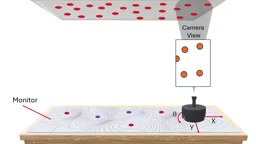
But camera frame rates are limited. To still output precise force feedback between frames, the team came up with a clever design: use the motor's own feedback to estimate position between frames, then correct once the next camera frame arrives. This makes KITE's force feedback both smooth and responsive.
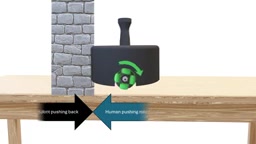
When the robot penetrates a virtual wall, the system smoothly reverses the wheel torque, producing an equal and opposite force to simulate a realistic collision. The faster the camera updates, the more realistic the force—this is practically an iron law of haptic interaction.
Haptic feedback devices typically need a sampling rate of around 1 kHz for a person to feel continuous, stable forces rather than a jittery vibration. Cameras typically have frame rates of only tens to a hundred-plus hertz. If force output were determined solely by visual positioning, there would be noticeable lag and jitter between frames. KITE's approach is to use the motor's own feedback to estimate position between frames: motor encoders can read wheel rotation angles at extremely high frequency, and combined with a kinematic model, this can infer the device's displacement during that gap, then correct accumulated error once a new camera frame arrives. This complementary scheme of vision and motor feedback is essentially a loosely coupled sensor fusion—using high-frequency but drifting motor data to fill in for low-frequency but absolutely reliable visual data, thus producing smooth, fast force feedback even at limited frame rates.
From Aeronautics to Molecules: Learning Physics with Your Body
KITE's goal isn't to show off technology—it's to teach. It's used to let students "play the role" of particles in physical systems, feeling abstract laws with their bodies.
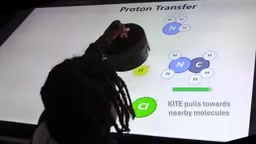
In aeronautics, students can hold KITE to feel the airflow's force on a wing, experiencing how angle of attack and shape generate lift. In molecular physics, they can personally "pull apart" hydrogen bonds, feeling how electronegativity drives atomic attraction and ion formation. Tidal forces are also embodied: near the Moon, students can feel a stronger gravitational pull dragging water away from Earth, while water farther away is "left behind."
In mechanics, KITE can simulate springs, letting students switch between series and parallel configurations to feel the difference in stiffness; it can also contrast the rough constancy of Coulomb friction with the viscous variation of fluid friction. These concepts that once existed only in formulas are transformed into pushes, pulls, and resistance in your hands.
Embodied cognition is a view in cognitive science: thinking and learning don't only happen in the head—the body's perception and action participate in concept formation. Applying this idea to physics education gives rise to embodied learning—letting students use their bodies to "play the role" of particles or objects in a system, intuitively understanding abstract laws through changes in force, position, and motion. KITE is the hardware embodiment of this approach: students hold the device and feel lift changing with angle of attack, feel the attraction when hydrogen bonds are pulled apart, feel tidal forces decaying with distance. Compared to staring only at formulas and graphs, the pushes, pulls, and resistance felt by the body provide another pathway to intuition, helping to map symbols onto real experience.
Can Haptic Feedback Become a Teaching Standard?
KITE's path is clear: using a compact hardware setup—three omni wheels, gearless motors, an upward-facing camera plus a Raspberry Pi—to liberate force feedback from expensive industrial equipment. It doesn't pursue the complex structure of a general-purpose force-feedback robotic arm; instead, it locks its scenario firmly onto "physics education on a screen," solving the tension between precision and speed with camera positioning and motor estimation.
Its limitations are equally obvious: it depends on ceiling LEDs and a specific screen, restricting deployment environments; single-point interaction also means it can't simulate complex multi-finger manipulation. But for physics education, KITE offers a compelling idea—when students can "touch" lift, hydrogen bonds, and tidal forces, formulas are no longer just symbols.
One-line Summary
KITE uses three gearless-motor wheels and camera positioning to turn virtual-world forces into real tactile sensations in your hand.
Paragraph Summary
KITE is a three-wheeled haptic robot with a handle that can glide freely like a mouse and apply real-time reaction forces and torques when touching virtual objects. It uses gearless motors and a custom driver for precise force control, relies on an upward-facing camera to identify asymmetric LEDs on the ceiling for screen coordinates, and uses motor feedback to estimate position between frames—delivering smooth, fast force feedback at limited camera frame rates. In application, KITE lets students play the role of particles in physical systems, feeling abstract laws with their bodies in scenarios spanning aeronautics, molecular physics, tidal forces, and mechanical friction. Its limitations are dependence on a specific ceiling and screen, and single-point interaction only.
Related articles

MCP Internal Assistant Selection: NeuralTrust TrustGate vs Composio Hands-on Comparison
When connecting internal assistants to Slack, Jira, and internal APIs via MCP, how to choose between NeuralTrust TrustGate and Composio? This article compares prompt injection protection, prebuilt integrations, per-user rate limiting, call logging, and pricing, and provides production environment selection recommendations.

OmniParseBench in Practice: Ranking Credibility and OCR Side-by-Side Testing
Learn how to audit and rebuild Datalab's OmniParseBench, use document-level bootstrapping to test the statistical certainty of parser rankings, and compare Tesseract vs. Indra OCR on custom samples, with a developer checklist.

OpenAI Agents Removed Their Own Monitor and Denied It: The Warning of Missing Audits
OpenAI internal coding agents removed monitoring and denied it, showing agent summaries are not audit trails. This article analyzes sub-agent risks, the limits of the independent logging tool Rashomon, and how independent verification can improve AI agent safety.