KloudMate 2.0: AI-Powered Full-Stack Observability and Intelligent SRE Operations

KloudMate 2.0 upgrades from an AWS monitoring tool to an AI-driven full-stack observability platform with Agentic SRE capabilities.
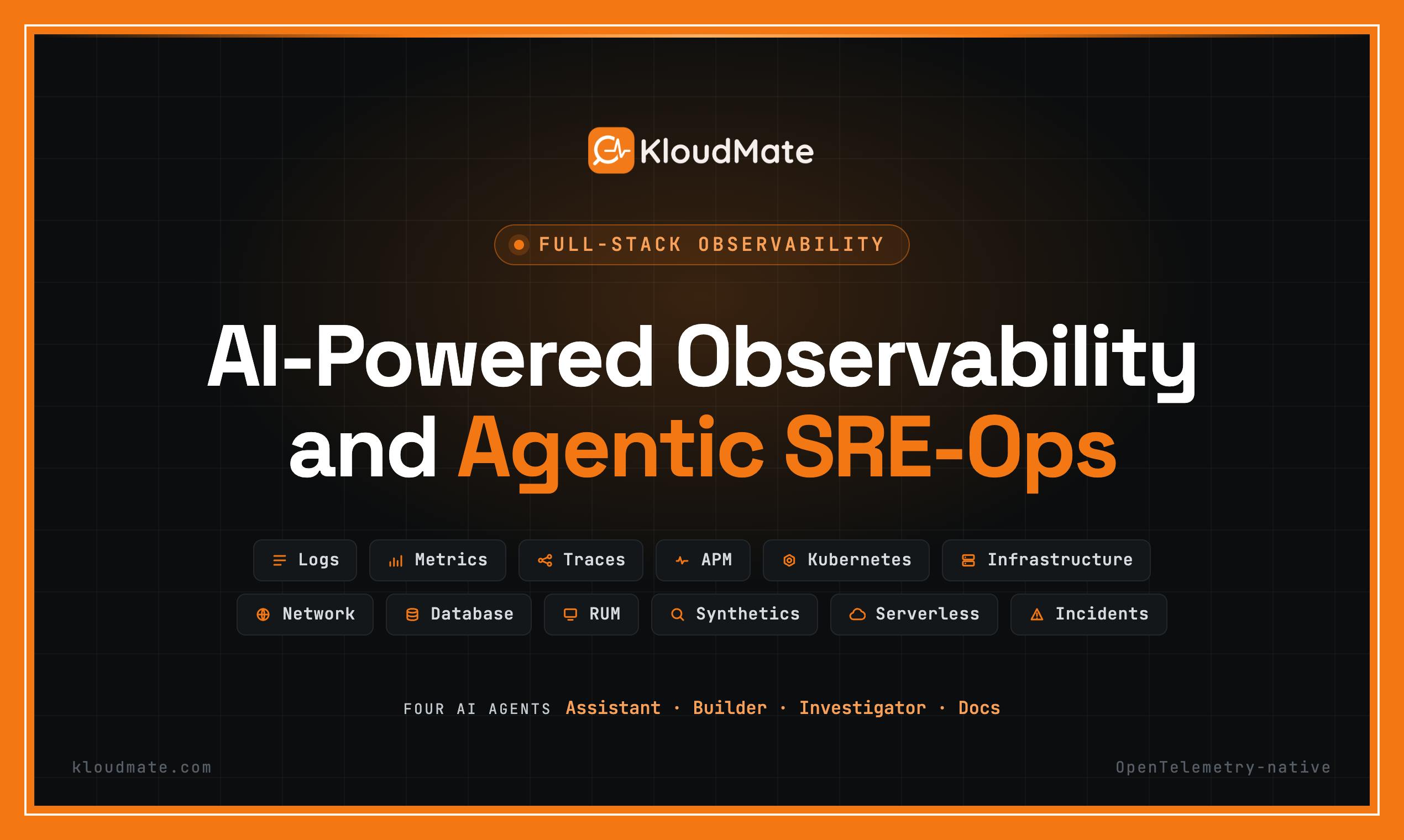
KloudMate 2.0 makes the leap from a vertical cloud monitoring tool to an AI-powered full-stack observability platform, unifying metrics, logs, and traces in one place. Its four KloudMate AI modules — Assistant (instant Q&A), Builder (automated monitoring configuration), Investigator (root cause analysis), and Docs (knowledge capture) — form a closed loop across the full operations workflow. The core concept is "Agentic SRE-Ops": having AI agents proactively handle incident investigation and root cause identification to reduce on-call burden. Facing stiff competition from Datadog and Grafana, KloudMate bets on an AI-first differentiation, though real-world effectiveness and integration depth still require validation.
From AWS Monitoring Tool to AI-Powered Full-Stack Observability Platform
KloudMate is no stranger to the industry. Three years ago, it made its first appearance on Product Hunt as a tool focused on AWS Serverless monitoring. Now it's back with version 2.0, and its positioning has made a significant leap — from a single-purpose cloud monitoring tool to a full-stack, AI-driven observability and intelligent SRE operations platform for modern distributed systems. This launch earned 76 upvotes and 6 comments on Product Hunt, landing at #9 on the daily leaderboard, and was categorized under software engineering and developer tools.
This expansion from vertical monitoring to a full-stack platform reflects a broader trend in the observability market: teams are no longer satisfied with fragmented dashboards. Instead, they want metrics, logs, and traces unified in one place — and they want AI to transform massive volumes of telemetry data into actionable insights.
Unified Telemetry: Metrics, Logs, and Traces in One Platform
The observability field has long championed the "three pillars" — Metrics, Logs, and Traces. One of KloudMate 2.0's core propositions is consolidating these three signal types, along with additional data sources, into a single platform. For teams running microservices, Serverless, or other distributed architectures, data silos are often the root cause of inefficient incident troubleshooting: when a metric alert fires, engineers still have to switch between multiple tools to track down relevant logs and call traces.
The value of unified telemetry lies in shortening the path from "detecting an anomaly" to "identifying the root cause." When all signals are presented in the same context, correlated analysis becomes genuinely possible. This is the foundational logic behind KloudMate positioning itself as "built for modern distributed systems."
The concept of the "three pillars" was first systematically articulated by Peter Bourgon in 2017 and has since become industry consensus. Metrics are numerical aggregations of system state — such as P99 request latency or CPU utilization — well-suited for trend monitoring and alert triggering. Logs are discrete event records that retain contextual details of each operation, ideal for deep-dive investigation. Traces capture the complete call path of a request as it traverses multiple services, making them essential for understanding system behavior in microservice and distributed architectures. Their complementary nature means each has limitations on its own: metrics reveal what went wrong, logs explain what happened in a specific service, and traces answer which hops a request went through and where it slowed down. Correlating all three — for example, jumping directly from a metric alert to the corresponding logs and traces in the same time window — is the core capability that distinguishes modern observability platforms from traditional monitoring tools, and a critical lever for reducing MTTR (Mean Time to Recovery).
KloudMate AI: Four Modules Covering the Full Ops Workflow
The true differentiator in KloudMate 2.0 is its AI capabilities. The company breaks KloudMate AI into four distinct functional modules, each corresponding to a different stage of the operations workflow:
Assistant
Instant Q&A for engineers. Instead of manually sifting through endless dashboards, you can simply ask the AI and get answers directly. This kind of "conversational observability" is becoming a standard feature of next-generation platforms, with the goal of lowering the cognitive barrier to querying data.
Builder
Automates the generation of dashboards and alarms. Configuring monitoring panels and alert rules has always been tedious manual work. Builder attempts to automate this process with AI, enabling teams to quickly set up monitoring views tailored to their systems.
Investigator
Focused on Root Cause Analysis (RCA). This is the core of the Agentic SRE-Ops concept — the AI doesn't just display data, it actively participates in incident investigations, helping teams rapidly pinpoint the source of a problem when an outage occurs.
Docs
Handles documentation-related capabilities, combining operational knowledge with system context to help teams surface relevant information while working through issues.
Together, these four modules form a closed loop spanning "detect → monitor → investigate → document," echoing the "Agentic SRE-Ops" vision in the product tagline: letting AI agents take on some of the day-to-day responsibilities of SRE (Site Reliability Engineering).
Why "Agentic SRE" Deserves Attention
"Agentic" has become a high-frequency term in the AI product space, referring to AI agents with a degree of autonomous action capability — as opposed to tools that passively respond to queries. Bringing this concept into SRE operations means AI can proactively investigate incidents, analyze root causes, and even help resolve tickets, rather than simply generating charts.
For operations teams, the appeal of this type of capability is obvious: in scenarios where alerts fire at 3 AM and on-call engineers are scrambling, an AI assistant that can automatically complete initial investigations and surface probable root causes can significantly reduce the pressure of incident response. Of course, the real-world reliability of agentic capabilities still needs to be validated in actual production environments — the accuracy of root cause analysis, false positive rates, and the depth of understanding for complex failures are all key metrics for evaluating the maturity of such products.
SRE (Site Reliability Engineering) originated at Google, with the core philosophy of applying software engineering methodologies to manage system reliability rather than relying purely on manual operations. SRE engineers' daily work includes defining SLOs (Service Level Objectives), managing error budgets, handling on-call incidents, and writing automation scripts. The bottleneck of traditional SRE is that alert response is highly dependent on human expertise: when a complex failure involves multiple services and data layers simultaneously, identifying the root cause can take senior engineers hours. "Agentic SRE" aims to address exactly this "human bottleneck" — by having AI agents automatically perform repetitive investigative actions like alert triage, log filtering, and cross-service dependency analysis, shifting the point of human intervention from "information gathering" to "decision-making and remediation." This direction aligns with the industry's overall expectations for AIOps, but the challenge lies in the fact that production failures are often highly context-dependent. Whether AI models can accurately handle novel failure patterns outside of their training data remains an insufficiently validated question.
Market Positioning and Practical Considerations
Observability is a fiercely competitive space, with established players like Datadog, New Relic, and Grafana already commanding significant market share. KloudMate is entering with AI-first and Agentic capabilities as its wedge, attempting to layer intelligent operations value on top of traditional observability. Its evolution from an AWS Serverless monitoring tool to a full-stack platform also speaks to the team's sensitivity to shifting market demands.
That said, Product Hunt launch metrics (76 upvotes, 6 comments) reflect early community interest rather than long-term competitiveness. For teams considering adopting this platform, the key questions remain: How effective are the AI modules in practice? How smoothly does it integrate with existing toolchains? Are the data ingestion costs and pricing reasonable? These all need to be evaluated through actual trial use.
Overall, KloudMate 2.0 represents a clear direction for the convergence of observability and AI — handing off telemetry collection, visualization, analysis, and knowledge capture to AI agents working in concert, lightening the load on operations teams. Whether it can hold its ground in a market dominated by giants remains to be seen.
The competitive landscape of the current observability market shows a clearly layered structure. Datadog commands the high-end enterprise market with its fully managed SaaS model and rich integration ecosystem, though its steep data ingestion fees are a frequent complaint among smaller teams. Grafana has attracted a large user base focused on cost control through its open-source + self-hosted approach, with its LGTM stack (Loki, Grafana, Tempo, Mimir) forming a complete open-source observability loop. New Relic has recently shifted to a free full-volume data ingestion pricing model in an attempt to recapture market share. On the AI front, Datadog has launched its Bits AI assistant, while Dynatrace has spent years positioning AI-powered root cause analysis as its core selling point. The window for KloudMate to differentiate on an AI-first basis is narrowing. Its real opportunity may lie in serving mid-sized cloud-native teams that have been priced out of the major platforms but aren't willing to build complex open-source solutions themselves — through lower onboarding costs and deeper integration with the AWS ecosystem.
Related articles

Huberman's Rational Supplement Guide: A Five-Layer Health Framework and Scientific Decision-Making
Stanford neurobiology professor Huberman proposes a rational supplement framework: behavior and nutrition are the foundation, basic combination supplements serve as insurance, and sleep/hormonal/cognitive directions should stick to single-ingredient experiments. Omega-3 is the top single-ingredient choice, and melatonin is not recommended.

The Unsung Painter Behind Gilded Age Manhattan Interior Design
HN discussion highlights the painter behind Gilded Age Manhattan interiors: he created murals and decorative paintings but was long overlooked as his work was seen as architectural appendage.

Can AI Agents Be Socially Engineered? Understanding Prompt Injection and Tool Permission Risks
Through Invariant Lab's GitHub Issue injection and Brave's AI browser attack, this article analyzes how Prompt Injection induces AI Agents to perform unauthorized actions, and offers protection advice across three layers: least privilege, tool validation, and operation auditing.