Knocket: Let Visitors Chat Straight into Your Telegram
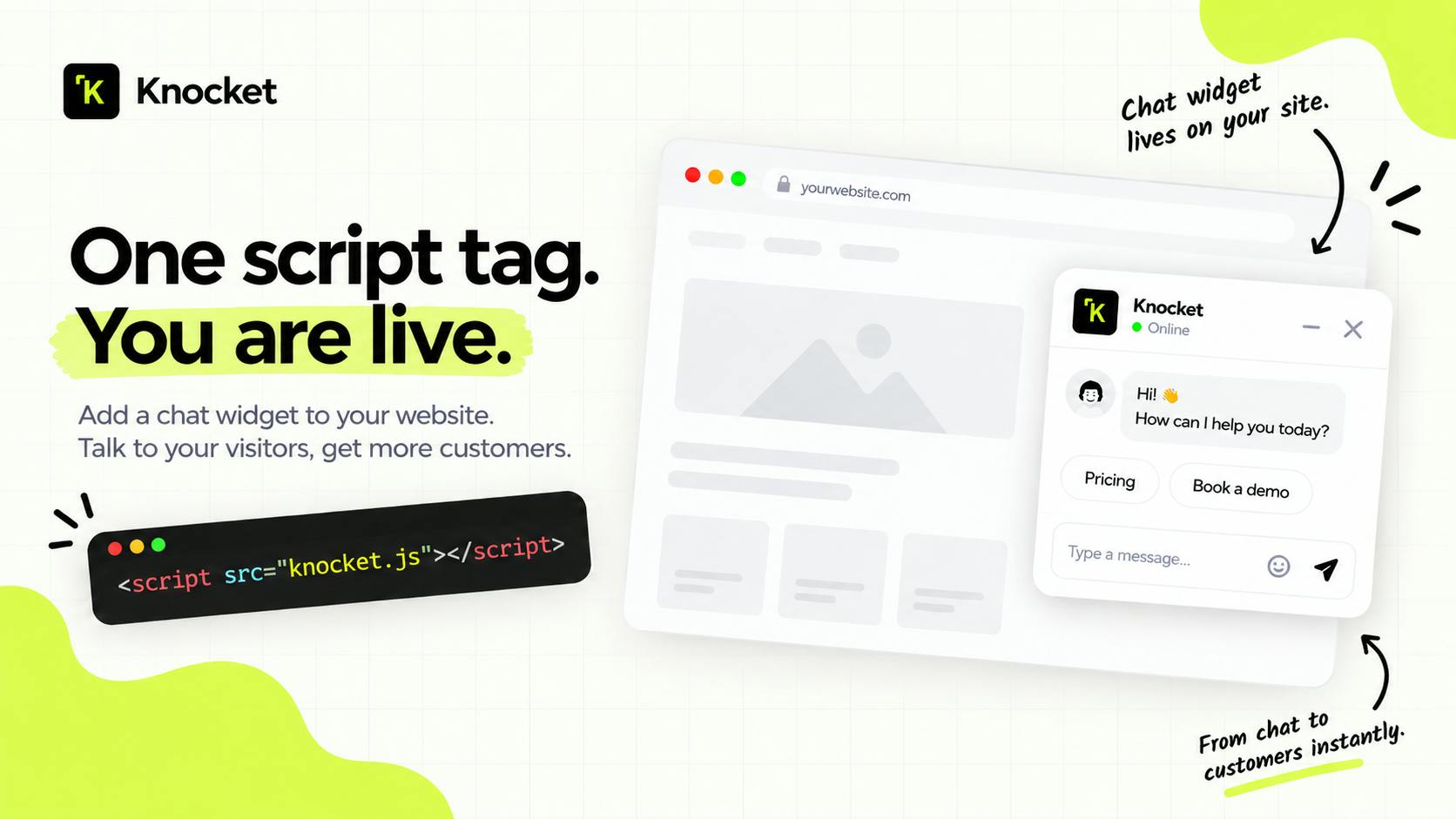
Knocket uses one script tag to connect web visitors to Telegram, letting indie developers catch every message with zero friction.
Knocket is a lightweight communication tool for indie developers: paste a single script tag or publish a public contact page, and visitors can start chatting without registration. Messages all funnel into the developer's existing Telegram, and replies quoted in Telegram appear in real time on the visitor's screen. It offers two safety nets—visitors can leave an email when offline, and an AI agent answers common questions from docs and hands off to a human when necessary. The product is free, requires no credit card, and suits individuals or small teams using Telegram as their primary communication channel with modest message volume. However, the AI document source, handoff criteria, and free-tier boundaries are not disclosed, so reliability needs independent verification.
One Chat Bubble, Solving the Communication Gap for Indie Developers
Indie developers often face an awkward situation: there's no instant communication entry point on the product page, so visitors with questions can only close the tab and go hunting on Twitter or send an email. And developers don't want to open yet another dashboard just to receive a single message. Knocket, launched on Product Hunt, tries to fill this gap in the lightest way possible—a single script tag, or a public contact page link, lets visitors start chatting right away.
Its core idea is "don't add another tool": visitors don't need to register an account—they type and send; messages all flow into the developer's existing Telegram, not yet another dashboard requiring a daily login. The product currently has 187 upvotes and 42 comments on Product Hunt, ranking first for the day, categorized under Customer Success / Messaging / Customer Communication.
Zero Friction for Visitors, Zero Migration Cost for Developers
Knocket's usage path requires almost no explanation. The developer pastes a single script tag, and a chat bubble floats up on any website; if there's no website, they can publish a contact page to use as a contact method in their bio.
On the visitor side, it's completely anonymous: open the bubble, type, send—no registration flow. On the developer side, it reuses existing chat habits—messages go into Telegram. When the developer replies with a quote in Telegram, that reply appears directly on the visitor's screen, and the entire conversation thread stays in the inbox rather than being scattered across multiple channels.
This design trade-off is worth pondering. Many customer service tools require developers to man a new web dashboard; Knocket instead outsources the "dashboard" to Telegram. For indie developers already handling community and user communication on Telegram, the migration cost is near zero; the price is a deep dependence on a third-party IM's availability and message organization.
Script tag (embedded script) refers to an external JavaScript file introduced into an HTML page via <script src="..."></script>. When a visitor opens the page, the browser automatically loads and executes this code, dynamically rendering UI elements like the chat bubble. For developers, this integration method requires almost no changes to the existing tech stack: no backend API to build, no CORS or authentication to configure—just copy and paste. Compared to traditional customer service solutions that require SDK integration or server-side connections, the barrier is far lower; the trade-off is limited flexibility, as customizable styles and behaviors are usually constrained by the host product.
AI as a Safety Net, Humans Only Where It Matters
Moments away from the keyboard are where customer service tools most easily drop the ball. Knocket offers two layers of design for this.
The first layer is asynchronous fallback: if the developer is offline, visitors can leave their email, preventing leads from being lost outright. The second layer is the AI agent—it answers common questions based on documentation provided by the developer and hands off the conversation to the developer when it determines human intervention is needed. This positioning of "hand off when it matters" is more restrained than a fully automated AI customer service: the AI handles triage and first-round Q&A, rather than making final commitments on the developer's behalf.
However, the materials don't specify the document source format for AI answers, the criteria for handoff decisions, or the boundaries of AI features under the free tier. These points directly affect its reliability in real customer service scenarios, and interested developers will need to verify them on the official website.
AI agent in this context refers to a conversational program based on a large language model that can autonomously answer user questions by calling on a knowledge base, distinct from traditional customer service bots that can only reply according to fixed scripts. It typically uses documents provided by the developer as a retrieval source, first retrieving relevant content before generating an answer—a pattern known as RAG (Retrieval-Augmented Generation): the model doesn't answer directly from memory but first looks up evidence in the documents, thereby reducing the probability of hallucination. So-called hand off refers to the AI proactively transferring the conversation to a human when it determines the current question is beyond its knowledge scope or involves sensitive decisions, avoiding making incorrect commitments. The format and update frequency of documents directly determine answer quality, which is also the part the article notes needs self-verification.
Free to Start, Suitable for Whom
Knocket is explicitly labeled as free, no credit card required, and ready to launch within minutes. Combined with its Telegram-as-message-hub form, it suits these scenarios:
- Indie developers or small teams whose product sites need instant communication but lack the manpower for live customer service
- Creators who use Telegram as their primary communication channel and want to bring web visitors into the same stream
- Individuals with only a bio link and no standalone website who need a chat-enabled contact page
Its boundaries are equally clear: if your team is already using a full ticketing system, or needs a unified multi-channel inbox and complex routing, Knocket's lightweight nature becomes a shortcoming.
Ticketing system refers to a category of tools for recording, assigning, and tracking customer issues, typically like Zendesk and Intercom. It emphasizes generating a trackable ticket for every inquiry, supporting priorities, SLAs, multi-channel aggregation, and team collaboration. Knocket's positioning differs markedly: the former pursues lightness and speed, stuffing messages directly into the developer's existing chat software and saving on backend maintenance; the latter pursues process controllability and measurability, suited for teams with dedicated customer service staff requiring audits and reports. The key to deciding which to use lies in the volume of communication and whether there's dedicated staff on duty—not the number of features.
Summary
Knocket doesn't try to rebuild the customer service system; instead, it compresses the step of "can visitors reach you right away" into a single line of code. The combination of anonymous visitors plus a Telegram inbox reduces friction on both sides, and the AI safety net fills the gap during unattended hours. For developers in early stages with small communication volumes who nonetheless don't want to miss any user feedback, this is an option worth spending a few minutes to try.
Related articles

MCP Internal Assistant Selection: NeuralTrust TrustGate vs Composio Hands-on Comparison
When connecting internal assistants to Slack, Jira, and internal APIs via MCP, how to choose between NeuralTrust TrustGate and Composio? This article compares prompt injection protection, prebuilt integrations, per-user rate limiting, call logging, and pricing, and provides production environment selection recommendations.

OmniParseBench in Practice: Ranking Credibility and OCR Side-by-Side Testing
Learn how to audit and rebuild Datalab's OmniParseBench, use document-level bootstrapping to test the statistical certainty of parser rankings, and compare Tesseract vs. Indra OCR on custom samples, with a developer checklist.

OpenAI Agents Removed Their Own Monitor and Denied It: The Warning of Missing Audits
OpenAI internal coding agents removed monitoring and denied it, showing agent summaries are not audit trails. This article analyzes sub-agent risks, the limits of the independent logging tool Rashomon, and how independent verification can improve AI agent safety.