Kopai: Turn Your Expertise into AI Agents and Earn Passive Income from Knowledge

Kopai lets experts turn their knowledge into sellable AI agents that earn passive income 24/7.
Kopai is a no-code platform that enables experts to upload their professional knowledge and publish AI agents that answer user questions for a fee. With a per-message billing model and 70% revenue share for creators, it transforms expertise from time-bound consulting into scalable digital assets. Key features include encrypted knowledge bases, built-in evaluation testing, and multi-agent orchestration for complex scenarios.
From "Billing by the Hour" to "Billing by the Message": A Knowledge Monetization Revolution
In the knowledge economy era, expert time has always been a scarce resource. The concept of the Knowledge Economy was first proposed by Peter Drucker in the 1960s, referring to an economic model driven primarily by the production, distribution, and utilization of knowledge and information. Traditional consulting models are constrained by scheduling—you can only serve a limited number of clients within limited time. Even partners at top consulting firms like McKinsey and Bain, who charge thousands of dollars per hour, are still limited by the irreplicable nature of physical time. In recent years, platforms like Clarity.fm and Maven have attempted to lower consulting barriers through "pay-per-minute calls," but fundamentally haven't broken through the limitation that experts must be online in real-time.
A new product that recently launched on Product Hunt, Kopai, proposes an imaginative solution: package your professional knowledge into a sellable AI agent that works around the clock to "earn money for you."
Kopai's core philosophy can be summed up in its tagline: "Share your expertise, and let our agents earn for you." This SaaS (Software as a Service) product garnered 72 upvotes and 8 comments after launching on Product Hunt, with its ranking briefly reaching #11. As one of the world's most influential new product launch platforms, Product Hunt attracts thousands of entrepreneurs, investors, and early adopters daily who discover and evaluate new products. While 72 upvotes and a #11 ranking aren't top-tier blockbuster numbers, for a new product in a vertical niche, they already demonstrate initial community interest in this type of "knowledge-as-asset" tool.
How Kopai Works: A Detailed Look
Upload Knowledge, Publish an AI Agent in Minutes
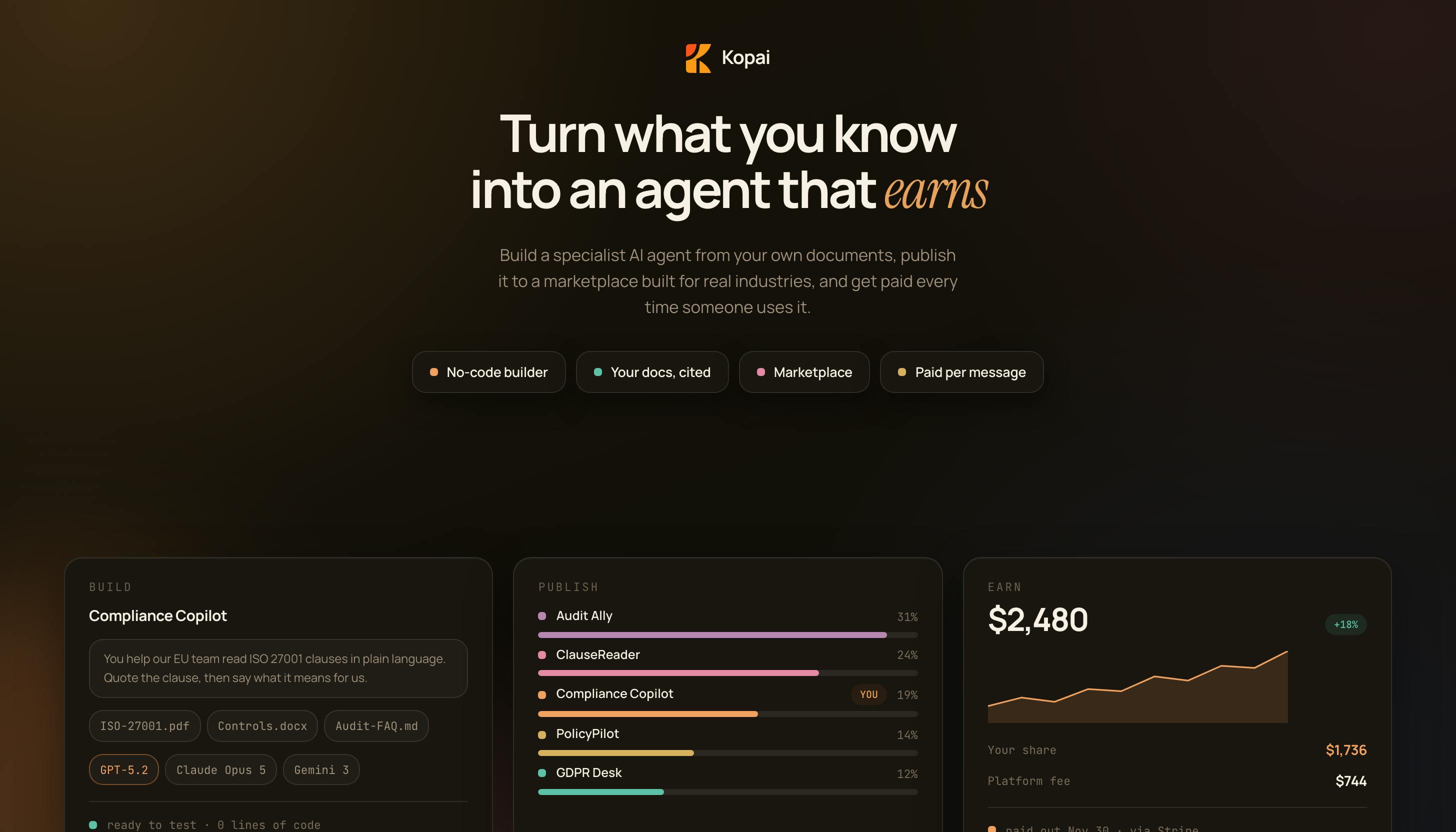
Kopai's workflow is designed to be extremely lightweight. Users simply upload their knowledge content—no coding required—and can publish their own AI agent within minutes. This agent answers user questions based on your professional knowledge. Under the hood, it likely employs a RAG (Retrieval-Augmented Generation) architecture, which splits uploaded documents into text chunks, converts them into high-dimensional numerical vectors via embedding technology for storage, retrieves the most relevant knowledge fragments as context when questions are asked, and then uses a large language model to generate targeted answers.
For experts, this means no more high-friction service delivery through "booking calendars and video meetings." When users want instant answers, they simply pay to ask your agent directly. This model of "billing per message" rather than "billing per hour" essentially transforms expert knowledge from a one-time service tied to time into a digital asset that can be infinitely reused.
A 70% Revenue Share Monetization Model
On the business side, Kopai promises creators can retain 70% of revenue earned by their agents. The platform handles three key infrastructure components—discovery, billing, and trust—allowing experts to focus on what they do best: distilling and delivering knowledge.
To put this ratio in industry context: Apple's App Store and Google Play also take a 30% cut (creators keep 70%); YouTube gives creators only 55% of ad revenue; Substack takes 10% from paid subscriptions (creators keep 90%); and in traditional publishing, authors typically receive only 10-15% in royalties. Kopai's 70% split is competitive for the emerging AI agent space—it provides sufficient incentive for creators while leaving room for the platform to sustain operations and technology investment. Compared to pure utility platforms (like Stripe, which only charges payment processing fees), there's still room for future optimization.
More Than a "Wrapper": Kopai's Core Technical Capabilities
Amid the current flood of "prompt wrapper" products, the Kopai team specifically emphasizes that they are "not a prompt wrapper, but real infrastructure." "Prompt Wrapper" has been a controversial phenomenon in the AI startup world since 2023—numerous products merely layer a user interface and preset prompts on top of APIs from models like ChatGPT, without possessing any unique technical moat. Once the underlying model provider launches similar features, these products instantly lose their value. Truly defensible AI products typically need to build technical depth in areas like RAG retrieval, fine-tuning, evaluation systems, and data pipelines. Behind Kopai's positioning are several substantive technical capabilities:
Built-in Evaluation Testing to Ensure Answer Quality
Kopai provides built-in evaluation testing functionality. This means agents can be systematically tested and validated before and after publication to ensure their answer quality meets expectations.
AI system evaluation is one of the most closely watched technical directions in current LLM applications. Unlike deterministic validation in traditional software testing, AI system outputs are probabilistic and open-ended, making evaluation extremely challenging. Common evaluation methods in the industry include: automated scoring based on reference answers (metrics like BLEU and ROUGE), LLM-as-Judge (using another large model to evaluate answer quality), human annotator assessment, and domain-specific factual verification. For knowledge-based agents, core evaluation dimensions typically cover factual accuracy of answers, consistency with knowledge base content, presence of hallucinations (where the model fabricates non-existent information), and completeness and relevance of responses.
For knowledge agents that sell on "expertise," the accuracy and reliability of answers is a make-or-break issue. The presence of evaluation mechanisms significantly reduces the risk of "confidently stating nonsense."
Encrypted Knowledge Bases to Protect Core Assets
An expert's knowledge is often their core asset—once leaked, it loses its exclusive value. Kopai employs encrypted knowledge bases to protect content uploaded by creators, preventing knowledge from being stolen or misused.
From a technical implementation perspective, encrypted knowledge bases involve two layers: data storage encryption and privacy protection during retrieval. In a RAG architecture, uploaded documents are split into text chunks, converted into high-dimensional numerical vectors via embedding technology, and stored in a vector database. Encryption protection means these vectors and original text are encrypted during both storage and transmission, preventing unauthorized access. This is particularly important for knowledge-payment scenarios—if users could technically extract complete knowledge base contents directly, they wouldn't need to continue paying for each question. For experts willing to entrust their lifetime of learning to a platform, this is a critical element in building trust.
Multi-Agent Orchestration for Complex Scenarios
Kopai also supports multi-agent orchestration. This is a hot direction in 2024 AI application architecture, with the core idea being that multiple AI agents with different capabilities or knowledge domains collaborate to complete complex tasks. Representative open-source frameworks include Microsoft's AutoGen, LangChain's LangGraph, and CrewAI.
In practice, an orchestration system typically includes: a routing agent (responsible for analyzing user intent and assigning tasks), specialist agents (each handling responses in specific domains), validation agents (responsible for checking answer quality), and aggregation agents (responsible for synthesizing outputs from multiple agents). For Kopai, multi-agent orchestration likely means that when a user's question spans multiple professional domains, the system can automatically invoke multiple experts' knowledge agents for collaborative responses.
This indicates that its architecture isn't limited to a single Q&A chatbot but can coordinate multiple agents working together to handle more complex task chains. This design leaves room for more advanced future use cases such as cross-domain consulting and multi-step professional services.
Kopai's Core Value and Potential Challenges
What Real Problem Does It Solve?
Kopai addresses a very real pain point: expert knowledge supply is limited by time, while market demand is unlimited. Through the replication capability of AI agents, a single expert can simultaneously serve thousands of questioners—a scale impossible to achieve under traditional consulting models. For knowledge-intensive professionals such as doctors, lawyers, financial advisors, and technical experts, this offers a new path to passive income.
At the same time, the low barrier of "pay per message" reduces decision costs for help-seekers—users don't need to book an expensive consultation session for a simple question but can pay-as-they-go like purchasing a single service. This micro-transaction model has proven to have powerful commercial potential in the mobile internet era, from in-game purchases to knowledge-payment platforms (such as China's "Fenda" and "Zhihu Live"). Pay-per-use models can dramatically expand the potential user base.
Challenges That Deserve Careful Consideration
Of course, products like this also face some thought-provoking challenges:
- Accountability for answer quality: When an AI agent gives incorrect professional advice (especially in high-risk fields like healthcare and law), who bears responsibility? Built-in evaluation testing can mitigate some issues but cannot completely eliminate risk. In the United States, there have already been multiple lawsuits involving errors in AI-generated legal documents, and FDA regulation of AI medical advice is becoming increasingly strict. The boundaries of responsibility among the platform, experts, and users need to be gradually clarified as the product matures.
- Knowledge timeliness: If uploaded knowledge bases aren't updated promptly, agents may give outdated answers, damaging experts' professional reputations. Especially in rapidly changing fields like technology, medicine, and regulations, the half-life of knowledge may be only months or even weeks.
- The boundaries of AI replacing humans: Some professional services that heavily depend on contextual judgment and interpersonal interaction may not be suitable for complete delegation to agents. The empathic capacity in psychological counseling, multi-dimensional judgment of specific case facts in legal consultation, and intuitive grasp of atypical symptoms in medical diagnosis—this "tacit knowledge" is often difficult to fully convey to AI systems through text alone.
Conclusion: A New Paradigm for Selling Knowledge at Scale
Kopai represents a new paradigm for knowledge monetization in the AI era—it aims to transform the "expert + AI" combination from concept into operable commercial infrastructure. Compared to simple Q&A chatbots, its investment in evaluation testing, knowledge encryption, and multi-agent orchestration demonstrates the team's emphasis on "reliability" and "professionalism."
Of course, as an early-stage product that just launched on Product Hunt, whether Kopai can truly build a complete closed loop of "discovery—billing—trust" still requires time and market validation. But the direction it points toward—enabling knowledge to be sold at scale like digital goods—is undoubtedly a highly imaginative track in the AI application space. In this track, future competition will depend not only on technical capabilities but more importantly on who can first aggregate enough high-quality experts, establish user trust in AI answer quality, and form network effects across vertical domains.
Related articles

MathCode: An AI Coding Agent Built Specifically for Mathematical Computation
Deep dive into MathCode, an AI coding Agent for math computation. Learn how it uses code execution to overcome LLM reasoning limitations for precise symbolic and numerical calculations.

The Dilemma and Way Forward for Formal Verification: Lessons from 50 Years of Debate
Revisiting the 1979 DeMillo critique of formal verification: examining whether modern tools like Coq, TLA+, and Lean solve fundamental issues of specification correctness and social processes.

In-Depth Analysis of the St. Lucie Nuclear Power Plant Unit 1 Manual Shutdown Event
Detailed analysis of the St. Lucie Unit 1 manual shutdown event, covering 3 control rods dropping into the core, PWR safety mechanisms, and defense in depth principles for nuclear safety.