kosa8: The Saveable, Forkable, and Rollback-Ready Sandbox Built for AI Agents

kosa8 secures AI agents with VM isolation, human approval gates, one-second rollback, and tamper-proof audit logs.
As AI agents move from the lab into enterprise production, threats like prompt injection, malicious tool servers, and data exfiltration grow in severity. kosa8 addresses this with sandboxed VMs per agent, default-off networking, one- or two-person approval for risky operations, ~1-second environment rollback, parallel fork execution across up to eight branches, and real-time hash-chain audit logs streamed to SIEM. It also supports local models, FIPS-compliant builds, and air-gapped deployment for regulated industries.
The Security Dilemma Facing AI Agents
AI agents are moving from experimentation into production — and the risks are multiplying just as fast. Picture this: an agent with file system access accidentally wipes a production database, a stealthy prompt injection quietly exfiltrates sensitive data, or a trusted AI tool turns against your own systems.
Malicious MCP servers, poisoned packages, leaked credentials, unmonitored Shadow AI, and the inability to trace what an agent actually did after the fact — these risks compound into one of the most difficult engineering challenges of deploying autonomous agents today. kosa8 (COSA 8) is designed to address exactly this set of problems.
Prompt Injection is one of the most covert threats facing AI agents today. Attackers embed malicious instructions in external content the agent will process — web pages, documents, emails — tricking it into performing unauthorized actions such as forwarding conversation history to a third party, modifying files, or making requests on the user's behalf. Unlike traditional software vulnerabilities, prompt injection exploits the model's inherent tendency to follow natural language instructions, making it difficult to block with conventional input filtering. MCP (Model Context Protocol) is an open protocol proposed by Anthropic that allows AI models to call external tools and data sources through a standardized interface; malicious MCP servers are rogue endpoints disguised as legitimate tool services that can inject harmful instructions or steal context data when an agent connects. Shadow AI refers to AI tools used by employees without approval from IT or security teams — because they operate outside oversight, their data handling behavior is completely opaque to the organization.
One "Sealed Machine" Per Agent
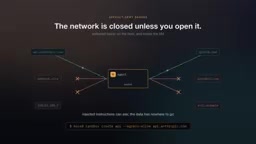
kosa8's core design philosophy is isolation: every AI agent gets its own dedicated, sealed virtual machine (VM) with its own kernel. This means everything an agent does is confined to its own environment — it cannot reach across boundaries to affect the host system or other agents.
Unlike lightweight container isolation, a true VM with its own kernel offers much stronger boundary protection. Networking is off by default and only enabled with explicit authorization — fundamentally cutting off the channels for data exfiltration and remote attacks. Each agent and each tool server is sandboxed independently, so even if an MCP server behaves maliciously, the blast radius is contained within its own sandbox.
High-Risk Operations Require Human Approval
A fully autonomous agent operating in production is dangerous. kosa8 introduces a human-in-the-loop approval mechanism: when an agent attempts to execute a high-risk operation, the system pauses and waits for confirmation from one or even two people before proceeding.
This two-person rule design draws from operational standards in high-security fields like finance and defense, adding a human checkpoint for critical actions. It strikes a balance between automation efficiency and safety — teams can enjoy the productivity benefits of agents without surrendering control entirely to unpredictable model outputs.
Rollback and Fork: Time Control Over Execution
One of kosa8's most distinctive capabilities is temporal control over agent execution state. If something goes wrong, you can rewind the environment to a previous state in roughly one second — no manual cleanup required.
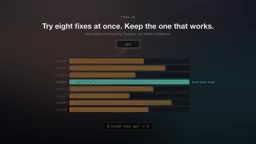
Going further, it supports forked execution: you can launch up to eight different fix attempts simultaneously, letting multiple agents explore different solutions in parallel, then keep only the one that actually works. This save-fork-rollback workflow dramatically reduces the cost of trial and error, making debugging and experimentation far more manageable — somewhat like version control for code, except it applies to an agent's entire runtime environment.
Full Audit Trail and Compliance
"What exactly did the agent do?" is an unavoidable accountability question in production deployments. kosa8 records every action in a hash chain and streams it in real time to your SIEM (Security Information and Event Management) system.
The hash chain guarantees tamper-proof audit logs — any after-the-fact modification to the records breaks the chain's integrity and leaves a detectable trace. This provides a trustworthy evidentiary foundation for security reviews, incident post-mortems, and compliance audits.
For high-security scenarios, kosa8 also offers local model support, FIPS-compliant builds, and fully air-gapped deployment options. This means organizations in sensitive industries can run agents without any external network exposure, meeting even the most stringent regulatory requirements.
SIEM (Security Information and Event Management) is the core platform of enterprise security operations, responsible for real-time collection, aggregation, and analysis of logs and events from across systems to rapidly detect anomalies and security incidents. Hash chains work similarly to blockchains: each new record incorporates the hash of the previous record in its computation, forming an interlocked chain. If someone attempts to alter a historical record, all subsequent records' hashes become invalid — auditors can detect tampering immediately. FIPS (Federal Information Processing Standards) are U.S. federal government security standards for cryptographic modules; FIPS 140-2/140-3 compliance requires software to use certified encryption algorithms and implementations, and is a common entry requirement in regulated industries such as finance, healthcare, and government. Air-gap deployment refers to a system being completely physically isolated from any external network — the highest-security deployment model for protecting extremely sensitive data.
Production-Ready Agent Infrastructure
Taken as a whole, kosa8 integrates isolation, approval workflows, rollback, and auditing into a unified platform — attempting to answer the core questions that arise when autonomous agents enter production: how to prevent runaway behavior, how to assign accountability, how to meet compliance requirements, and how to recover quickly from mistakes.
As more organizations wire AI agents into real business processes, this kind of foundational infrastructure focused on security and observability is likely to become standard for enterprise AI deployments. The direction kosa8 represents — treating agents as "untrusted entities" that require strict sandboxing, auditing, and governance — reflects a maturing industry understanding of AI security.
It's worth noting that the information above is largely drawn from product marketing materials; actual performance, compatibility, and real-world security strength remain to be validated in production environments.
Related articles

AgentCore in Practice: Connecting Custom Tools and MCP Servers to Agents
DebuggerCafe tutorial shows how to connect custom tools and MCP servers to Amazon Bedrock AgentCore agents, covering tool contract design, MCP reuse, and production concerns.

816B Parameters Scores Only 39? The Real Cost-Effectiveness of the Open-Source LLM Parameter Race
Meta's 816B Muse Spark Open scores just 39 on Artificial Analysis, while 180B Qwen3.8-Flash-Next scores 40. This article analyzes 11 open-weight models' parameters vs. scores, exploring the real impact of activated parameters, quantized size, and deployment cost.

Aerial Manipulators: The Next Step for Drones from 'Seeing' to 'Changing'
Starting from a Reddit discussion, this article analyzes the technical challenges, potential applications, and deployment bottlenecks of aerial manipulators, exploring the key challenges for drones moving from environmental perception to physical manipulation.