Kova: The Open-Source Tool for Building Presentations with Markdown
Kova is an open-source Markdown presentation tool that hit 250 GitHub Stars in three weeks.
Kova is a developer-focused open-source tool that lets you build presentations in pure Markdown, keeping content separate from styling and enabling Git-based version control. Launched publicly just three weeks ago, it quickly reached 250 GitHub Stars and attracted multiple contributors. The project also openly discusses LLM-augmented development practices, signaling a transparent and forward-thinking approach to open-source collaboration.
From Zero to 250 Stars: The Growth Story of an Open-Source Project
In the presentation tool space, PowerPoint, Keynote, and web-based tools like Slidev and Marp have long dominated the landscape. The ecosystem has a clear technical lineage: Reveal.js (2011) laid the architectural foundation for web-based slides, Remark.js was one of the earliest pioneers in combining pure Markdown with presentations, and Slidev — released by Anthony Fu in 2021 — is built on Vue.js with support for code highlighting and animations. Marp takes a lighter approach, focused on converting standard Markdown directly into slides. Both tools use the --- separator convention to divide pages, establishing a shared philosophy that "presentations are, at their core, structured text." For developers and technical writers, tools that let you write slides in pure Markdown while keeping content and style separate have always held a unique appeal.
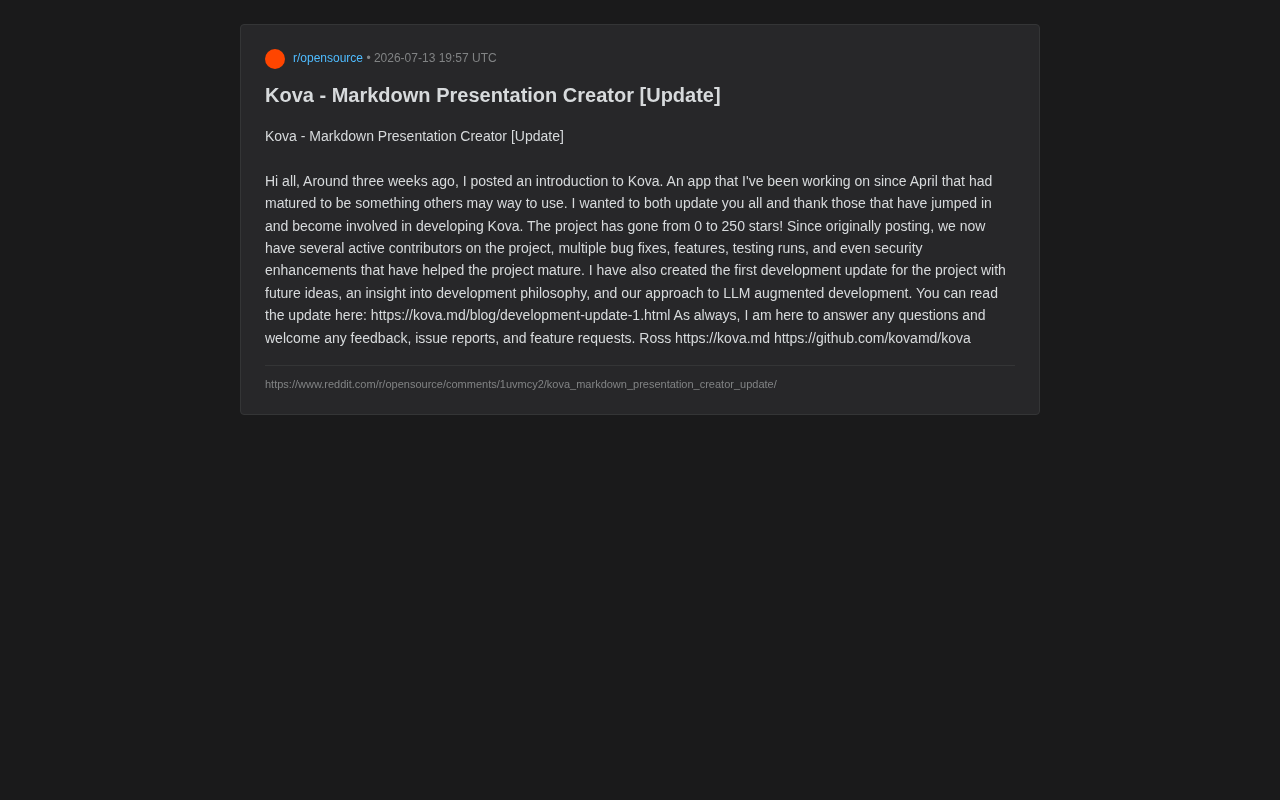
Recently, a Markdown presentation tool called Kova posted an update on Reddit and quickly caught the attention of the developer community. According to the project's author, Ross, Kova began development in April of this year and made its first public appearance about three weeks ago — since then, it has grown from 0 to 250 GitHub Stars and attracted several active contributors. For a solo-initiated open-source project, that kind of growth rate is a strong signal of community recognition.
What GitHub Stars Actually Mean: GitHub Stars are essentially a bookmarking and follow mechanism, but within the open-source ecosystem they've evolved into an important metric for measuring a project's visibility and initial community interest. GitHub's own data shows that the vast majority of public repositories have fewer than 10 stars — so 250 stars places a personal open-source project in the higher end of the long-tail distribution, representing genuine early community validation. That said, fork counts and issue activity are better indicators of deep engagement, and those are worth watching too.
![reddit source: Kova - Markdown Presentation Creator [Update]](/media/screenshots/source/13928_0.png)
What Is Kova?
Kova's core philosophy is simple: write presentations in Markdown. Authors can focus entirely on content, organizing slides with familiar plain-text syntax — no dragging and dropping in a GUI, no endless formatting tweaks. This "content-first" approach resonates especially well with developers accustomed to code editors and version-control workflows.
The project's website is hosted at kova.md, and the source code is available at the GitHub kovamd/kova repository. As an open-source project, anyone can submit issues, report bugs, or request features.
Why Use Markdown for Presentations?
Using Markdown to create slides isn't a new concept, but it genuinely addresses several pain points developers face every day:
- Plain text is version-controllable: Track every change with Git, making team collaboration and history review straightforward. Git was originally designed by Linus Torvalds in 2005 for the Linux kernel; its distributed architecture means every copy is a full repository. For presentations, a plain-text format means Git's diff functionality can show exactly which lines changed — whereas binary formats like .pptx can only indicate "file modified." Pull Request workflows on platforms like GitHub and GitLab enable asynchronous multi-person collaboration and content review, bringing a mature engineering collaboration paradigm directly into content creation.
- Content and style are decoupled: Authors focus on writing; a unified theme handles rendering. Neither interferes with the other.
- Highly portable: Plain-text files don't depend on specific software and are maintainable over the long term.
- Developer-friendly: Complete slide creation without ever leaving your code editor.
Kova targets exactly this niche, offering a lightweight, open Markdown presentation solution for technical audiences.
Community Progress in Three Weeks
In this update, Ross shared the project's milestones since its initial launch:
- GitHub Stars grew from 0 to 250
- Multiple active contributors have joined development
- Several bug fixes and new features were shipped
- Progress was made on test coverage and security hardening
The mention of security hardening is worth highlighting. The primary security threat Markdown parsers face when rendering HTML is cross-site scripting (XSS) — since standard Markdown allows embedded raw HTML, malicious input can be executed if not properly sanitized. Common defenses include using libraries like DOMPurify to whitelist-sanitize output HTML, rendering content in sandboxed environments, and disabling raw HTML embedding entirely. Several well-known Markdown platforms have had security vulnerabilities related to this issue historically, including early versions of Marked.js and showdown. For any content-processing tool — especially one involving sharing or online preview — this is a critical area that cannot be overlooked. Contributors proactively addressing this signals that Kova is maturing in the right direction.
LLM-Augmented Development: A New Paradigm for Open-Source Collaboration
The most forward-looking part of this update is Ross's release of the project's first development update document (Development Update #1). Beyond outlining a future feature roadmap, the document specifically discusses the team's thinking and practice around "LLM augmented development".
LLM-augmented development refers to systematically leveraging large language models to assist with coding, testing, documentation, and other phases of software development. The current mainstream toolchain includes GitHub Copilot, Cursor, Cline, and others, typically built on models like GPT-4o, Claude 3.5 Sonnet, or DeepSeek. Typical use cases include auto-generating unit test skeletons, filling in documentation comments, and providing code review and refactoring suggestions. It's worth noting the fundamental distinction between "LLM-augmented" and "LLM-generated" — the former emphasizes that human developers retain decision-making authority, with AI serving as an efficiency-boosting tool; the latter implies that large portions of code are directly produced by AI. Kova's deliberate use of the word "augmented" signals that it leans toward the former — which also aligns with the mainstream framing of responsible AI development practices today.
More and more open-source projects are publicly sharing their methodology here. This isn't just a transparency gesture — it marks a shift where AI-assisted programming moves from "something individuals quietly use" to "an openly documented team collaboration norm." By writing their development philosophy and LLM usage practices directly into documentation, Kova is also sending a clear signal to potential contributors: this is a project with a clear vision that's happy to share. That kind of openness tends to attract developers who share those values and are more likely to stay engaged over time.
Three Takeaways for Developers
Kova's growth trajectory reflects several characteristic patterns of today's open-source ecosystem:
1. Niche needs still have room. Even in an already crowded presentation tool space, a tool focused on "Markdown + developer-friendliness" can still gain traction quickly. Identifying a vertical pain point is often more effective at winning early users than trying to build something for everyone.
2. Community transparency is a growth catalyst. From public development updates and clear contribution guidelines to openly explaining how LLM is being used, Kova's approach effectively lowers the barrier for outside participation and helps the project build community trust.
3. AI-assisted development is becoming the norm. Incorporating LLMs into the development workflow and discussing it openly is becoming standard practice for emerging open-source projects — not something to hide.
Closing Thoughts
Kova is still a young project, and 250 stars is just a starting point in the broader open-source world. But the community energy it's demonstrated, its clear product positioning, and its honest approach to AI-assisted development make it worth keeping on your radar if you're a technical writer or developer.
If you're tired of endlessly tweaking slide formatting in a GUI, or you want to manage your presentation content with version control, head over to kova.md or the GitHub repository to take a look. For a project that's actively welcoming feedback and feature requests, now is a great time to get involved and help shape where it's headed.
Related articles

Transformer²: Achieving Co-Design of Robot Morphology and Control with a Unified Architecture
Deep dive into how Transformer² uses a unified Transformer architecture to integrate robot morphology design and motion control into one model, enabling task-driven end-to-end co-design for embodied AI.

Tutorial: Installing Tailscale on a Jailbroken Kindle to Create a Private Network Node
Learn how to deploy Tailscale on a jailbroken Kindle, turning an idle e-reader into a private network node. Covers cross-compilation, power optimization, and risk considerations.
Tutorial: Installing Tailscale on a Jailbroken Kindle to Create a Private Network Node
Learn how to deploy Tailscale on a jailbroken Kindle to turn an idle e-reader into a private network node. Covers cross-compilation, power optimization, and risk considerations.