Krea 2 Turbo Style Reference LoRA: Define Your Generation Style with a Single Image

A new open-source LoRA that lets Krea 2 Turbo generate images in the style of any reference image.
ostris released the Krea 2 Turbo Style Reference LoRA on Hugging Face, enabling AI image generation to precisely transfer styles using one or more reference images. Rather than a fixed art style, it trains the model's general ability to read and imitate any reference image's style—open-source, free, and locally deployable.
A New Style Transfer Tool: Define Output Aesthetics with a Single Image
In the field of AI image generation, precisely controlling the visual style of output images has always been a core concern for creators. Renowned developer ostris recently released the Krea 2 Turbo Style Reference LoRA on Hugging Face, offering a lightweight and practical solution to this challenge. This tool allows users to generate entirely new images directly in the style of any one or more reference images on the Krea 2 Turbo model.
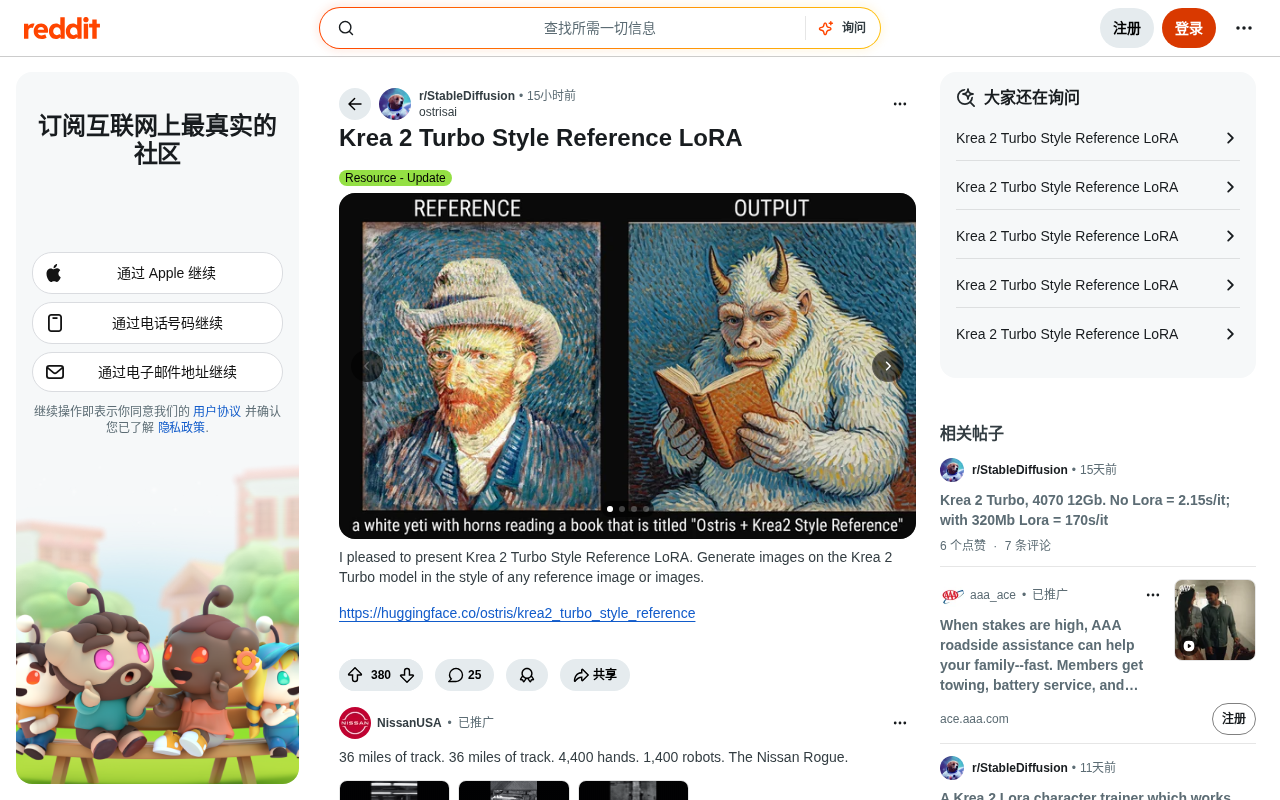
According to the release information from the Reddit community, the core capability of this LoRA lies in "Style Reference"—simply provide a reference image with specific aesthetic characteristics, and the model can capture its stylistic features and transfer them to entirely new generated content. This capability holds considerable practical appeal for creators pursuing visual consistency.
What Is Style Reference LoRA
A Brief Overview of LoRA Technology
LoRA (Low-Rank Adaptation) is a lightweight model fine-tuning technique first proposed by Microsoft Research in 2021 in the paper LoRA: Low-Rank Adaptation of Large Language Models, originally used for efficient fine-tuning of large language models. Its core idea stems from an important observation: when a pre-trained large model adapts to downstream tasks, the weight update matrix is essentially "low-rank" and can be approximated by the product of two matrices far smaller than the original. Specifically, LoRA decomposes the weight matrix W that would otherwise need updating into W + ΔW, where ΔW = A×B, with A and B being small matrices of a rank far lower than W. This means the number of parameters requiring training can be reduced to one ten-thousandth or even less of the original.
This low-rank assumption is not baseless but is supported by a solid foundation in linear algebra. In large pre-trained models, weight matrices often have extremely high dimensions (such as 2048×2048), but researchers found that when a model adapts to a specific downstream task, the "degrees of freedom" that actually undergo effective change are far lower than the matrix's full dimensions. By analyzing the weight difference matrix before and after fine-tuning through Singular Value Decomposition (SVD), one can observe that the vast majority of singular values approach zero, confirming the reasonableness of this assumption. Intuitively, SVD decomposes any matrix into a superposition of several "direction-magnitude" pairs: singular values represent the importance of each direction, and the fact that the importance of the vast majority of directions approaches zero means the truly informative changes are concentrated in a very small number of principal directions. LoRA uses two small matrices A (d×r) and B (r×k) of rank r (typically 4 to 64) to approximate the original d×k update matrix, compressing the parameter count from d×k to r×(d+k). When r is far smaller than d and k, the compression ratio is remarkably significant. Notably, LoRA also introduces a scaling factor α/r to control the magnitude of updates, preventing the low-rank matrices from disturbing the original weights too much during the initialization phase—a design detail crucial to training stability.
Compared to retraining an entire large model from scratch, LoRA only needs to train a very small number of parameters to enable a base model to acquire specific capabilities or styles. This technique was subsequently widely adopted by the image generation community, and the Stable Diffusion community carried it to great heights—creators can complete style fine-tuning within hours on consumer-grade GPUs, and the resulting LoRA files are typically only tens to hundreds of MB, making them extremely easy to distribute and reuse. It's worth mentioning that LoRA in the image generation field typically operates on the attention layers (Query, Key, Value projection matrices) within the U-Net or Transformer backbone, rather than all weight layers. This is because the attention mechanism is responsible for establishing semantic associations between different regions of an image and textual conditions, making it the key channel for style information transfer.
The Krea 2 Turbo Style Reference LoRA does not train a fixed artistic style but instead trains the model's general ability to "read and imitate the style of a reference image." This is the key difference from traditional style LoRAs—traditional style LoRAs are often locked into a particular painting style (such as watercolor or cyberpunk), whereas this tool pursues "style generalization," letting the reference image itself determine the output direction.
This "style generalization" capability also reflects the overall evolution of AI style transfer technology. As early as 2015, the paper A Neural Algorithm of Artistic Style by Gatys et al. laid the foundation for early techniques—separating an image's content representation from its style representation through Convolutional Neural Networks (CNNs). Its core mathematical tool was the Gram matrix: after flattening the feature maps extracted at different CNN layers, an autocorrelation matrix is computed. The values of the Gram matrix reflect the co-occurrence relationships between different feature channels, independent of spatial position, thus naturally encoding texture and style information rather than specific content. Style transfer optimizes an output image via gradient descent so that its content-layer features approach the content image while its Gram matrix approaches the style image. However, at that time each image took minutes or even hours to process, and each network could only express one fixed style. The arrival of the diffusion model era completely transformed this landscape: under the diffusion model systems represented by modern architectures like FLUX, the way style information is encoded is fundamentally different from the CNN era. Such models rely on the Cross-Attention mechanism of the Transformer architecture, where text prompts are converted into semantic vectors through text encoders like CLIP or T5, and fused with visual features in the attention layers. The technical core of style reference LoRA lies in training the model to encode the visual features of a reference image—color tone distribution, brushstroke texture, compositional patterns, lighting habits—into conditional signals that can be injected into the generation process, essentially expanding the model's "conditional input space." This shares similarities with technical approaches like IP-Adapter: IP-Adapter adds an independent image prompt branch to the cross-attention layers, allowing image conditions to be injected in parallel with text conditions. Its advantages are an extremely small number of training parameters (only about 22 million) and decoupling from the base model, so switching between different styles only requires replacing the output of the image encoder. However, the LoRA approach has the advantage that the weights are directly integrated into the model, requiring no additional image encoder forward pass during inference, resulting in lower deployment costs. Moreover, when deeply customized for a specific base model, it can typically achieve tighter style coupling. The current "style generalization LoRA" is precisely the latest form in this evolutionary chain.
Integration with Krea 2 Turbo
Krea 2 Turbo is an image model focused on generation speed. In the field of AI image generation, the "Turbo" naming typically refers to a model variant that has been optimized for inference acceleration. Such optimization involves multiple technical approaches: one is Knowledge Distillation, which compresses the capabilities of a large teacher model into a smaller student model; another is step-reduction sampling techniques—standard diffusion models typically require 20-50 denoising steps, whereas Turbo-class models compress the steps to 1-8 using methods like Consistency Models or adversarial training. SDXL Turbo and FLUX Schnell are representatives of such accelerated models, capable of compressing single-generation time from tens of seconds to within a few seconds.
Understanding the acceleration principle behind "Turbo" helps evaluate the capability boundaries of such tools. Consistency Models were proposed by OpenAI researcher Yang Song in 2023, with the core idea that: along the same denoising trajectory of the diffusion process, inputs at all time steps should map to the same clean image—i.e., "trajectory consistency." By training the model to satisfy this self-consistency constraint, it can jump directly to the endpoint in single-step or few-step inference. Specifically during training, consistency models minimize the distance between the outputs of adjacent time steps on the same trajectory (consistency loss), enabling the model to "reach the endpoint directly" at any noise level. Building on this, the Latent Consistency Model (LCM) further combines with latent diffusion models to achieve the ability to generate high-quality images in 4 steps. Another representative approach is Adversarial Diffusion Distillation (ADD), which introduces a discriminator network to supervise the realism of few-step generation results—SDXL Turbo adopts this approach. The two paths each have their emphasis: consistency models focus more on mathematical self-consistency and training stability, while ADD leverages adversarial training to raise the ceiling of perceptual quality, though adversarial training itself carries training instability risks such as mode collapse and is relatively harder to tune. Additionally, it should be noted that step reduction optimization typically comes at the cost of some detail diversity—the fewer the steps, the narrower the exploration space of random sampling, which is also why Turbo-class models underperform standard models in certain highly detailed scenarios.
Attaching style reference capability on top of a high-speed model means creators can enjoy controllable style output while iterating quickly. The combination of "speed + controllability" is precisely the core need of today's AI creative workflows.
Core Capabilities and Application Scenarios
Single-Image and Multi-Image Reference
This LoRA supports style extraction from "any one or more reference images," a design detail worth noting:
- Single-image reference: Suitable for scenarios with a clear style template, such as replicating the work style of a particular illustrator.
- Multi-image reference: By fusing the stylistic features of multiple reference images, it can create more composite visual effects, avoiding the style rigidity caused by over-reliance on a single sample. Multi-image reference is typically implemented at the technical level through weighted averaging or attention aggregation of the feature vectors from multiple reference images, with the weight of each reference image dynamically adjustable according to its semantic relevance to the target prompt. This is also one of the important indicators for judging the maturity of a style reference tool.
Potential Application Directions
Such AI style transfer tools have quite broad uses in actual creation:
- Brand visual consistency: Companies or designers can use a single brand tone image to batch-generate marketing materials with a unified style.
- Series work creation: Projects that require overall visual consistency, such as comics and game art, can rely on reference images to ensure coherent output.
- Rapid style exploration: During the concept phase, designers can use different reference images to quickly experiment with multiple visual directions, greatly shortening the early exploration time.
- Personalized creation assistant: Independent creators can use their own historical works as reference images to train a personal style tag unique to their aesthetic habits, maintaining continuity of personalized visual language in subsequent creation.
The Value of the Open-Source Ecosystem
This project is hosted on the Hugging Face platform and is open to the community as an open-source resource. Founded in 2016, Hugging Face was originally positioned as a chatbot company. After pivoting to an AI model hosting and collaboration platform in 2018, it rose rapidly and has now become the world's largest open-source AI model and dataset community, hosting over 500,000 models and 100,000 datasets. Its Model Hub employs a version control mechanism similar to GitHub, supporting public model releases, version management, and community discussions.
Hugging Face's technical influence largely also stems from its open-source Diffusers library—an inference and training framework designed specifically for diffusion models, providing a unified Pipeline abstraction that allows models of different architectures (SDXL, FLUX, Stable Diffusion 3, etc.) to run with nearly identical calling interfaces. For loading LoRA, Diffusers provides standardized methods such as load_lora_weights(), supporting dynamic adjustment of the LoRA weight coefficient (scale), allowing creators to control the intensity of style transfer within a range of 0 to 1 or even higher—when scale is below 1, the style influence weakens and content freedom increases; when above 1, the style features are excessively amplified, potentially causing artifacts. Fine-grained control of this parameter is often the key to obtaining ideal output. Hugging Face also maintains the PEFT (Parameter-Efficient Fine-Tuning) library, unifying multiple efficient fine-tuning methods such as LoRA, Prefix Tuning, Prompt Tuning, and IA³ under one framework, greatly lowering the technical barrier for the community to develop and reuse new LoRAs. Another important contribution of the PEFT library is support for "LoRA composition"—multiple LoRA weights can be activated simultaneously through linear superposition, for example loading a style reference LoRA and a character feature LoRA at the same time, with the influence of each independently adjustable through scale coefficients, providing creators with a nearly infinite combinatorial space. This is also why Hugging Face has become the central hub of the open-source LoRA ecosystem.
Developer ostris has long had a reputation in the AI creative tools community. Another well-known contribution of theirs on the platform is the AI Toolkit (ai-toolkit)—a Flux model training framework widely used by the community. These open-source contributions have established high technical credibility in the diffusion model community.
The direct benefit of the open-source model is that creators can obtain and deploy it locally for free, without relying on closed-source cloud services; the community can also carry out secondary development and optimization based on it. For users who wish to control their creative workflow and value data privacy, a locally runnable open-source LoRA is clearly more appealing than a black-box online service. It's worth noting that the open-source ecosystem also brings controversy regarding style copyright: when creators upload others' artistic works as style references, the copyright ownership and moral boundaries of the generated results remain unresolved issues in the industry—a problem that becomes increasingly pressing as style transfer tools become more widespread.
A Rational Perspective and Usage Recommendations
Although the capabilities of this tool are exciting, as a newly released community project, several points still warrant attention during actual use:
- Effectiveness depends on reference image quality: The effectiveness of style extraction highly depends on the clarity and style recognizability of the reference image, and improper image selection will affect the final output. An ideal reference image should have distinct stylistic features (such as strong color tendencies, unique line styles, or obvious texture) rather than being an ordinary photo with vague style.
- Must match the specified base model: This LoRA must be used with the Krea 2 Turbo model; please ensure the local environment is correctly configured. There is a strict architectural binding relationship between LoRA weights and the base model—a LoRA trained for SDXL cannot be directly transferred to a different architecture model like FLUX. This is a technical prerequisite that must be confirmed before use.
- Testing verification recommended: Currently, public information mainly comes from the developer's release notes, and actual performance still needs more community testing feedback for verification.
- Be mindful of content copyright boundaries: When using others' published works as style references, it is advisable to pay attention to the latest developments in relevant copyright laws and follow platform usage guidelines.
Conclusion
The Krea 2 Turbo Style Reference LoRA is a typical case of AI image generation tools evolving toward "more controllable and more practical" directions. From Gatys et al. laying the theoretical foundation of neural style transfer with the Gram matrix in 2015, to LoRA technology compressing fine-tuning costs to consumer-accessible levels in 2021, and now to style generalization LoRA achieving "any image as a style tag," the direction of technological evolution has always pointed toward lower barriers to use and higher creative freedom. This tool transforms the creative pain point of "style control" into a lightweight, flexible plug-and-play solution, significantly lowering the threshold for achieving visual consistency.
Interested readers can visit its Hugging Face page to learn more and download it for a trial. In an era where AI creative tools iterate rapidly, continuously following such open-source projects may help you gain an edge in your creative practice.
Key Takeaways
Key Takeaways
Related articles

The Truth Behind Codex 'Build a Website in 5 Minutes': AI Isn't Creating Sites—It's Helping You Copy Them
Exposing the truth behind viral Codex 5-minute website videos: creators aren't building original sites with AI—they're copying shared prompts or scraping others' work. Learn AI coding tools' real limits.

Getting Started with AI Agent Development: A Complete Guide from Concept to Practice
A comprehensive guide to AI Agent architecture and development, covering automated marketing, intelligent customer service, and investment analysis scenarios with single and multi-agent collaboration.

The Truth Behind Codex 'Build a Website in 5 Minutes': AI Isn't Creating Sites — It's Helping You Copy Them
Exposing the truth behind viral Codex 5-minute website videos: creators aren't building original sites with AI — they're copying shared prompts or scraping others' work.