Ladybird Browser: An Independent Browser Engine Built from Scratch

Ladybird is a truly independent browser engine built from scratch, earning 65K+ GitHub stars.
Ladybird is an independent web browser with its engine built entirely from scratch in C++, without relying on Chromium, WebKit, or Gecko. Born from the SerenityOS project and now operating as a nonprofit, it has earned over 65,000 GitHub stars. While still in early development with an Alpha planned for 2026, its existence as a community-driven independent engine is a vital contribution to Web diversity and open standards.
A Truly Independent Browser Engine
In today's browser market, mainstream browsers like Chrome, Edge, Brave, and Opera are almost all built on the same foundation — Google's Chromium/Blink engine. Even Firefox struggles to maintain its position under the pressure of continuously shrinking market share. The entire Web ecosystem is heavily dependent on rendering engines controlled by a handful of tech giants, raising serious questions about diversity and independence in the browser space.
The monopolization of browser engines didn't happen overnight. In 2013, Google forked the Blink engine from WebKit. Shortly after, Opera abandoned its proprietary Presto engine and switched to Chromium. In 2018, Microsoft also announced it would drop EdgeHTML in favor of the Chromium engine. While each of these decisions had its own business rationale, the objective outcome was making Blink the de facto arbiter of Web standards. When a single engine commands over 70% of market share, web developers tend to test only against that engine, creating a vicious cycle of "as long as it works in Chrome, it's fine" — further squeezing the survival space of other engines.
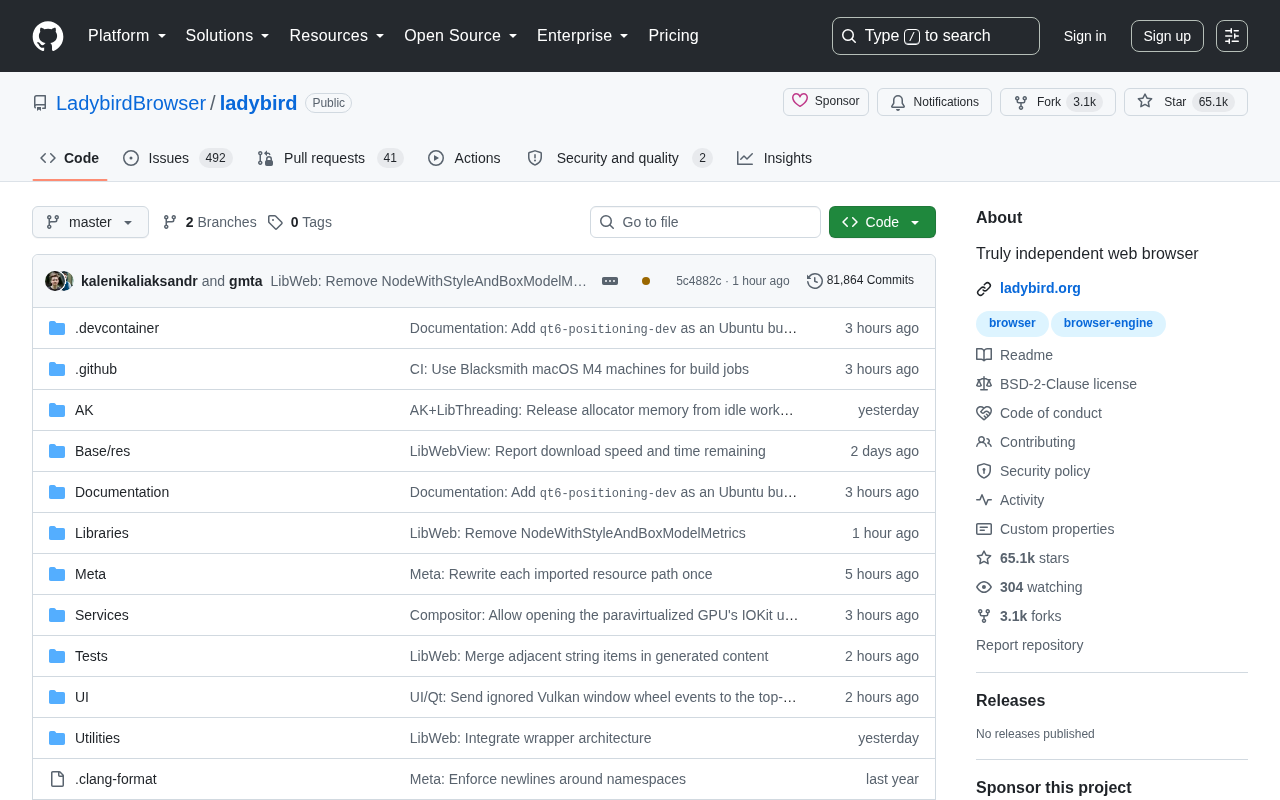
It's against this backdrop that the Ladybird project stands out as truly exceptional. It is a "truly independent web browser" with its own engine written from scratch, without relying on any existing browser codebase. The project has accumulated over 65,000 stars on GitHub, with more than 3,100 forks and 190 new stars per day, demonstrating continuously growing community enthusiasm.
Why an "Independent Engine" Matters So Much
Ladybird's core value lies in the fact that it doesn't build upon Blink, WebKit, or Gecko. The entire browser engine, JavaScript engine, and rendering pipeline are built from the ground up in C++. This means it isn't beholden to any single commercial company's roadmap, and it provides a completely new reference implementation for Web standards.
In the domain of software standards, a "reference implementation" refers to an independently developed version that strictly follows specification documents, used to verify the completeness and implementability of the specification itself. When standards bodies like the W3C develop Web standards, it's difficult to determine whether a standard truly achieves interoperability if only one or two engines implement a given feature. As a completely independent third-party implementation, Ladybird can expose ambiguities or omissions in standard documents, thereby driving improvements to the standards themselves. This value is especially important as the Web platform grows increasingly complex.
For a field increasingly monopolized by a few vendors, having one more independent engine implementation is in itself a significant contribution to Web openness. It helps verify whether Web standards can truly be independently implemented, rather than becoming a vendor's de facto proprietary specification.
Ladybird's Origins: An Independent Project Born from SerenityOS
Ladybird was originally born within the SerenityOS project — a Unix-like operating system also written entirely from scratch. Project founder Andreas Kling initially just wanted to build a browser component for SerenityOS. As development progressed, Ladybird gradually grew into an independent project capable of running cross-platform, separate from the operating system.
SerenityOS was a personal project that Andreas Kling started in 2018, originally as a programming exercise during his recovery. The project's unique characteristic is that it uses virtually no third-party libraries — everything from the kernel, file system, and GUI framework to applications is written from scratch. While this "reinventing the wheel" philosophy doesn't optimize for engineering efficiency, it gives developers the opportunity to deeply understand every layer of the system. SerenityOS's visual style mimics late-1990s desktop operating systems, and it has accumulated a large following in the developer community, also cultivating Ladybird's initial core contributor team.
In 2024, Ladybird officially separated from SerenityOS, establishing a nonprofit organization for governance and receiving sponsorship from multiple parties including prominent developers. GitHub co-founder Chris Wanstrath and Shopify founder Tobi Lütke are among the notable tech figures who have provided financial support for the project, signaling broad industry recognition of the need for an independent browser engine. This nonprofit, community-and-donation-driven model further reinforces its positioning as "free from commercial interests" — unlike the Mozilla Foundation's long-standing dependence on Google's default search engine agreement for revenue (approximately $400-500 million annually), Ladybird avoids similar conflicts of interest through diversified donation sources.
Ladybird's Tech Stack and Architecture
The project is primarily written in C++, both for performance reasons and to continue SerenityOS's technical tradition. Browser engine development is an extraordinarily complex engineering endeavor, involving HTML parsing, CSS layout, JavaScript execution, network protocols, graphics rendering, and many other subsystems. Modern browser engines are considered among the most complex software systems in human engineering history — the HTML specification alone exceeds 100,000 words, CSS specifications are spread across dozens of modules, and JavaScript engines need to implement JIT (Just-In-Time compilation) to achieve acceptable performance. Additionally, browsers must handle modern APIs like WebAssembly, Web Workers, Service Workers, and WebGL/WebGPU. For reference, the Chromium project exceeds 35 million lines of code, and even the relatively lean Firefox has approximately 20 million lines. This explains why virtually no new browser engines have been built from scratch in the past two decades.
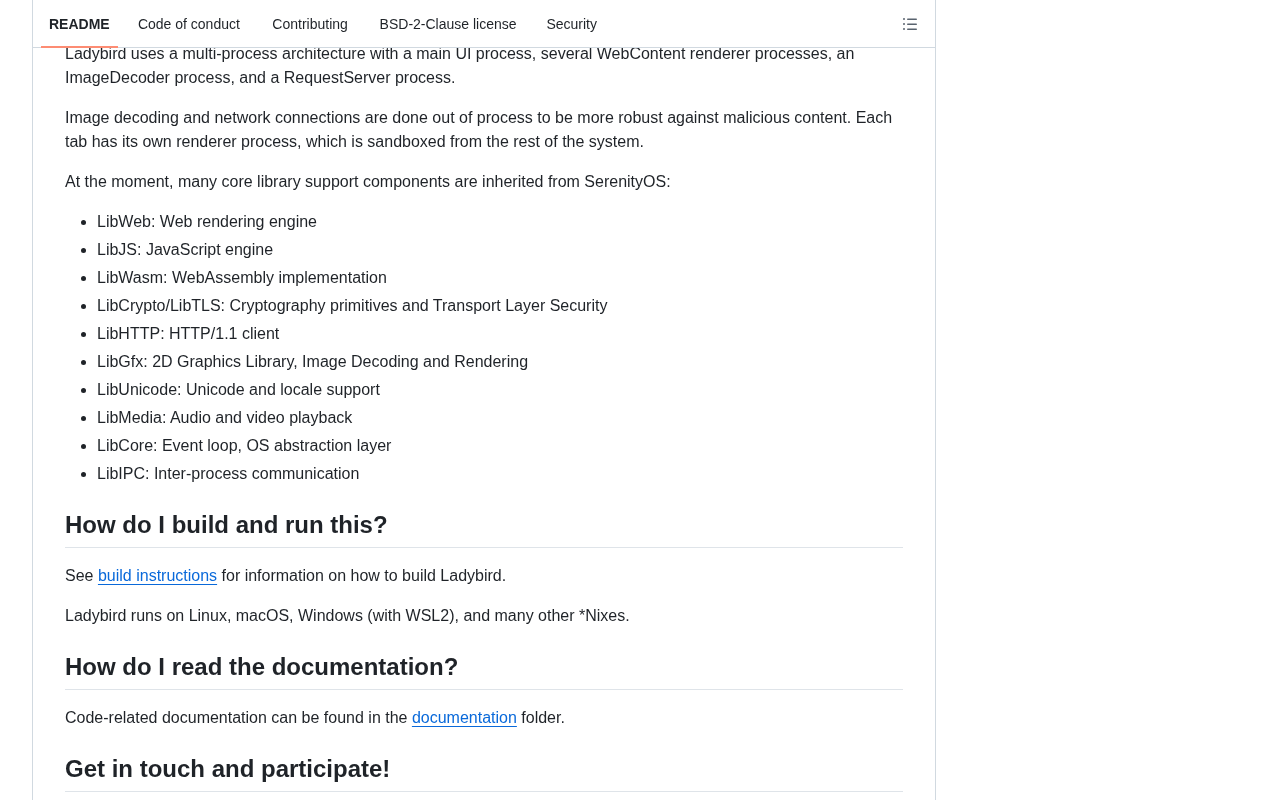
The Ladybird team is progressively implementing these capabilities, with core components including:
- LibWeb: A custom-built web rendering engine responsible for HTML parsing and CSS layout
- LibJS: A custom-built JavaScript engine
- An independent network protocol stack and graphics rendering pipeline
Notably, the project is also actively evaluating the introduction of Swift and other more modern, memory-safe languages to address C++'s inherent memory safety challenges. C++ has long been the language of choice for system-level software due to its zero-cost abstractions and fine-grained memory control. However, research shows that approximately 70% of security vulnerabilities stem from memory safety issues (such as buffer overflows and use-after-free), which are especially critical in browsers that must parse large amounts of untrusted input. Swift provides compile-time memory safety guarantees through Automatic Reference Counting (ARC) and strict ownership models while maintaining performance close to C++. Apple's Safari team already uses Swift in some components, and Rust was introduced by Mozilla into Firefox's critical security components (such as the CSS engine Stylo). Ladybird's consideration of Swift reflects the broader trend in systems programming toward memory-safe languages and demonstrates the team's pragmatic approach to modern software engineering practices.
Current Development Progress and Challenges
As a project still in its early development stage, Ladybird currently targets developers and tech enthusiasts. The team plans to release its first Alpha version for general users within the next few years (estimated around 2026).
Major Real-World Challenges
Building a browser that can compete with Chromium is no easy feat:
- The sheer complexity of Web standards: The modern Web platform encompasses thousands of standards and countless edge cases, requiring massive engineering investment for complete implementation. The Web Platform Tests (WPT) test suite alone contains over 1.7 million test cases, and pass rate is a key metric for measuring browser engine maturity
- Website compatibility challenges: Many websites are optimized for Chrome, and non-mainstream engines often encounter compatibility issues. Some websites even actively block non-mainstream browsers through User-Agent sniffing — a practice that's non-standard but extremely common
- Security and performance requirements: Reaching production-grade security and rendering performance still has a long way to go. Modern browsers need to implement complex security mechanisms like process sandboxing and Site Isolation while maintaining smooth 60fps rendering
- Limited human resources: Compared to Google's thousands of engineers, community-driven projects are inherently resource-constrained. The Chrome team is estimated to have over 1,000 full-time engineers, while Ladybird's core contributors currently number only in the dozens
Despite these challenges, Ladybird's very existence carries symbolic significance. It proves that community-driven independent browser engines can still grow and thrive even under the dominance of tech giants.
Hope for Web Diversity: Why Ladybird Deserves Your Attention
Ladybird may not be able to challenge Chrome's market position in the short term, but its significance extends far beyond market share. It provides the Web ecosystem with a precious independent option and brings hope to countless developers who care about the open internet.
From a historical perspective, the healthy development of the Web has always depended on healthy competition among multiple independent engines. In the early 2000s, when Internet Explorer dominated alone, progress on Web standards nearly stagnated. It was Firefox and later Chrome that introduced competition, driving the rapid development of modern standards like HTML5 and CSS3. While Chromium's current dominance hasn't yet caused obvious standards stagnation, there are already signs of Google unilaterally pushing controversial APIs (such as Web Environment Integrity), making the "checks and balances" role of independent engines increasingly important.
In an increasingly homogenized browser world, the fact that a project "built from scratch, truly independent" has garnered 65,000 stars speaks volumes about the community's strong desire for Web diversity. Whether you're a frontend developer, an open-source enthusiast, or an everyday user who cares about the future of the internet, this project is worth your continued attention.
Key Takeaways
Related articles

Should U.S. College Fraternities Be Banned? A Researcher's Incisive Observations
Why not just ban U.S. college fraternities? A researcher finds the key resistance comes from decision-makers' own fraternity identities and schools' "willful ignorance."

Microsoft Discovery: Accelerating Scientific Discovery with AI Agents
Microsoft's Discovery platform runs specialized AI agents to help researchers screen and prioritize the most promising compounds and experimental paths, reducing experiments and accelerating scientific discovery.

Cambridge Heavy Industries Secretly Develops Desktop-Scale Nuclear Fusion Device
Cambridge Heavy Industries is secretly developing a desktop-scale laser-driven nuclear fusion device, targeting the equipment supply market for fusion power plants. This article analyzes its miniaturization technology path, commercialization logic, and unique positioning in the fusion startup wave.