Ladybird Browser Enters Alpha: A Milestone for Independent Engines

Ladybird's independent browser engine enters Alpha, with its self-built rendering pipeline facing the public for the first time.
The Ladybird browser has entered Alpha, with discussion on Hacker News receiving 198 points and 32 comments. Built from scratch rather than on Blink, WebKit, or Gecko, it gains freedom in architecture, performance, and privacy but must bear the full cost of Web standards compatibility alone. Alpha means core page loading, rendering, and script execution work; stability and edge cases remain incomplete.
An Independent Browser Engine Built from Scratch
The Ladybird browser has officially announced its entry into the Alpha stage. The news drew attention in the technical community—the related discussion on Hacker News received 198 points and 32 comments. For a project building an independent browser engine from scratch, reaching Alpha means its core rendering and browsing capabilities have crossed the usability threshold.
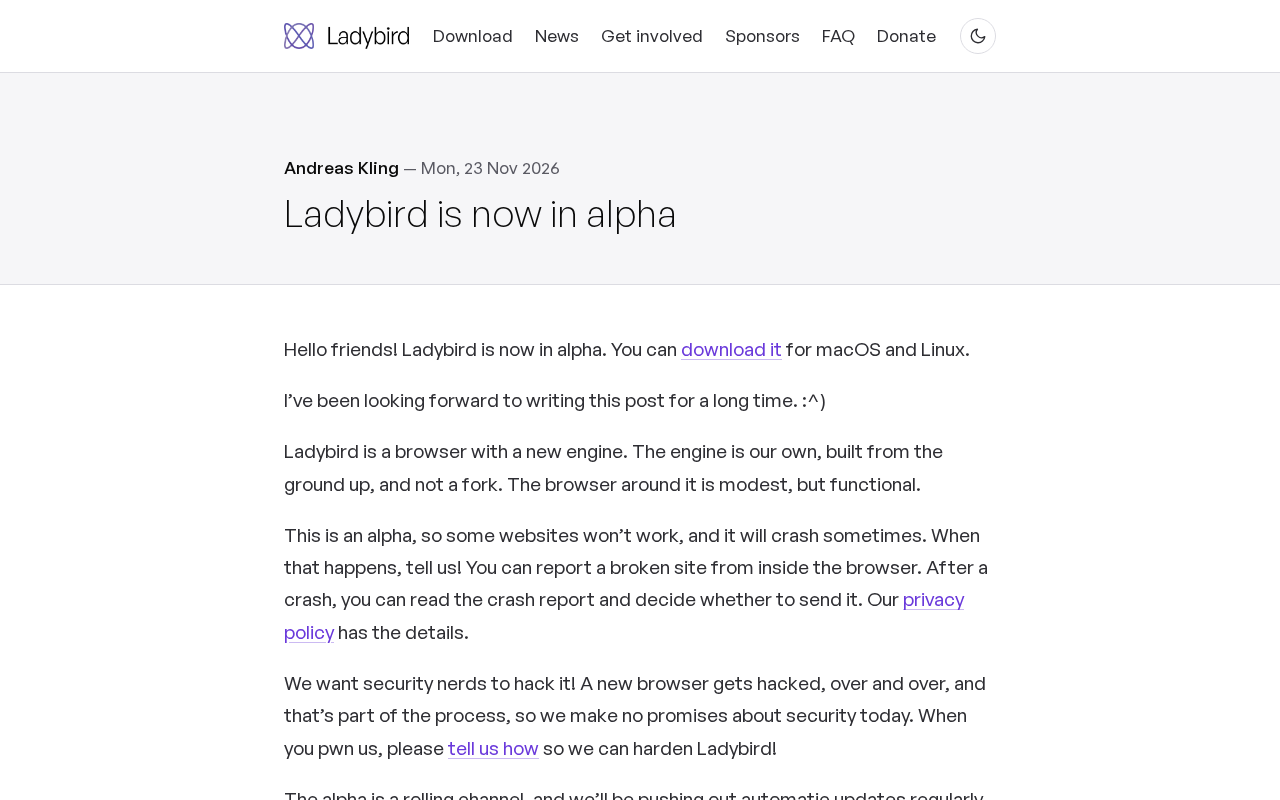
The browser world has long been dominated by three major engines: Blink, WebKit, and Gecko. Ladybird chose not to build on any existing engine, instead constructing its own rendering pipeline—giving it greater architectural freedom, but also meaning it must shoulder the entire workload of Web standards compatibility on its own. The Alpha release is essentially the first public progress report from this self-built engine.
A browser engine is the core component of a browser responsible for parsing HTML, building the DOM tree, computing styles, layout, and painting, while also coordinating with the JavaScript execution environment and network stack. The mainstream engine Blink originated as a fork of WebKit, is led by Google, and is used in Chrome and Edge; WebKit is led by Apple and used in Safari; Gecko is maintained by Mozilla and used in Firefox. Together, the three cover the vast majority of browser market share and, in effect, define how Web standards land in real-world environments. An independent engine refers to a browser core that is not based on any of these codebases and implements everything from the rendering pipeline to the scripting engine itself; historically, projects such as Servo and WebRender have explored partial paths, but a complete independent engine is extremely rare.
What Alpha Means
In software engineering parlance, Alpha typically refers to a state where the core functionality is connected and can handle the main use cases, but stability, performance optimization, and edge-case handling remain incomplete. For a browser, this means at minimum that the basic chain—page loading, rendering, and script execution—is working.
Opening up at this stage holds special value for an independent browser project. It expands the testing surface from the development team to real users and real web pages, and the breadth of feedback far exceeds what internal testing can provide. The community discussion's focus on the Alpha version's practical usability and the boundaries of compatibility is precisely the input the project needs most.
In the software release cycle, Alpha usually precedes Beta, and the two often correspond to "dogfooding" (internal testing) and "public testing." Products in the Alpha stage typically only guarantee that the main path works and do not promise API or behavioral stability; the Beta stage enters a convergence phase focused on bug fixing with features frozen. For infrastructure software like browsers, Alpha also carries an implicit meaning: it must contend with the large volume of non-standard but widely relied-upon "implicit behaviors" on real web pages—such as legacy CSS prefixes and the specific error-tolerance behaviors of JavaScript engines—which are the long-tail compatibility issues that specification documents cannot fully cover.
The Value and Cost of an Independent Engine
The appeal of a self-built engine lies in not being constrained by upstream decisions. Rendering behavior, performance trade-offs, and privacy policies can all be designed according to the project's own philosophy, without having to follow any single vendor's roadmap. For developers and users hoping to escape the ecosystem monopoly of a single engine, this independence is irreplaceable.
The cost is equally clear. The Web platform's standards and implicit behaviors are vast, and mainstream engines have accumulated years of compatibility handling. For a new engine to reach the same level in real-world web environments requires a long iterative process. Alpha is only the starting point of this road; the real test lies ahead in advancing standards coverage, performance, and stability.
Web standards are set by organizations such as the W3C, WHATWG, and Ecma International, but a gap has long existed between the text of the standards and actual browser behavior—known in the industry as the "interoperability" problem. Mainstream engines gradually converge differences through years of compatibility test suites (such as Web Platform Tests) and online web telemetry. Even when a new engine implements strictly according to the specification, it will encounter rendering deviations on a large number of real websites, because sites often adapt to the existing behavior of mainstream engines. Therefore, the compatibility cost of an independent engine is not just implementing the specification but also reverse-engineering and reproducing these de facto standards—one of the hardest thresholds for the project to cross.
Next Steps Worth Watching
After entering Alpha, the project's key metrics will shift to compatibility coverage, crash rates, and actual browsing experience. These data will say more about where the project stands than version numbers alone. For developers who care about the diversity of browser technology, Ladybird is a sample worth following—it tests just how far one can go in building a browser from scratch outside the engine landscape of the giants.
One-line Summary
Ladybird's independent browser engine enters Alpha, with its self-built rendering pipeline facing the public for the first time.
Paragraph Summary
The Ladybird browser has announced its entry into the Alpha stage, with the related discussion receiving 198 points and 32 comments on Hacker News. The project is not based on Blink, WebKit, or Gecko but builds its rendering pipeline from scratch, giving it greater freedom in architecture, performance trade-offs, and privacy policy—while also requiring it to bear the full cost of Web standards compatibility alone. Alpha means the core chain of page loading, rendering, and script execution is working, while stability, performance optimization, and edge-case handling remain incomplete. The article notes that the value of this stage lies in extending the testing surface to real users and real web pages; going forward, key metrics will shift to compatibility coverage, crash rates, and actual browsing experience.
Related articles

Nothing CMF Buds 2A Drops to $17.89 on Black Friday: A New Low for ANC Earbuds
Nothing CMF Buds 2A wireless earbuds Black Friday deal: just $17.89 on Amazon, about $11 off retail and a record low. ANC earbuds at an entry-level price.

When AI Creation Gets Accused of "Spitting": Hacker News Heats Up Over the Glaude Controversy
A Hacker News post, "Spitting in the Face of Glaude," sparks debate on AI creation transparency and attribution ethics. This analysis examines the blurred creator identity behind the controversy and offers practical advice for AI content production.

Akai Embraces Custom Firmware: MPC Sample 1.4 Lets Users AI-Program Their Sampler
Akai embraces the modding community with MPC Sample 1.4 firmware, supporting vibe-coded custom firmware and effects. We analyze the impact of this open strategy on music hardware and AI-assisted programming.