Lakehouse Federation: Investment Analysis Without Data Migration

Lakehouse federation enables querying everywhere without moving data, reducing cross-system data retrieval costs and compliance risks for investment analysis.
The article discusses Lakehouse Federation's value and boundaries in investment analysis. Traditional ETL centralization faces long pipelines, duplicate storage, and compliance risks. The federated model advocates "query anywhere, move nothing," with the analytics engine querying source systems through connectors and bringing back only results. The key is query pushdown depth: deeper pushdown reduces transmission and local computation but increases dependency on source capabilities and connector maturity. For investment analysis, federation shortens cross-system data acquisition and keeps governance at the source. However, it cannot replace data governance—source quality issues carry to the query layer. Before implementation, test cross-source latency, unify permission models, and re-evaluate costs.
Enterprise data is often scattered across data warehouses, data lakes, SaaS applications, and various business databases. The traditional approach is to first perform ETL to centralize data in one place before analysis. But for scenarios like investment analysis that demand high timeliness and compliance, the cost of moving data keeps rising. Lakehouse Federation offers an approach where queries can happen anywhere, and the data itself doesn't need to move.
Why "Not Moving Data" Has Become a Necessity
Investment analysis requires viewing transaction records, position data, market quotes, and risk control metrics simultaneously—data that typically belongs to different systems maintained by different teams. Physically centralizing them into one warehouse means long synchronization pipelines, duplicate storage costs, and governance and compliance risks that arise when data leaves its original system.
The core proposition of Lakehouse Federation targets these pain points directly: the analytics engine queries source systems directly, data stays in place, and only results are brought back. The original text summarizes this model as "Query Anywhere, Move Nothing," emphasizing the extension of query capability rather than data relocation.
The significance for investment scenarios is that analysts can obtain cross-system views faster, while data engineering teams don't need to build a new pipeline for every analytical request.
ETL and Data Centralization
ETL (Extract-Transform-Load) is the traditional paradigm of data engineering: extract data from source systems, clean and transform it in an intermediate layer, then load it into a unified data warehouse or data lake. Its value lies in integrating scattered, heterogeneous, and inconsistently quality data into a consistent analytical foundation that facilitates modeling, reuse, and governance. The cost is long pipelines and poor timeliness—changes in source systems often only reflect in the warehouse at the next scheduling cycle; meanwhile, every physical copy means additional storage costs and the need to re-apply access controls and masking policies after data leaves the original system. In regulated financial scenarios, the copy itself may constitute a compliance burden, because the responsibility boundaries of data governance blur as copies proliferate. Lakehouse Federation is precisely the counter-complement to this paradigm: it doesn't negate ETL, but rather provides an on-demand query path without creating copies, beyond the assumption that "data must be centralized before analysis."
How Federated Queries Work
Federated queries aren't a new concept, but under lakehouse architecture they have taken on a more complete form. The query engine connects to external data sources through connectors, pushing SQL down to the source for execution, or pulling only necessary data shards and then performing joins and aggregations locally.
The key trade-off here is "how much to push down." The more thorough the pushdown, the less pressure on network transmission and local computation—but the greater the dependency on the source system's query capabilities; conversely, more data needs to be pulled back for local processing, weakening the value of federation. In practice, the maturity of connectors and the concurrency capacity of source systems often determine the experience more than the architecture diagram does.
From an investment analysis perspective, cross-source joins are the norm—positions in business databases, market quotes in specialized data services, reference data possibly in SaaS systems. The federated model allows these joins to be completed without pre-modeling, suitable for exploratory analysis; but for high-frequency, stable core reports, whether governed centralized copies should still be retained—the original text doesn't provide a unified answer, which is itself a point requiring trade-offs in practice.
Query Pushdown and Connectors
Query pushdown refers to the query engine translating operations such as filtering, projection, and even aggregation and joins into statements the source system can execute, delegating them to the source and pulling back only the result set. The deeper the pushdown, the smaller the volume of data transmitted across the network and the lower the local computation pressure; but the prerequisite is that the source system itself has the corresponding SQL capabilities and that the connector can accurately translate the engine's semantics. Connectors are the adaptation layer for federated queries, responsible for protocol interfacing, type mapping, predicate pushdown capability declaration, and metadata synchronization. The maturity of different connectors varies greatly: some only support basic filter pushdown, while others can handle complex joins and aggregations. This means the actual performance of federated queries depends heavily on the quality of connectors for specific data sources, not on the engine's architectural claims. When evaluating federation solutions, the granularity of connector support for target source systems is often more important than the overall architecture.
Practical Value for Investment Insights
Placing federation capabilities into the investment workflow, the most direct change is shortened analysis cycles. Cross-system data that previously required scheduling and data request processes can now yield preliminary results through a single query, potentially compressing idea validation time from days to minutes.
Second is clarity of governance boundaries. Data doesn't leave the original system, so access controls, auditing, and masking policies can continue using the source's existing mechanisms, reducing the risk of "data copies out of control." For regulated investment operations, this is often more convincing than performance.
It's worth noting that federated queries cannot replace data governance. When source system data quality is uneven, federation merely moves the problem from the warehouse to the query layer. The "no migration" emphasized in the original text addresses the cost of data movement, not the reliability of the data itself.
Data Governance and Access Control
Data governance is a set of institutional and technical measures around data availability, quality, security, and compliance, typically including metadata management, data lineage, access control, audit logs, masking, and retention policies. In centralized warehouses, governance policies are applied to copies; in federated mode, access control and auditing need to extend along the query chain to source systems, relying on the source's existing permission models and identity systems. This brings a practical requirement: the federation layer must have unified identity mapping capabilities to correctly translate analytical users' identities into access credentials for each source system, otherwise permission mismatches or unauthorized queries may occur. The advantage of the federated model is that data copies don't proliferate and governance boundaries remain at the source; but it also shifts governance complexity from "managing one copy" to "coordinating policy consistency across multiple source systems," which places higher demands on identity and permission architecture.
Practical Considerations for Implementation
Before deciding to adopt the federated model, there are several questions worth answering clearly. On performance, cross-source query latency depends on network and source system response, and interactive analysis experiences need empirical validation—not just architectural promises. On permissions, the federation layer needs a unified identity and access model, otherwise awkward situations arise where "the connector can connect, but permissions don't align."
The cost structure also changes. Centralized storage and pipeline maintenance costs are saved, but cross-system calls during queries may introduce new computation and network costs that need to be evaluated in light of usage patterns.
Overall, Lakehouse Federation offers a pragmatic path: turning scattered data into a queryable whole without breaking existing data boundaries. For cross-system, governance-intensive scenarios like investment analysis, it deserves to be included in architectural options—but it addresses "whether you can query," not "whether the data is usable"—the latter still requires governance to answer.
One-line Summary
Lakehouse federation enables querying everywhere without moving data, reducing cross-system data retrieval costs and compliance risks for investment analysis.
Paragraph Summary
The article discusses the value and boundaries of Lakehouse Federation in investment analysis scenarios. Traditional ETL centralization faces long synchronization pipelines, duplicate storage, and rising compliance risks. The federated model advocates "query anywhere, move nothing," where the analytics engine queries source systems directly through connectors and brings back only results. The key to its operation lies in the degree of query pushdown: the more thorough the pushdown, the less transmission and local computation pressure—but the greater the dependency on source system capabilities and connector maturity. For investment analysis, federation shortens cross-system data acquisition cycles and keeps governance boundaries at the source, reducing the risk of uncontrolled copies. However, the article emphasizes that federation cannot replace data governance—source data quality issues will be carried to the query layer. Before implementation, cross-source latency must be tested, permission models unified, and cost structures re-evaluated.
Related articles
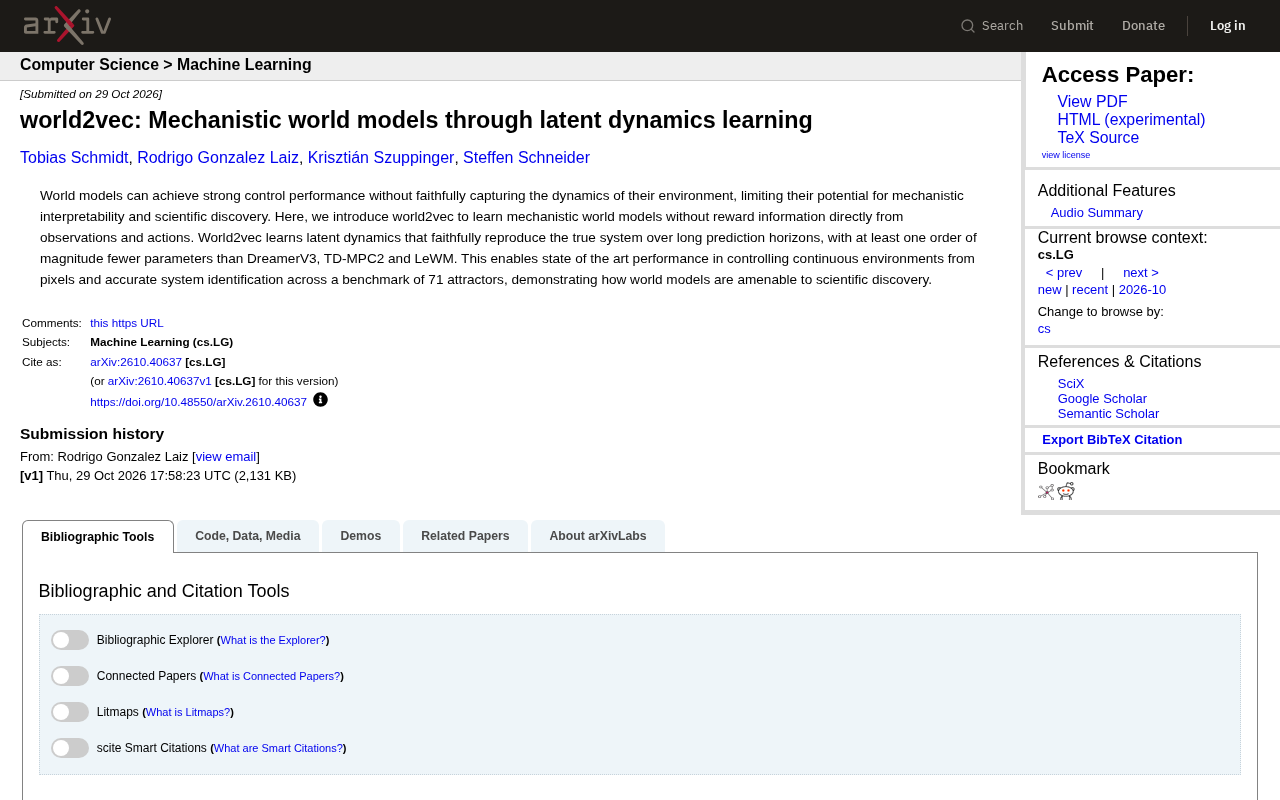
world2vec: Building Mechanistic World Models with Latent Dynamics Learning
world2vec proposes a reward-free method for learning mechanistic world models via latent dynamics, faithfully reproducing systems over long horizons with at least an order of magnitude fewer parameters than DreamerV3, TD-MPC2, and LeWM, and achieving accurate system identification on 71 attractor benchmarks.

A New KL-DRO Paradigm: Adaptive Scenario Generation Around a Learned Density Model
KL-DRO research proposes centering the KL ball on a learned density model instead of the empirical distribution, with adaptive scenario generation guiding sampling toward the worst case. Experiments show lower cost under distribution shift when records are scarce and the model can extrapolate, with comparable in-distribution cost.

ODE Samplers for Discrete Diffusion Models: Exponential Residual Flows Accelerate Generation
Discrete diffusion models lack deterministic ODE sampling? This article introduces Exponential Residual Flows (ERFs), which introduce continuous residual variables per token to construct piecewise ODEs for deterministic sampling and support consistency distillation acceleration. Superior to prior methods on code and text generation tasks.