Lamoom: An AI Agent Marketplace Where Apps Run in Your Own Claude Environment

Lamoom is an AI Agent marketplace where apps run in your own Claude environment, keeping data private.
Lamoom is a two-sided marketplace for AI Agents that run directly in users' own Claude environments rather than on platform servers. Developers can publish Agent loops and charge per-run or monthly, without bearing inference costs. The platform leverages Anthropic's MCP protocol for local execution, offers $20 free credits for new users, and represents a decentralized alternative to cloud-hosted AI platforms like OpenAI's GPTs Store.
What is Lamoom
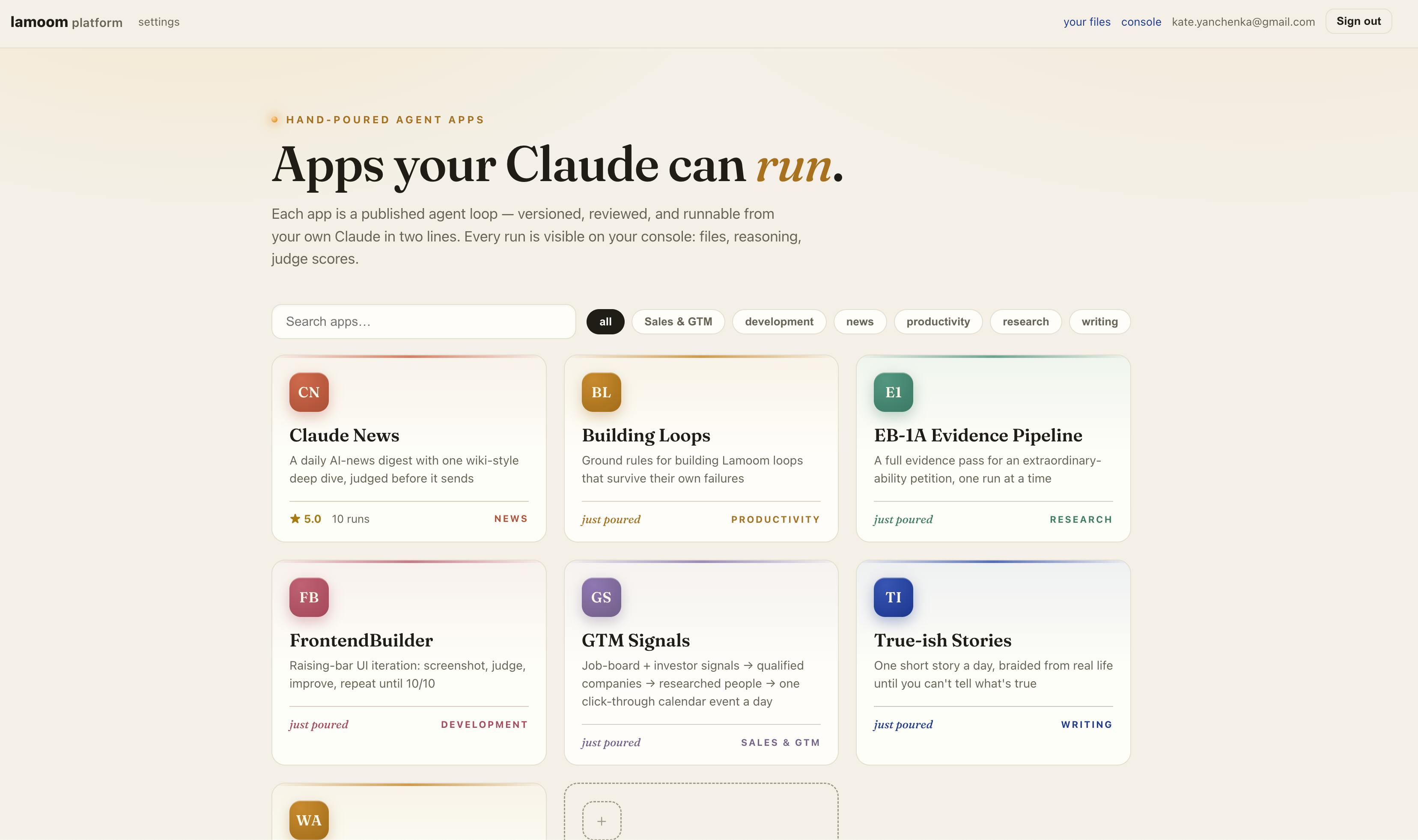
Lamoom is a marketplace platform for AI Agent applications, but its operational model is fundamentally different from typical cloud-based SaaS: these Agent applications don't run on Lamoom's servers — they run in your own Claude environment. Users simply install an Agent app, and it works directly on your files and your data.
The product recently launched on Product Hunt, receiving 108 upvotes and 15 comments, ranking 19th on that day's leaderboard. It was categorized under Productivity, Developer Tools, and Artificial Intelligence. The maker is Kate Yanchenko.
Core Philosophy: Your Data Never Leaves Your Hands
Most mainstream AI Agent platforms today adopt a cloud-hosted model — user data needs to be uploaded to the platform's servers, where the platform calls large models on the user's behalf to complete tasks. While this approach is undeniably convenient, it always carries concerns about data privacy and controllability.
To understand Lamoom's differentiated positioning, we first need to understand the architectural evolution of current AI Agent platforms. Three main paradigms currently exist: The first is the fully cloud-hosted model, such as AutoGPT Cloud and AgentGPT, where user data and execution logic are entirely processed on platform servers. The second is the local deployment model, such as the LangChain framework running with local LLMs. The third is the hybrid model that Lamoom represents — application logic is distributed through the marketplace, but the execution environment runs on the user's own large model interface. This architecture is similar to the early browser extension store model: the Chrome Web Store distributes extensions, but the extensions actually run in the user's browser environment.
Lamoom attempts to offer a different answer. The official description emphasizes three key points:
- Runs in your own Claude, not on Lamoom's servers;
- Works directly on your files and data, with no data leaving your environment;
- Every run is yours to see — full transparency of each execution.
In other words, Lamoom positions itself as a "distribution and settlement layer," while the actual computing power and execution environment remain in the user's hands. This "bring your own Claude" architecture essentially returns Agent execution sovereignty to users, making every Agent's behavioral chain transparent and auditable.
Why Claude Was Chosen as the Execution Environment
Lamoom's choice of Claude as the execution environment is no coincidence. Anthropic launched the Model Context Protocol (MCP) in late 2024 — an open standard protocol that allows external tools and data sources to connect with Claude in a standardized way. MCP's design philosophy enables AI models to securely access local file systems, databases, and various APIs without uploading data to the cloud. Both the Claude desktop client and API support MCP integration, providing the technical foundation for products like Lamoom that run Agents in the user's local Claude environment. The Agent "loops" are essentially pre-configured combinations of MCP tool chains and prompt engineering, achieving tool invocation portability through standardized protocols.
The Compliance Significance of Data Privacy
The design of keeping data within the user's environment carries important significance under current regulatory trends. The EU's GDPR requires data controllers to bear responsibility for cross-border transfers of personal data, and China's Data Security Law and Personal Information Protection Law also set strict thresholds for data export. Enterprise users frequently face compliance reviews when using cloud-based AI tools — will the data be used for model training? Is there unauthorized third-party access? Lamoom's local execution model theoretically circumvents these issues, as data is always processed within the user's own Claude session without passing through Lamoom's third-party servers. However, it's important to note that the Claude API itself still needs to send data to Anthropic's servers for inference — the boundary definition of "local execution" still requires further clarification. The "local" here more accurately refers to "the user's own Claude account environment" rather than a physically local device.
Two-Sided Market Model: Use Agents and Sell Agents
Another highlight of Lamoom is that it's a two-sided market. It not only allows regular users to install and use ready-made Agent applications but also enables developers to publish their own Agent loops and charge per run or via monthly subscriptions.
The two-sided market is a core concept in platform economics, with a systematic theoretical framework proposed by economists Jean-Charles Rochet and Jean Tirole in 2003. Its core characteristic is the existence of cross-network effects: an increase in users on one side enhances value for users on the other side. Classic examples include Apple's App Store (developers and users) and Uber (drivers and riders). For Lamoom, more quality Agent developers joining the platform attracts more users, and conversely, growing user scale incentivizes developers to publish more applications.
This model offers clear value to participants on both sides of the platform:
Value for Developers
In the past, if independent developers wanted to monetize their AI workflows, they typically needed to build their own backend, handle computing bills, and set up payment systems. On Lamoom, developers simply publish their Agent "loops" to the marketplace and can choose between per-run billing or monthly subscription business models. Since execution happens in the user's own Claude environment, developers don't need to bear expensive inference costs, which theoretically significantly lowers the operational barrier for AI products.
The economic implications of this inference cost transfer model deserve attention. In the traditional SaaS model, AI application developers need to bear the API call costs for large model inference, which constitutes the major portion of operational costs. Taking Claude 3.5 Sonnet as an example, its API pricing is $3/million tokens for input and $15/million tokens for output. A complex Agent loop may involve multiple conversation rounds, with single-run costs ranging from $0.1 to $1. Lamoom's model shifts this cost to users (who use their own Claude account or API credits), allowing developers to focus solely on Agent logic design and optimization. This is similar to open-source software authors selling configuration files — the core value lies in the design wisdom of the workflow, while the runtime environment is provided by the user.
Value for Users
For users, a marketplace-based app ecosystem means they can quickly access Agents optimized for specific scenarios (such as document processing, code tasks, data organization) — as easily as installing plugins. The platform also offers $20 in free credits for new users to try things out, lowering the psychological barrier to first-time use.
Challenges and Open Questions Facing Lamoom
As an emerging product, Lamoom's concept is clear enough, but several areas remain to be observed.
Can the Ecosystem Achieve Flywheel Effects
The value of any marketplace product depends on scale effects from both the supply and demand sides. The current 108 upvotes indicate it has captured early community attention, but forming a healthy Agent app ecosystem requires a sufficient number of quality developers to continuously join. The cold-start problem (chicken-and-egg problem) of two-sided markets is the biggest challenge — when neither side has sufficient scale, the platform can easily stagnate in growth. Historically, many platforms have broken through cold starts by subsidizing the supply side (such as Uber's generous early subsidies for drivers) or building seed content themselves (such as Amazon actively contacting publishers during Kindle Store's early days). Lamoom's $20 free credits and zero inference cost for developers can be seen as part of its cold-start strategy.
Technical Implementation Details of Local Execution
The specific form of "running in your own Claude" still needs clarification. Whether this relies on Claude's official API, desktop client, or some form of local integration (such as through the MCP protocol) will directly affect users' onboarding costs and the authenticity of data boundaries. Transparent and visible execution logs are certainly a plus, but their security and compliance still need practical verification. If it relies on API calls, data still passes through Anthropic's inference servers; if it's based on Claude desktop client local integration, then client capability limitations and version compatibility issues need to be considered.
Sustainability of the Billing Model
The per-run or monthly billing design is developer-friendly, but how the platform completes settlement, revenue sharing, and trust endorsement without hosting computing power is key to whether this "asset-light marketplace" model can work. Core issues the platform needs to solve include: how to verify that an Agent was actually run (billing authenticity), how to handle refund mechanisms when runs fail, and how to prevent users from bypassing the platform to directly copy Agent logic. These are all long-standing governance challenges that traditional digital goods marketplaces have faced.
Summary: A New Paradigm for AI Agent Distribution
Lamoom represents a new approach to AI Agent products: rather than centralized cloud hosting, it delegates execution rights, data rights, and revenue distribution as much as possible. Using Claude as the hosting environment, it has built a two-sided market where Agent applications are "install and use, use and pay."
From a broader perspective, this model reflects an architectural divergence currently underway in the AI application layer. On one hand, centralized platforms represented by OpenAI's GPTs Store attempt to integrate development, distribution, and execution entirely within a closed ecosystem. On the other hand, decentralized marketplaces represented by Lamoom attempt to decouple these layers — distribution belongs to the platform, execution belongs to the user, and large model capabilities belong to Anthropic. Whether this decoupling will become the mainstream model for AI Agent ecosystems, or merely a supplementary approach for specific scenarios, is an industry trend worth continued observation over the coming year.
For users concerned about data privacy and independent developers looking to monetize AI workflows at low cost, this is an early-stage project worth watching. Whether it can move from concept to a scaled ecosystem still depends on subsequent product refinement and community building.
Key Takeaways
Related articles

Gemini 3.7 Flash Spotted in Google Cloud Console — Launch Countdown Begins
Developers spot Gemini 3.7 Flash in Google Cloud Console, sparking discussion about its relationship to Pro and Google's model distillation strategy.

AI-Memory: Building a Cross-Tool Long-Term Memory System for Coding AIs
AI-Memory is a Rust-based open-source project providing long-term memory for Claude Code, Cursor, Aider and other Agent coding CLIs, enabling seamless handoff between vendors.

Bullet Enters the Stage: YC Newcomer Bets on a Faster Coding Agent
YC S26 startup Bullet launches a speed-focused coding Agent targeting developer latency pain points. Analysis of its differentiation, acceleration techniques, and market opportunity against Cursor and Claude Code.