LangChain 1.0 In-Depth: Unified Agent Interface and Middleware System

LangChain 1.0 refactors the Agent entry, middleware, and output system to drive production readiness.
LangChain 1.0 is not a simple API optimization but a ground-up architectural refactor aimed at production deployment. It unifies Agent creation under create_agent, introduces an AOP-inspired middleware system for non-intrusive controls, standardizes multi-vendor output via content_block, and constrains model output with response_format. Built on LangGraph, it lowers the cost of ordinary Agent development while complex orchestration still favors LangGraph.
In its 1.0 series, LangChain completed a ground-up architectural refactor aimed at production deployment—not merely minor API tweaks. According to a tutorial on Bilibili, across the update path from 0.3 to 1.0, 1.1, and 1.2, the most important changes center on a unified Agent interface, the introduction of a middleware system, standardized and structured output, and a bottom-layer refactor built on LangGraph. These changes directly lower the cost of multi-model adaptation and complex agent development.
From 0.3 to 1.0: A Production-Grade Refactor
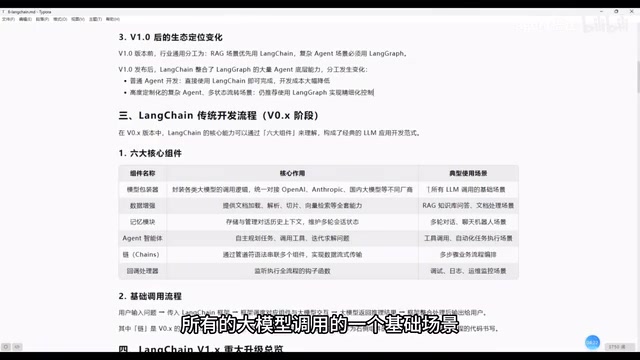
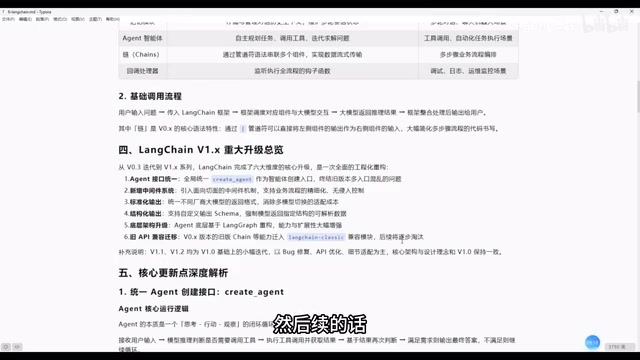
Version 0.3 consisted of six core components that formed the classic development paradigm: model wrappers for unified integration with various large models, data augmentation for RAG document loading and retrieval, a memory module for managing multi-turn context, Agents for autonomous planning and tool calling, Chains for piping components together, and callback handlers for listening to execution hooks. This paradigm remained in use for a long time during the 0.3 era.
The changes in 1.0 are structural. The tutorial lays out the version timeline as follows: 1.0 launched in October 2025, 1.1 in November, and 1.2 in December; the latest version is currently 1.4. However, the tutorial also notes that minor releases like 1.1 and 1.2 are mainly detail adjustments and bug fixes, with few functional changes—so when learning, focus on 1.0.
Unified Agent Interface: create_agent Ends Entry-Point Chaos
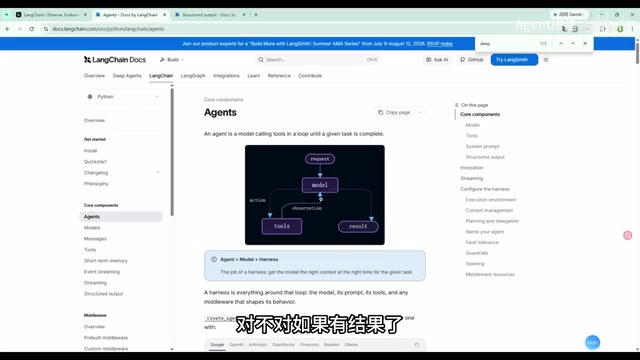
The most important upgrade is the unification of the Agent interface. In the 0.3 era, there were multiple ways to create an Agent, such as create_function_agent and create_openai_agent, each with different usage, and some models did not support tool calling, making creation error-prone. 1.0 consolidates all entry points into a single global unified entry: create_agent.
An Agent's core operating logic is the "think—act—observe" loop: after receiving user input, the model decides whether to call a tool; if so, it executes the tool (for example, querying the weather), then based on the result decides again whether the need is satisfied—if so, the loop stops; otherwise, it continues thinking and calling. The entire process requires no manual intervention.
Model initialization has also been unified. The recommended approach is init_chat_model, passing the model vendor and model name; a dedicated method for OpenAI is also retained. The tutorial suggests going straight to the official docs' quick start, noting that it requires Python 3.10—older versions need to be upgraded first.
What Is "Tool Calling"?
Tool calling is the key mechanism that lets large models break free from the limitation of "only generating text." The model itself cannot actually check the weather, search the web, or read and write files, but based on the user's request it can output a structured "call intent" (for example, the function name get_weather and the argument {"city": "Beijing"}). The framework captures this intent, actually executes the corresponding function, and passes the result back to the model, which decides the next step. This is precisely the underlying support for the Agent's "think—act—observe" loop. In the 0.3 era, some models did not support tool calling, meaning they could not participate in this loop; thus create_agent's unified entry implicitly also filters model capabilities. Understanding tool calling helps clarify why Agent development is highly dependent on model selection, and why structured output (forcing the model to return a parseable structure) and tool calling often share the same underlying capabilities in implementation.
Middleware System: Non-Intrusive Control via Aspect-Oriented Programming
Middleware is the most representative engineering feature of 1.0, borrowing the AOP (aspect-oriented programming) idea from backend frameworks to insert custom logic at various nodes of the main flow through hook functions.
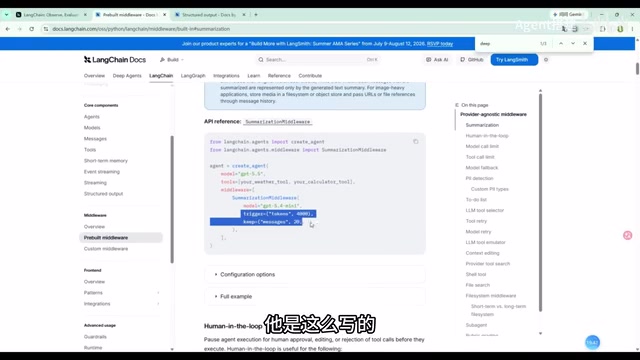
Its value lies in decoupling business logic from cross-cutting concerns and preventing main-flow code from becoming bloated. The tutorial divides middleware capabilities into two categories: monitoring—logging, timing analysis, full-trace debugging, and security auditing; and control—tool-call interception, output format unification, automatic retry on failure, fallback responses, call rate limiting, and safe content validation. The framework includes a variety of built-in middleware, such as summarization middleware that compresses conversation history by token count, human-review middleware, middleware that limits model and tool call counts, and middleware that detects personal information.
The tutorial focuses on demonstrating two typical scenarios. The first is automatic summary compression in multi-turn conversations: to avoid exceeding the context window in tokens, a compression model compresses early conversation while retaining core information, and the most recent 20 raw messages are kept. One detail: the parameters differ between 1.0 and 1.2—1.0 uses parameters such as max_token_before_summary, while 1.2 configures via trigger and message parameters—but the core functionality is the same. The second is Human-in-the-loop: pausing the flow before executing dangerous tools such as sending emails or deleting files, waiting for a human to choose to approve, modify parameters, or reject. Custom middleware can be implemented by inheriting AgentMiddleware or by mounting via decorators.
AOP (Aspect-Oriented Programming) and Hook Functions
AOP is a programming paradigm whose core idea is to extract "cross-cutting concerns" such as logging, authentication, rate limiting, and transactions out of the main business flow and weave logic automatically at specified join points (such as before a method executes, after it executes, or on exception) via "aspects." In traditional object-oriented programming, this logic is often scattered across business methods, causing code duplication and bloated main flows; AOP lets business code focus only on the business itself. LangChain middleware borrows exactly this approach: the Agent's main flow (model thinking, tool calling, result observation) remains unchanged, while developers insert custom logic at nodes such as "before model call," "before tool call," and "after tool call." In this way, capabilities like logging, human review, and rate limiting can be developed independently and composed on demand, without affecting the main flow, and are easy to reuse and test.
Standardized Output vs. Structured Output: Two Different Problems
Standardized output addresses the problem of inconsistent response formats across model vendors. Some models call the process field thinking, others reasoning, so switching models requires extensive adaptation in upper-layer business code. LangChain provides the content_block property, which maps each vendor's response into a unified standard structure so upper layers only need to read the content, enabling seamless multi-model switching; the type field indicates whether it is text content or reasoning process.
Structured output solves a different problem: making model output controllable. By specifying a schema via response_format, the model is forced to return parseable structured data of the specified shape (for example, containing fields such as name and email), turning output from uncontrollable to controllable. There are three implementation approaches: tool-call formatting, invoking the vendor's native structured capability, and automatically selecting the optimal method for the current model.
Schema and response_format
A schema is a formal description of a data structure, specifying which fields an object should contain and the type and constraints of each field. In structured output scenarios, developers define the desired output structure using JSON Schema or Pydantic models, for example {name: string, email: string}, and then pass it to the model via the response_format parameter. The framework converts the schema into instructions or tool definitions the model can understand, forcing the model to generate content according to that structure; if the model's return does not conform to the schema, the framework can also trigger retries or corrections. The essence of response_format is turning "free-text generation" into "constrained filling," so downstream code can safely parse by field without fragile string matching. It complements standardized output (content_block): the latter unifies return formats across vendors, while the former constrains the content structure of a single output.
Ecosystem Positioning and Learning Advice
The LangChain ecosystem includes three core products: the open-source frameworks LangChain and LangGraph, and the commercial operations platform LangSmith (paid commercial). The tutorial argues that for most development scenarios, learning LangChain is sufficient; only particularly complex agent orchestration requires LangGraph. After 1.0, LangChain has integrated a large amount of LangGraph's underlying Agent capabilities, significantly lowering the cost of ordinary Agent development; for highly customized complex Agents, LangGraph is still recommended for fine-grained control.
The old Chain capability has been migrated to the LangChain Classes module and will gradually be replaced by the Agent form. The tutorial warns that the official docs' Chinese translation is sometimes inaccurate (for example, middleware-related pages), so it is advisable to study against the English original.
Overall, the core strengthening direction of 1.0 is the agent and engineering-oriented middleware system, with substantial improvements in stability, maintainability, and extensibility. For developers who need to ship production-grade large-model applications, this unified Agent entry, non-intrusive middleware mechanism, and standardized output constitute framework capabilities that must be mastered today.
One-line Summary
LangChain 1.0 refactors the Agent entry, middleware, and output system to drive production readiness.
Paragraph Summary
LangChain 1.0 is not a simple API optimization but a ground-up architectural refactor aimed at production deployment. The article reviews the core changes from 0.3 to 1.0 and subsequent minor releases: the Agent creation entry is unified as create_agent, ending entry-point chaos; an AOP-inspired middleware system is introduced, using hooks for non-intrusive controls such as summary compression, human review, and rate limiting; standardized output uses content_block to unify return formats across vendors, while structured output uses response_format to constrain model output structure. With the bottom layer rebuilt on LangGraph, ordinary Agent development costs are lower, while complex orchestration still favors LangGraph. The article also offers ecosystem positioning and learning advice, emphasizing focusing on 1.0 and studying against the English docs.
Related articles

Gemini 4 Neon Leak: A Potential Strong Contender Against Opus 5.5
A Hacker News thread suggests Gemini 4 Neon looks like an Opus 5.5 competitor. This article unpacks the product positioning behind this community signal, shifts in the top-model competitive landscape, and what it means for developers' model selection strategy.

Claude Fable 5.2's Self-Authored Short Film 'Fable' Sparks Discussion
A short film 'Fable,' credited to Claude Fable 5.2 for script, visuals, and directing, appears on Hacker News. This article analyzes the significance of full-pipeline AI creation, community reactions, and what it means for content creators.

Anthropic IPO Pricing: A Signal of AI Giants Going Public
Anthropic's IPO pricing draws attention. This article analyzes its potential impact on AI industry valuation, commercialization paths, and the competitive landscape, and highlights public-market expectations and challenges for AI companies.