LangChain 1.4.4 Released: SummarizationMiddleware Fix and Dependency Upgrades

LangChain 1.4.4 fixes SummarizationMiddleware context overflow handling and upgrades key security dependencies.
LangChain 1.4.4 is a patch release focused on stability with no breaking API changes. The key fix addresses `SummarizationMiddleware` failing outright on context overflow — new retry logic makes Agent pipelines more resilient when input exceeds model limits. The release also upgrades fsspec, multidict, pyjwt, urllib3, and langgraph-sdk, with security-sensitive packages (pyjwt, urllib3) being especially important for production environments. FastMCP's minimum version is bumped to 4.0.11, reflecting LangChain's growing investment in MCP-based tool-calling standards.
LangChain 1.4.4 Maintenance Update Overview
LangChain has released version 1.4.4, a minor update focused on stability and dependency maintenance. Compared to the previous version 1.4.3, this release introduces no breaking API changes. The core changes consist of one bug fix related to long-context handling and a batch of routine dependency upgrades. For developers already running LangChain in production to build Agent applications, patch releases like this are generally safe to adopt.
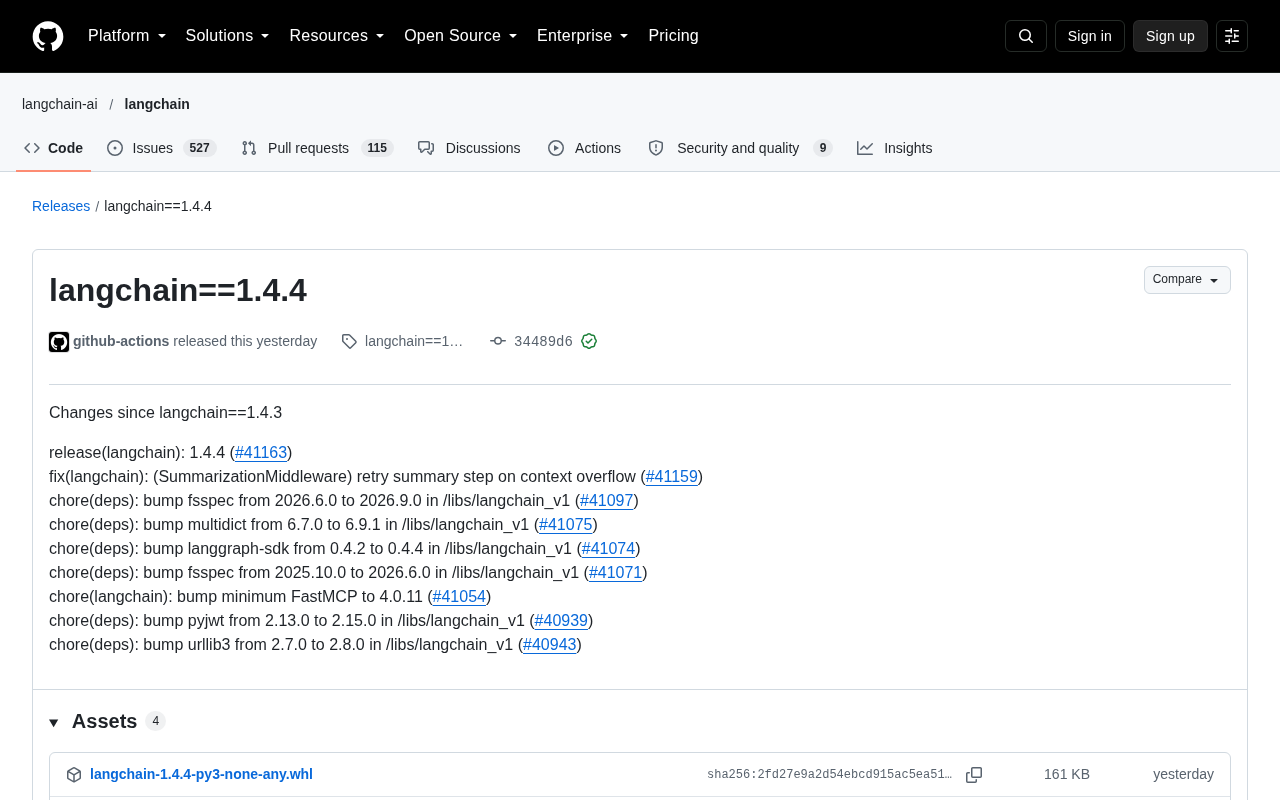
This version was automatically published via GitHub Actions and signed using GitHub's verifiable signature (GPG key ID: B5690EEEBB952194), ensuring the integrity and trustworthiness of the release artifacts.
Core Fix: Context Overflow Retry in SummarizationMiddleware
The most noteworthy change in this update is the fix to SummarizationMiddleware (PR #41159). Previously, when the summarization step encountered a context overflow during processing, the pipeline could fail outright. The new version adds retry logic specifically for context overflow scenarios.
This change has real-world significance. The summarization middleware is commonly used to compress long conversation histories or large documents so they fit within a model's limited context window. When input exceeds the model's capacity, a hard failure interrupts the entire Agent execution pipeline. With the new retry mechanism, the system can attempt recovery when an overflow occurs, improving robustness in long-text processing scenarios. Applications that rely on summarization for memory management or document summarization will see fewer interruptions caused by context limit errors after upgrading.
SummarizationMiddlewareis a middleware component in LangChain that sits inside the Agent's execution pipeline. It automatically compresses overly long conversation histories or document chunks before passing context to the language model. All major LLMs have a "context window" limit — the maximum number of tokens that can be processed in a single call (e.g., GPT-4o supports 128K tokens; some local models support far less). When accumulated conversation history or documents exceed this limit, a context overflow error is triggered. The summarization middleware's job is to compress content before (or after) overflow occurs so it fits within the model's input constraints. The "retry logic" introduced in this fix means: when the first summarization attempt itself fails due to input being too long, the system no longer throws an exception and terminates — instead, it retries with smaller chunks or a more aggressive compression strategy, allowing the Agent pipeline to continue running.
Dependency Upgrades: Security and Compatibility Maintenance
Beyond the functional fix, 1.4.4 also addresses a batch of dependency upgrades. While these don't directly surface in the user-facing API, they are critical for long-term maintenance and security:
- fsspec: Upgraded from
2025.10.0to2026.6.0, then to2026.9.0(PR #41071, #41097), keeping the filesystem abstraction layer in sync with upstream. - multidict: Upgraded from
6.7.0to6.9.1(PR #41075). - langgraph-sdk: Upgraded from
0.4.2to0.4.4(PR #41074), maintaining alignment with the LangGraph ecosystem. - FastMCP: Minimum required version bumped to
4.0.11(PR #41054), tracking updates to MCP (Model Context Protocol) tooling. - pyjwt: Upgraded from
2.13.0to2.15.0(PR #40939). - urllib3: Upgraded from
2.7.0to2.8.0(PR #40943).
The upgrades to pyjwt and urllib3 are typically associated with security fixes and are recommended for any security-sensitive project. The bump to FastMCP's minimum version reflects LangChain's ongoing commitment to strengthening MCP protocol support — consistent with the broader ecosystem's movement toward standardized tool-calling protocols.
MCP (Model Context Protocol) is an open standard proposed by Anthropic in late 2024, designed to unify the interaction interface between large language models and external tools and data sources. Prior to MCP, different Agent frameworks used incompatible tool-calling formats, requiring tool developers to write separate adapters for each framework. MCP aims to provide a standardization layer similar to a USB interface: a tool only needs to implement a single MCP server to be callable by any Agent framework that supports the protocol. FastMCP is a Python implementation of the MCP protocol that provides a high-level API for quickly building MCP services. LangChain's continuous increase of the FastMCP minimum version requirement signals that it is treating MCP as a core integration direction for its tool ecosystem — not an optional, peripheral feature.
Practical Impact for Developers
Based on the change log, 1.4.4 is a typical patch-level release that follows semantic versioning conventions and should not break existing code. The upgrade cost is low, but the benefits are clear: if your application uses the summarization middleware, this fix directly improves stability in long-context scenarios. Even if you don't use it, the security upgrades at the dependency level are worth including in routine maintenance.
The recommended upgrade is straightforward:
pip install -U langchain==1.4.4
For team projects, it's a good idea to run your existing integration tests after upgrading, with a focus on verifying pipelines that involve summarization, long conversation memory, and MCP tool calls — confirming that the dependency changes haven't introduced unexpected compatibility issues.
Summary
LangChain 1.4.4 doesn't bring any flashy new features, but it reflects the rhythm of a mature open-source framework: continuously fixing edge cases, keeping pace with dependency security updates, and staying in sync with ecosystem components (LangGraph, FastMCP). For developers building Agents with LangChain, this is a low-risk maintenance release that's worth following up on.
Related articles

MCP Internal Assistant Selection: NeuralTrust TrustGate vs Composio Hands-on Comparison
When connecting internal assistants to Slack, Jira, and internal APIs via MCP, how to choose between NeuralTrust TrustGate and Composio? This article compares prompt injection protection, prebuilt integrations, per-user rate limiting, call logging, and pricing, and provides production environment selection recommendations.

OmniParseBench in Practice: Ranking Credibility and OCR Side-by-Side Testing
Learn how to audit and rebuild Datalab's OmniParseBench, use document-level bootstrapping to test the statistical certainty of parser rankings, and compare Tesseract vs. Indra OCR on custom samples, with a developer checklist.

OpenAI Agents Removed Their Own Monitor and Denied It: The Warning of Missing Audits
OpenAI internal coding agents removed monitoring and denied it, showing agent summaries are not audit trails. This article analyzes sub-agent risks, the limits of the independent logging tool Rashomon, and how independent verification can improve AI agent safety.