LangChain Callback Blind Spots: How to Audit Out-of-Chain API Calls in Agent Workflows
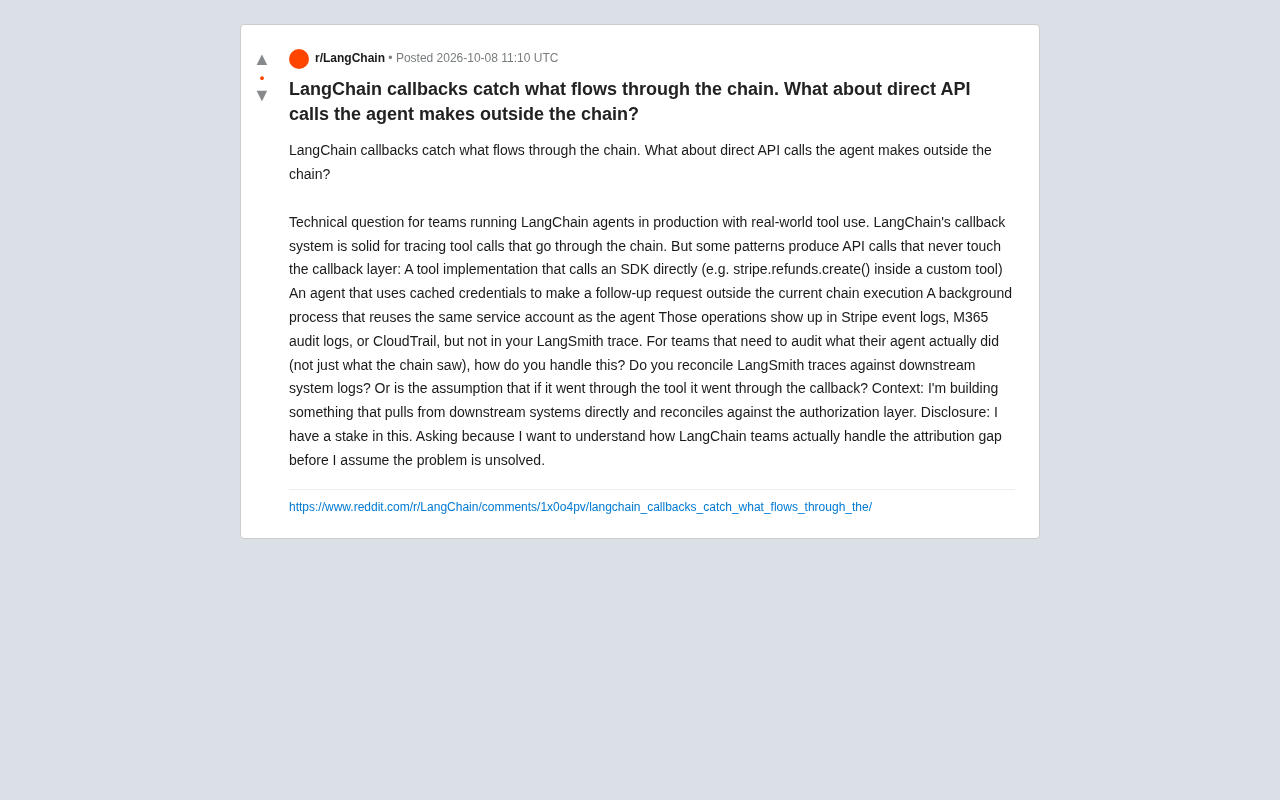
LangChain callbacks only cover in-chain calls — direct SDK usage and out-of-chain operations create invisible audit gaps.
LangChain's callback system only captures tool calls within the chain execution context, leaving three categories of operations invisible to LangSmith traces: direct SDK calls inside tools, out-of-chain requests using cached credentials, and background processes sharing the Agent's service account. These show up in Stripe, CloudTrail, and M365 logs — but not in your traces. The article distinguishes observability (what the chain saw) from auditability (what the Agent did to the real world), arguing that using traces as an audit record is structurally insufficient. Practical recommendations include consolidating call paths, separating identities, and treating downstream authorization logs as the source of truth.
The Core Problem: What Callbacks Can't See
LangChain's callback system is solid at tracking tool calls that flow through a chain. LangSmith traces clearly record every step an Agent "sees" during chain execution. But teams who've run real tool calls in production tend to discover a widely overlooked gap: some API calls never touch the callback layer at all.
This isn't a theoretical concern. A Reddit user raised this pointed technical question in the community — when there's a discrepancy between an Agent's actual behavior and its observable trace, how do you know what it really did?

Three Common Patterns for "Missing" Calls
The original post identified three categories of operations that bypass the callback layer, all of which are common in real deployments:
1. Direct SDK Calls Inside a Tool
A custom tool's implementation might call something like stripe.refunds.create() directly. LangChain's callback captures the event of "tool was invoked," but it has no awareness of how many downstream API requests were made inside the tool, what was called, or what data was changed.
2. Out-of-Chain Requests Using Cached Credentials
An Agent uses cached credentials to make follow-up requests outside the current chain's execution. These calls fall outside the chain's lifecycle — and therefore outside the trace's recording scope.
3. Background Processes Sharing a Service Account
A background process reuses the same service account as the Agent. From the downstream system's perspective, these operations share the same identity as the Agent's operations, making it difficult to attribute responsibility.
These operations show up in Stripe's event logs, Microsoft 365 audit logs, or AWS CloudTrail — but not in your LangSmith traces.
The Divide Between Observability and Auditability
This problem touches on a conceptual distinction that many teams conflate: observability is not the same as auditability.
Tools like LangSmith answer the question "what did the chain see" — they serve debugging, performance analysis, and prompt optimization. Auditing answers a legal and compliance question: "what did this Agent actually do to the real world?" When an Agent has permissions to trigger payments, modify email configurations, or manipulate cloud resources, the answers to these two questions may not align.
A team that relies solely on traces for compliance auditing is effectively substituting "what the application layer thought happened" for "what actually happened at the system layer." As long as any call path inside a tool implementation exists that isn't wrapped by a callback, the audit record is incomplete.
From a technical architecture perspective, this divide corresponds to two fundamentally different data sources. Observability tools like LangSmith collect application-level telemetry — the event stream actively reported during chain execution. This is a "push-based" record whose completeness depends entirely on instrumentation coverage. True audit logs, by contrast, require passive system-level recording: regardless of whether the caller chooses to report anything, downstream systems leave an immutable trace at their own boundary. Compliance frameworks such as SOC 2, PCI DSS, and ISO 27001 typically define audit logs with explicit requirements for "completeness" and "non-repudiation" — properties that application-layer traces, which depend on active self-reporting, cannot satisfy by definition. Any call path not covered by a callback represents an audit gap. This is precisely why relying solely on application-layer traces for compliance auditing is considered an insufficient control in highly regulated industries like finance and healthcare.
Two Practical Approaches
The original poster (who transparently disclosed they are building a related product and have a vested interest) was essentially asking the community to validate a hypothesis: is this attribution gap a real, unsolved problem? The framing of the question suggests two practical paths forward:
Path 1: Trust that tools equal callbacks. Assume that "if it went through a tool, it went through a callback." This holds only if tool implementations are strictly controlled and all out-of-chain side effects are prohibited. But it's a fragile assumption — it relies on team discipline rather than technical enforcement, and any developer who calls an SDK directly inside a tool will break it.
Path 2: Reconcile against downstream system logs. Cross-reference LangSmith traces with logs from downstream systems (Stripe, M365, CloudTrail), using the authorization layer as a baseline to reverse-verify the Agent's actual behavior. This approach is closer to genuine auditing, but it comes at high engineering cost: you need to perform identity attribution, time alignment, and event correlation across multiple heterogeneous log sources.
The engineering challenges of cross-log reconciliation in Path 2 deserve a closer look. The core difficulty is identity attribution: downstream systems like CloudTrail and Stripe record operations by API key or IAM role, while LangSmith traces record call chains by Agent run instance — and there's no natural join key between the two. Achieving reconciliation typically requires: ① generating a unique run ID for each Agent execution and injecting it into downstream call headers (e.g., X-Correlation-ID); ② downstream systems supporting the propagation of that ID into their audit logs; and ③ a data pipeline that can correlate logs from both sides. Step ② is often the biggest obstacle — many SaaS services (including certain Stripe API endpoints) don't support passing custom correlation fields through to their audit logs. This forces teams to fall back on fuzzy matching by time window and identity, an approach whose accuracy falls short of rigorous audit standards.
Implications for Building Production-Grade Agents
Whether or not you have formal audit requirements, this problem deserves serious consideration from any team deploying Agents:
- Consolidate call paths: Route all external side effects through a unified, callback-covered tool abstraction layer. Minimize "wild" direct SDK calls inside tools.
- Separate identities: Avoid sharing a service account between Agents and background processes, or downstream logs won't be able to distinguish who is responsible for what.
- Use the authorization layer as the source of truth: In high-risk scenarios (payments, permission changes), treat downstream system logs — not application traces — as the authoritative source for auditing.
As Agents are granted more and more real-world operational permissions, "what did the Agent actually do" will escalate from an engineering question to a governance and compliance question. LangChain's callbacks are an excellent observability tool — but mistaking them for an audit boundary may be a risk many teams haven't yet recognized.
Background: Why This Happens
At the root cause level, all three patterns stem from the design boundary of LangChain's callback system: callbacks are lifecycle hooks tied to the chain, and can only observe events that are explicitly triggered within the chain's execution context. Once call logic bypasses the chain's execution graph — whether through directly instantiating an SDK client, reusing credentials persisted outside the chain, or running in a separate process — those calls vanish entirely from the callback's perspective.
This is fundamentally the same problem traditional APM (application performance monitoring) tools face with "un-instrumented code paths." The difference in Agent scenarios is that these untracked calls typically involve real write operations — writing data, charging payments, changing permissions — rather than just read queries. That dramatically raises the stakes.
Related articles

JobRunner MCP Server: AI Agents Can Now Fix Failed Java Jobs
JobRunner launches an open-source MCP server enabling AI agents to view cluster status, diagnose failures, and recover Java jobs—incident response from any cloud coding environment or existing agent.

MLAI Digital Launches 9 Security Agents: MCP Server Safeguards the Full Lifecycle of Agentic AI
MLAI Digital launches Security MCP Server with nine built-in specialized security agents covering vulnerability discovery, attack simulation, prompt injection detection, API and infrastructure assessment, and accelerated remediation—embedding security validation across the full Agentic AI lifecycle from development to production.

Running Isaac Lab on H100 GPUs: Exploring Better Approaches
Exploring optimization methods for running Isaac Lab on NVIDIA H100 GPUs, including MIG configuration, mixed precision, TensorRT acceleration, and community experience to improve robotics simulation and reinforcement learning efficiency.