LangChain Core 1.6.6 Released: Claude Sonnet 5.5 Support and Documentation Fixes

langchain-core 1.6.6 adds Claude Sonnet 5.5 support and fixes documentation examples in a low-risk patch release.
The LangChain team has released langchain-core 1.6.6, a minor patch update focused on model compatibility and documentation quality. The two key changes are: added compatibility support for Anthropic Claude Sonnet 5.5, enabling developers to call the latest Claude model through LangChain without extra adaptation; and fixed docstring examples in core modules that couldn't be directly copied and run, lowering the barrier for new users. This release introduces no breaking changes and is verified with a GitHub GPG signature. Teams using LangChain in production who plan to integrate Claude Sonnet 5.5 are encouraged to validate and upgrade in a test environment first.
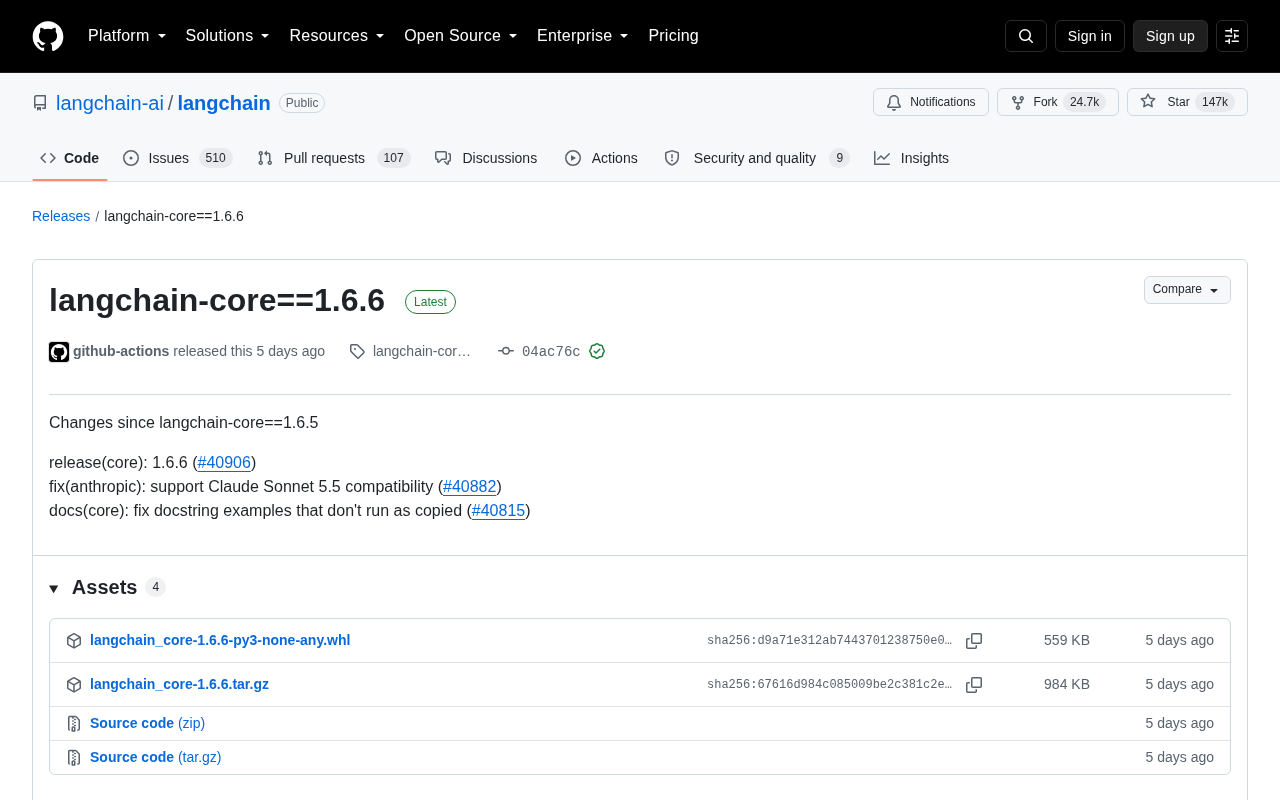
LangChain has released langchain-core version 1.6.6. As one of the leading AI application development frameworks on GitHub — with over 147,000 stars and 24,700 forks — every core package update from LangChain has a broad impact on the vast number of LLM applications built on top of it. This 1.6.6 release is a minor patch update focused on model compatibility and documentation quality.
What's in This Update
According to the official release notes, langchain-core 1.6.6 includes three key changes compared to the previous version 1.6.5:
Claude Sonnet 5.5 Compatibility Support
The most notable change is a compatibility fix for Anthropic Claude Sonnet 5.5 (PR #40882). This means developers using LangChain to call the latest Claude models can integrate the new model without any additional adaptation. As Anthropic continues to iterate on the Claude model family, whether a framework can keep up in a timely manner is an important consideration for developers evaluating their toolchain. LangChain has responded quickly to this need in the current release.
Claude Sonnet 5.5 is Anthropic's next-generation mid-tier model introduced in 2025, designed to strike a balance between performance and cost — targeting production scenarios that require strong reasoning capabilities while remaining sensitive to latency and pricing. Anthropic's model naming follows a "family + tier + version" convention: Haiku for lightweight and fast, Sonnet for balanced, and Opus for flagship high-performance use cases. Each time Anthropic releases a new model, subtle changes to API request/response formats, tool-calling protocols, or supported parameter fields can cause issues if the framework hasn't been updated accordingly — including unrecognized model identifiers or response parsing failures. LangChain's Claude integration is implemented via the langchain-anthropic sub-package, but the foundational compatibility abstractions are defined in langchain-core, making core package updates a prerequisite for new model support.
Documentation Example Fixes
This update also fixes docstring examples in core modules that couldn't be directly copied and run (PR #40815). Code examples in documentation that don't work out of the box can be a significant source of frustration for newer developers. While this type of fix doesn't touch functional logic, it has real value for the framework's usability and community friendliness.
Routine Version Release
In addition to the above, there is a standard release commit for version 1.6.6 (PR #40906). This commit was completed automatically by GitHub Actions and verified with a GitHub GPG signature (Key ID: B5690EEEBB952194), ensuring the trustworthiness of the release artifact.
What This Means for Developers
For teams running LangChain in production, this is a low-risk patch-level update. It introduces no breaking changes, and its primary value lies in:
- If your application is planning to use or is already using Claude Sonnet 5.5, upgrading to 1.6.6 can help you avoid potential compatibility issues;
- If you rely on the official documentation for development, more accurate example code reduces the likelihood of running into pitfalls.
For users who haven't upgraded yet, you can prioritize the update based on your own need to use the new Claude model. Pure patch versions are generally safe to follow promptly.
LangChain's Continuous Iteration
As a middleware framework connecting large language models to application logic, LangChain's core package carries the foundational abstractions for messages, prompts, chain calls, and more. The frequent minor version releases reflect the project's active development pace — keeping up with the rapid update cycles of major model providers is critical for this type of framework to remain competitive.
This update also highlights a broader trend: AI application development frameworks are increasingly investing effort in model compatibility adaptation. In an environment where model providers iterate rapidly, the "adapter" role played by the framework layer becomes ever more important — shielding developers from the differences in underlying model APIs and allowing them to call different models through a unified interface.
langchain-core is the lowest-level package in the entire LangChain ecosystem, defining core abstract interfaces such as BaseMessage, PromptTemplate, and Runnable. Higher-level packages — including langchain, langchain-community, and vendor-specific integration packages like langchain-anthropic and langchain-openai — all depend on these interfaces. This layered architecture gives the framework excellent extensibility: adding a new model provider only requires implementing the corresponding integration package, without modifying core logic. However, this also means that any changes to langchain-core propagate upward and affect the entire dependency chain. For this reason, core package updates tend to be conservative — minor versions strictly adhere to Semantic Versioning (SemVer) and introduce no breaking changes, allowing downstream projects to safely follow along.
How to Upgrade
Upgrading is straightforward — simply use pip:
pip install -U langchain-core==1.6.6
It's recommended to review your project's dependency lock file before upgrading, and to validate in a test environment before pushing to production. For projects using the Anthropic integration, pay particular attention to verifying that Claude-related calls work as expected after upgrading.
Related articles

Why Does the Tesla Roadster Need to Fly? A Deep Dive into Musk's Wild Demo
Tesla's Roadster launch showed wall-climbing, upside-down driving, and flying stunts—but The Vergecast notes the demo car may lack a battery, the Rocket version is invite-only and not street-legal, and the website terms don't guarantee delivery. After nine years of delays, why does this car still need to exist?

AI Is Not a Replacement: Human-AI Collaboration Through the Lens of Factory Root Cause Analysis
Starting from factory root cause analysis, this article explains how AI accelerates evidence chain construction rather than replacing human experts, exploring the pragmatic implementation logic and business value of 'AI supporting people rather than replacing them.'

AI Agent Decision Auditing: Building an Evidence Chain in Regulated Workflows
Starting from a Reddit discussion, this article analyzes three core issues in AI agent decision auditing within regulated workflows: what fields audit records should contain, how to handle feedback latency for erroneous decisions, and how to continuously calibrate LLM judge consistency with human judgment.