LangChain-Fireworks 1.7.0 Released: Introduces Prompt Caching Middleware

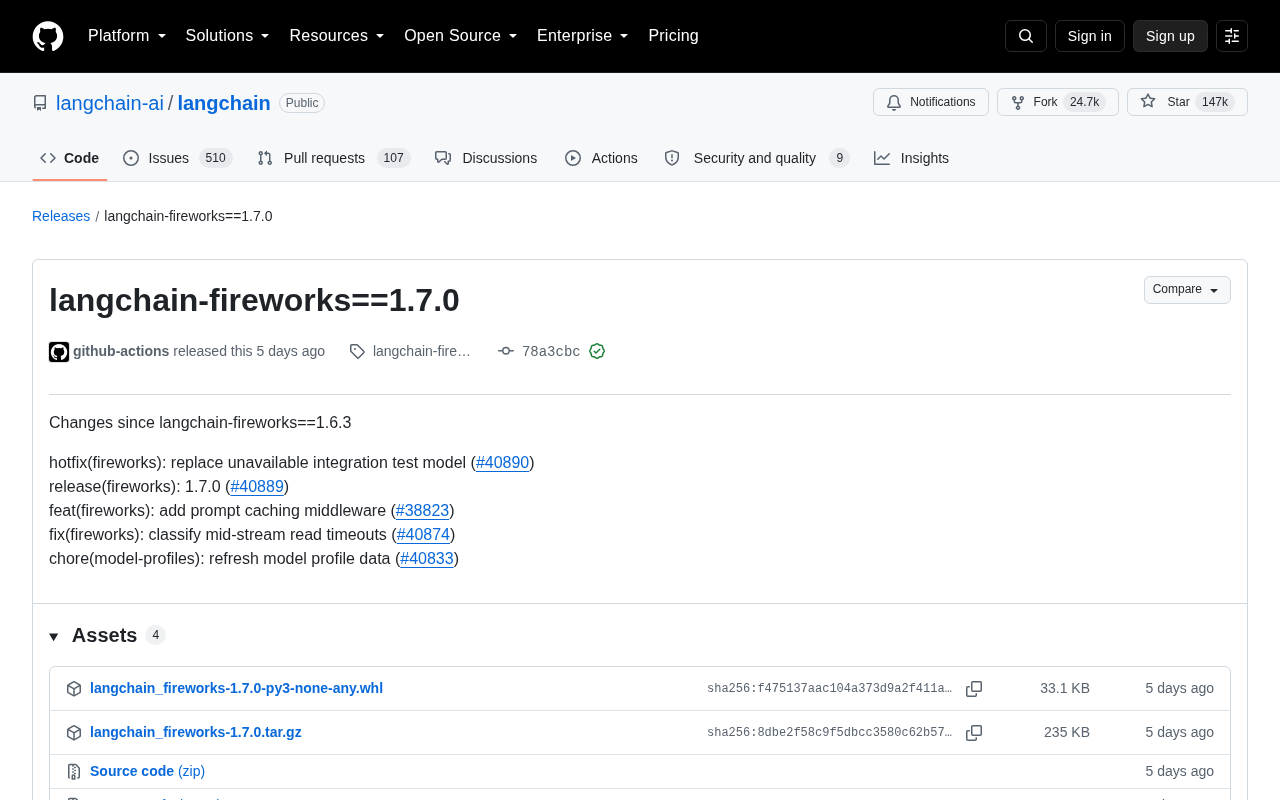
LangChain-Fireworks 1.7.0 adds prompt caching middleware and fixes streaming timeout classification.
langchain-fireworks 1.7.0 is a routine but impactful update to LangChain's official Fireworks AI integration. The headline feature is a prompt caching middleware (PR #38823) that reuses KV Cache for identical prefixes — reducing latency and token costs in high-frequency call scenarios without any changes to business logic. On the stability side, the release fixes mid-stream read timeout classification for more accurate error handling and retry logic, replaces a broken model in integration tests via hotfix, and refreshes built-in model profile metadata. Following semantic versioning, this is a backward-compatible minor release recommended for teams relying on streaming responses or frequently calling with fixed context.
The Fireworks integration package for the LangChain ecosystem has landed its 1.7.0 update. Automatically published via GitHub Actions, this release brings a prompt caching middleware, improved streaming timeout classification, and refreshed model profile data — delivering both performance gains and stability improvements for LangChain developers using Fireworks AI inference services.
Release Overview
langchain-fireworks is an officially maintained LangChain integration module that connects to large model inference services provided by Fireworks AI. As part of LangChain — one of the most prominent open-source projects with over 147,000 stars and 24,700 forks — every iteration sees widespread adoption in production environments.
Compared to the previous stable release 1.6.3, version 1.7.0 merges several key commits spanning new features, bug fixes, and maintenance changes. The release was automatically built by the github-actions bot and signed with GitHub's verified signature, ensuring the integrity of the distribution chain.
Core Highlight: Prompt Caching Middleware
The most noteworthy addition in this release is the new prompt caching middleware (PR #38823). Prompt caching has become an important technique for reducing costs and improving efficiency in LLM applications — when an application repeatedly sends requests with identical prefixes (such as system prompts, fixed context, or few-shot examples), the caching mechanism can reuse previously processed portions, significantly reducing latency and cutting token costs from redundant computation.
This scenario is extremely common for developers building RAG systems, agent workflows, or multi-turn conversation applications. Integrating caching as middleware into the Fireworks call chain means developers can enable this optimization with minimal code changes, without having to manually rework request logic.
Prompt caching is typically implemented using KV Cache (key-value cache) technology: when a Transformer model processes input, it computes Key and Value matrices for the attention mechanism for each token. If the token sequence of an identical prefix is cached across multiple requests, the inference engine can skip recomputing that portion and read directly from the cache. Both Anthropic's Claude and Google's Gemini already offer similar capabilities at the API level, billing separately for cache hits and misses — token costs can drop by 50%–90% on a cache hit. Fireworks AI, as a platform focused on inference acceleration, exposes this capability as middleware within the LangChain call chain. Developers can benefit without changing any business logic, making it especially suitable for scenarios with long system prompts (such as those containing extensive tool descriptions or RAG retrieval results).
Stability and Maintenance Improvements
Beyond the new feature, this release includes two reliability-focused changes. The first is a fix for the classification logic of mid-stream read timeouts in streaming output (PR #40874) — previously, a read timeout occurring mid-stream might not be correctly categorized, undermining error handling and retry strategies. Explicitly classifying mid-stream read timeouts helps upstream applications capture and respond to network anomalies more precisely.
The second is a hotfix (PR #40890) that replaces a no-longer-available model used in integration tests. While not directly visible to end users, this keeps the continuous integration pipeline healthy and reflects the long-term maintenance quality expected of an open-source project.
Additionally, the release refreshes the model profile data (PR #40833), keeping the framework's built-in model metadata in sync with the models currently available on the Fireworks platform.
Timeout classification in streaming scenarios is inherently complex because HTTP connections can experience different types of timeouts at different stages: a connect timeout during connection establishment, a response timeout while waiting for the first response byte, and a read timeout when data packets stop arriving after data has already started flowing. For non-streaming requests, these three timeout semantics are relatively clear-cut. However, streaming requests maintain a long-lived connection and continuously receive chunked data — mid-stream read timeouts can be incorrectly categorized as generic network errors by some HTTP client libraries. This prevents the upstream retry logic from distinguishing between "server has not yet responded" and "response interrupted mid-stream" — two fundamentally different failure modes — leading to inappropriate retry strategies. This fix clarifies that classification, allowing developers to set separate retry rules specifically for mid-stream interruptions.
What This Means for Developers
Overall, this update is a routine iteration that balances feature enhancements with stability improvements. Prompt caching is a practical capability for cost-sensitive production scenarios — teams that frequently call with fixed context are especially encouraged to take note. The streaming timeout classification fix is more relevant for real-time applications that rely on streaming responses.
Upgrading follows the same process as other LangChain integration packages — simply specify the version via your package manager. The version bump from 1.6.x to 1.7.0 follows semantic versioning conventions and represents a minor release with backward-compatible new features, so breaking changes are generally not expected. That said, it's still recommended to review the full changelog and validate in a test environment before upgrading.
Related articles

Why Does the Tesla Roadster Need to Fly? A Deep Dive into Musk's Wild Demo
Tesla's Roadster launch showed wall-climbing, upside-down driving, and flying stunts—but The Vergecast notes the demo car may lack a battery, the Rocket version is invite-only and not street-legal, and the website terms don't guarantee delivery. After nine years of delays, why does this car still need to exist?

AI Is Not a Replacement: Human-AI Collaboration Through the Lens of Factory Root Cause Analysis
Starting from factory root cause analysis, this article explains how AI accelerates evidence chain construction rather than replacing human experts, exploring the pragmatic implementation logic and business value of 'AI supporting people rather than replacing them.'

AI Agent Decision Auditing: Building an Evidence Chain in Regulated Workflows
Starting from a Reddit discussion, this article analyzes three core issues in AI agent decision auditing within regulated workflows: what fields audit records should contain, how to handle feedback latency for erroneous decisions, and how to continuously calibrate LLM judge consistency with human judgment.