LangChain Multimodal in Practice: Image Recognition with ChatPromptTemplate

A practical guide to multimodal image recognition using LangChain's ChatPromptTemplate.
This article introduces the concept and technical principles of multimodal AI, focusing on how to build multimodal image recognition applications using LangChain's ChatPromptTemplate. Image input supports three methods: URL, Base64 encoding, and local file paths, with calling logic consistent across audio and video modalities. The article also demonstrates an advanced approach to integrating multimodal capabilities into PySide6 desktop applications for practical features like OCR.
What is Multimodal AI
Multimodal AI is one of the most closely watched technological directions in the field of artificial intelligence today. In simple terms, it's an intelligent system with full sensory interaction capabilities — combining perception, understanding, and content generation to simultaneously process multiple types of information input and output, including text, images, audio, and video.
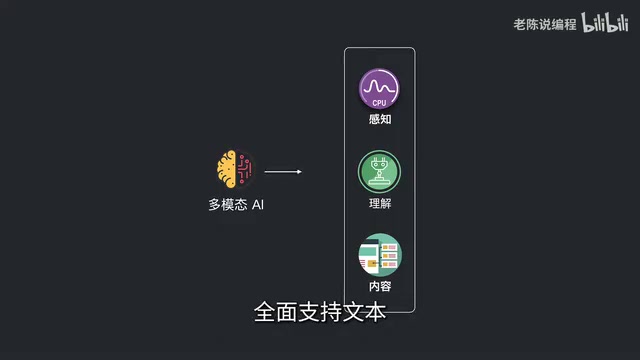
The core idea behind multimodal AI originates from human cognitive science — the human brain is naturally a multimodal processing system, simultaneously receiving and integrating information through multiple sensory channels such as vision, hearing, and touch. On the technical implementation level, breakthroughs in multimodal AI have been driven by the Transformer architecture's unified representation capabilities. The Transformer architecture proposed by Google in 2017 was initially used for natural language processing, but researchers quickly discovered that by splitting images into patch sequences (like the ViT model) or converting audio into spectrograms, data from different modalities could all be encoded into unified vector representations, enabling joint training and inference within the same model framework. Models like OpenAI's GPT-4V, Google's Gemini, and Anthropic's Claude 3 all adopt this cross-modal alignment approach, giving a single model the ability to simultaneously understand multiple information types.
Unlike traditional single-modal models (such as early versions of ChatGPT that only handled text conversations), multimodal AI breaks down barriers between information types. Users can simultaneously send an image and a text description, and the model can comprehensively understand these different modalities and provide accurate responses. This capability is enormously valuable in real-world scenarios — from image content recognition and document OCR to video understanding, multimodal technology is continuously expanding the boundaries of AI applications.
How LangChain Supports Multimodal Input
In the LangChain framework, ChatPromptTemplate natively supports multimodal message formatting. This means developers don't need to build complex data processing logic themselves to quickly build multimodal AI applications.
LangChain is an open-source AI application development framework created by Harrison Chase in 2022. Its core design philosophy is to connect large language models with external data sources, tools, and workflows through "chain" calls. ChatPromptTemplate is the core component responsible for message formatting in LangChain, elevating prompt engineering from hardcoded string concatenation to a structured template system. In multimodal scenarios, ChatPromptTemplate follows OpenAI's multimodal message specification — message content is no longer a single text string, but an array containing multiple content blocks, where each block can be of type text, image_url, or other modality types. This design allows developers to combine inputs from different modalities like building blocks, without worrying about the serialization details of the underlying API.

Image Modality: The Best Starting Point for Multimodal Development
This article uses image modality as the entry point for hands-on demonstration. The good news is that the calling logic and syntax for other modalities (audio, video, etc.) are exactly the same as for image modality — once you master image modality usage, you can directly apply the knowledge to other modalities.
LangChain's ChatPromptTemplate provides three flexible parameter input methods when handling image input:
- URL method: Directly pass in the image's web link address, suitable for web application scenarios. The model service will download and process the image on its own, and developers don't need to worry about image transmission details.
- Base64 encoding: Convert the image to a Base64 string before passing it in, suitable for local images or scenarios requiring embedded transmission. Base64 is an encoding scheme that converts binary data into ASCII strings, using 64 printable characters (A-Z, a-z, 0-9, +, /) to represent arbitrary binary data. In multimodal AI applications, since HTTP APIs typically transmit data in JSON format, and JSON is a plain text format that cannot directly embed binary files, Base64 encoding solves this critical problem — an image can be converted into a long string directly embedded in the JSON request body. The tradeoff is that encoded data volume increases by approximately 33%, so for large images, the URL method is usually a more efficient choice. In Python, the
base64standard library provides theb64encodemethod, and encoding can be completed in just a few lines of code. - Local file path: Directly specify the image file path on the local disk, the preferred choice for desktop application development.
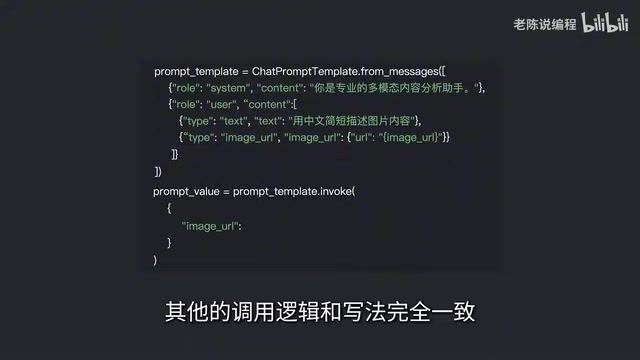
All three methods can be dynamically injected into the template as parameters, and developers can flexibly choose based on actual business requirements. For example, web applications typically use the URL method, while local file paths are more convenient for desktop applications.
Hands-On: Implementing Image Recognition with ChatPromptTemplate
Core Code Approach
The process of building a multimodal image recognition application using ChatPromptTemplate can be broken down into four steps:
- Create the message template: Define the message structure containing image content in
ChatPromptTemplate. Specifically, you need to include both text-type and image_url-type content blocks in the human message, where the image_url value can be a template string containing placeholder variables. - Dynamically inject parameters: Pass the image path (URL / Base64 / local path) as a variable into the template. LangChain automatically replaces variables with actual values and serializes the message according to the format required by the model API.
- Call model inference: Send the formatted multimodal message to a large language model with vision capabilities (such as GPT-4o, Gemini, etc.). Note that not all large language models support multimodal input — developers need to confirm that the chosen model has visual understanding capabilities. GPT-4o is currently one of the most comprehensive commercial models for multimodal capabilities, while open-source models like LLaVA and Qwen-VL also provide decent visual understanding abilities.
- Get recognition results: The model returns its understanding and analysis of the image content.
The entire process requires very little code — just a few lines can run a complete image recognition pipeline.
Verifying the Results
After running the code directly, the model successfully recognized the content in the image, verifying the correctness of the entire multimodal call chain.
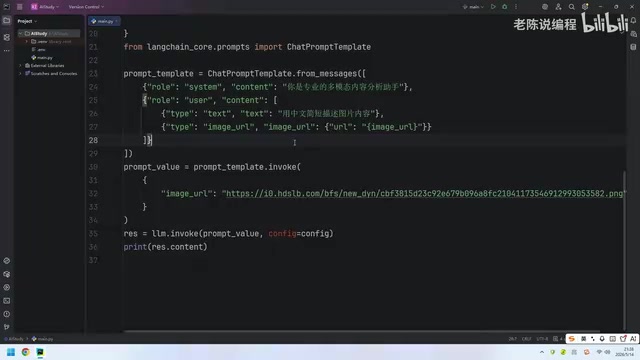
From the results, LangChain's multimodal support is not only clean in API design but also delivers impressive recognition accuracy. From template definition to result output, the entire process is very smooth, fully demonstrating LangChain's design advantages in simplifying AI development workflows.
Advanced Application: Integration with PySide6 Desktop Applications
After mastering basic multimodal calls, the next step is to integrate image recognition functionality into actual application interfaces. A very practical direction is combining it with PySide6 to develop desktop AI tools.
PySide6 is the officially maintained Python binding library from The Qt Company, which fully exposes the Qt 6 mature C++ cross-platform GUI framework to Python developers. Compared to another popular Qt binding library PyQt6, PySide6 adopts the more permissive LGPL license, allowing free use in commercial projects, making it the preferred choice for enterprise-level desktop application development. PySide6 provides rich UI components (buttons, tables, file dialogs, etc.), layout management systems, signal and slot mechanisms, and multithreading support. In AI tool development scenarios, PySide6's QFileDialog can conveniently implement image selection functionality, QThread can move time-consuming model inference to background threads to avoid UI freezing, and QWebEngineView can even embed complete web pages.
Combining LangChain's multimodal capabilities with PySide6's GUI framework, you can implement the following features:
- Text Recognition (OCR): Upload images to automatically extract text content. Traditional OCR solutions (such as Tesseract, PaddleOCR) typically use specially trained text detection and recognition models, requiring multiple pipeline steps including text region localization, character segmentation, and individual character recognition. In contrast, multimodal large model-based OCR takes a completely different paradigm — the model directly "sees" the entire image and understands the text content within it, without requiring explicit text detection steps. This end-to-end approach often performs better when handling complex layouts, handwriting, and multilingual mixed text, because large models have powerful contextual understanding capabilities that can leverage semantic information to correct recognition errors. Of course, the inference cost of multimodal large models is much higher than traditional OCR engines, and in practice, trade-offs need to be made based on accuracy requirements and cost budgets.
- Link Recognition: Identify URL links from screenshots and support one-click navigation
- Image Content Description: Generate natural language descriptions for uploaded images
- Table Data Extraction: Extract structured data from tables in images
By combining LangChain's multimodal capabilities with PySide6's GUI framework, developers can quickly build fully-featured, user-friendly desktop-level AI tools. This combination is particularly suitable for internal enterprise tool development and personal productivity tool creation, with low development costs and a fast learning curve.
Summary: Why Choose LangChain for Multimodal Development
LangChain's ChatPromptTemplate provides a concise yet powerful solution for multimodal AI application development. Looking back at this hands-on guide, its core advantages are reflected in three aspects:
- Unified API design: The calling logic for different modalities (images, audio, video) remains consistent — learn one, know all three. This design follows the "Principle of Least Astonishment" in software engineering, significantly reducing developers' learning costs.
- Flexible parameter input: Supports multiple methods including URL, Base64, and local paths, covering various business scenarios. The template-based parameter injection mechanism allows the same codebase to easily adapt to different data sources.
- Good extensibility: Easy to integrate into web frameworks (such as FastAPI, Flask), desktop applications (such as PySide6), and other types of projects. LangChain's chain-based calling design also supports chaining subsequent processing steps after multimodal recognition, such as feeding OCR results into a text analysis pipeline for further information extraction.
If you're getting ready to start with multimodal AI development, I recommend beginning with image modality for hands-on practice, then gradually expanding to audio and video modalities, building your own multimodal AI applications step by step.
Related articles
 Tutorials
ChatGPT Plus Subscription Guide: Are GPT-5.5, image-2, and Codex Worth the Upgrade?
A detailed look at ChatGPT Plus features — GPT-5.5, image-2, and Codex — with a Plus vs Pro comparison and a complete step-by-step subscription guide for users outside the US.
 Tutorials
Harness AI Engineering in Practice: Using Claude Code to Master Enterprise-Level E-Commerce Development
Deep dive into Harness AI Engineering: master enterprise e-commerce development with Claude Code using the Rules, Skills, Wiki, and Changes framework.
 Tutorials
Cursor + Codex Dual-IDE Collaboration: A Practical Methodology for Open-Source Project Customization
A complete methodology for open-source project customization based on real-world experience, detailing the Cursor+Codex dual-IDE workflow, seven-stage process, MVP validation, and AI source code reading techniques.