langchain-openai 1.7.0 Released: Adds Decisions API Support

langchain-openai 1.7.0 adds native Decisions API support and ships routine security dependency upgrades.
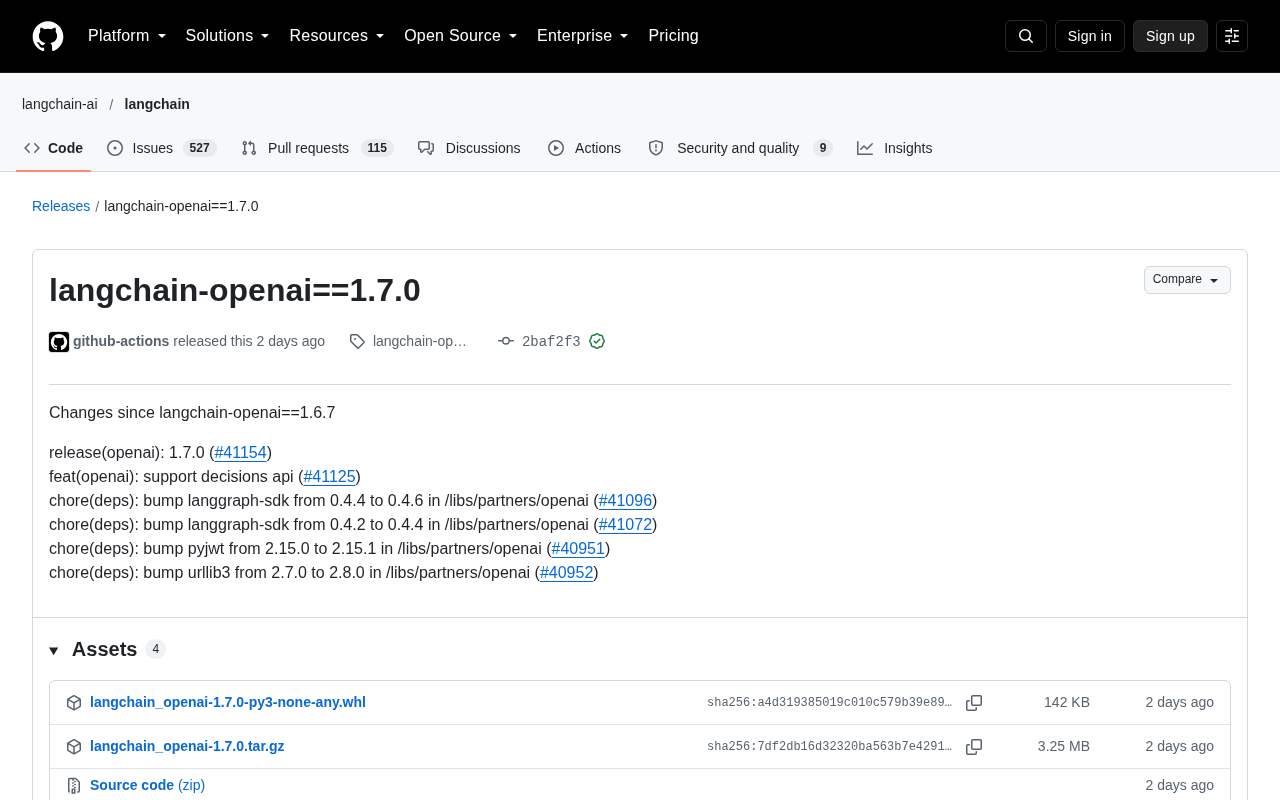
langchain-openai 1.7.0 builds on 1.6.7 with one key functional addition: native support for OpenAI's Decisions API via PR #41125, enabling LangChain developers to call the interface without managing low-level request logic. The release also includes routine security maintenance upgrades for langgraph-sdk (0.4.4→0.4.6), urllib3 (2.7.0→2.8.0), and pyjwt (2.15.0→2.15.1). Published via GitHub Actions with GPG signature verification, the release offers traceable provenance. Teams following LangChain and OpenAI's latest capabilities are advised to validate compatibility in a test environment before pushing to production.
LangChain's OpenAI integration package has received a version update — langchain-openai==1.7.0 is now officially available. Building on the previous stable release 1.6.7, this version introduces one notable functional addition along with several routine dependency upgrades. While relatively small in scope, the new API support it brings could influence how developers approach future integrations when building OpenAI-powered applications with LangChain.
Core Change: Decisions API Support
The most significant functional update in this release comes from PR #41125, which adds native support for the Decisions API in langchain-openai. This means developers can now call this interface directly through LangChain's OpenAI wrapper, without having to maintain their own low-level request logic.
For teams that rely on LangChain as an abstraction layer, official package support typically translates to more stable interface compatibility and lower maintenance overhead. When OpenAI introduces new API capabilities upstream, the ability of LangChain's partner packages to keep pace is one of the key factors in ensuring long-term application viability.
Since the original release notes only list the feature entry itself, the specific invocation patterns, parameter design, and applicable use cases will need to be confirmed by referring to the corresponding PR and official documentation.
What is the Decisions API? The Decisions API is an interface from OpenAI designed for scenarios that require structured decision-making or content moderation at the application layer. The core idea is to have the model return not just free-form text, but structured responses with explicit decision outcomes — such as allow/deny, classification labels, or risk levels — simplifying downstream business logic processing. Compared to parsing free-text outputs, the structured responses from the Decisions API are more amenable to rule engines or automated workflows. Within LangChain's abstraction layer, native support means developers can access this API through a unified chain-based interface, without manually assembling HTTP requests or handling response format conversions, and it integrates more smoothly with other LangChain components such as Memory, Agent, and Tool.
Dependency Upgrades at a Glance
Beyond the functional update, this release also includes several routine dependency maintenance upgrades, primarily within the /libs/partners/openai directory:
- langgraph-sdk: upgraded from 0.4.4 to 0.4.6 (accumulating changes across minor versions 0.4.4, 0.4.5, etc.)
- pyjwt: upgraded from 2.15.0 to 2.15.1
- urllib3: upgraded from 2.7.0 to 2.8.0
While these dependency bumps may seem routine, they have real implications for security and compatibility. For instance, urllib3 and pyjwt, as foundational networking and authentication libraries, often include security patches and bug fixes in their updates. The langgraph-sdk upgrade, meanwhile, relates to how langchain-openai interoperates with LangGraph within the broader LangChain ecosystem.
Release Security and Publishing Process
The release metadata shows that this version was published via GitHub Actions automation and signed with GitHub's verified signature (GPG key ID: B5690EEEBB952194). This indicates that the LangChain project maintains a reasonably rigorous CI/CD and release pipeline, with verifiable provenance for published artifacts — reducing the risk of supply chain attacks.
For teams incorporating this dependency in production environments, a signed and verified release is a positive indicator. That said, it's still advisable to validate your existing integrations in a test environment before upgrading, following standard practice to check whether the Decisions API-related changes introduce any compatibility issues.
A note on GPG signature verification: GPG signature verification is a critical component of software supply chain security. GPG (GNU Privacy Guard) is a digital signing tool based on asymmetric encryption — publishers sign release artifacts (such as Git tags or release artifacts) with their private key, and users can verify the signature using the corresponding public key to confirm the content hasn't been tampered with and the source is trustworthy. GitHub's verified signature badge means the release tag was created by an account or Actions bot holding a specific GPG key, rather than a forged commit. In the open-source ecosystem, supply chain attacks — such as malicious maintainers tampering with published packages — are a real threat. A rigorous signing process serves as a verifiable trust anchor and, combined with PyPI's package hash verification, significantly reduces the risk of introducing malicious code through dependencies.
Upgrade Recommendations
If your project uses LangChain's OpenAI integration, you can upgrade with the following command:
pip install -U langchain-openai==1.7.0
A few considerations before upgrading:
- Do you need the Decisions API? If your use case can benefit from this new interface, the value of upgrading is clear.
- Check for dependency conflicts: Verify that the version bumps in
langgraph-sdk,urllib3, andpyjwtdon't conflict with other dependencies in your project. - Incremental validation: It's recommended to run your full test suite in a non-production environment first to confirm compatibility before rolling out to production.
Overall, langchain-openai==1.7.0 represents a solid incremental update. Its core value lies in native Decisions API support, complemented by security-focused dependency maintenance — making it a worthwhile upgrade for developers looking to stay current with the latest capabilities from both LangChain and OpenAI.
Related articles

Why Does the Tesla Roadster Need to Fly? A Deep Dive into Musk's Wild Demo
Tesla's Roadster launch showed wall-climbing, upside-down driving, and flying stunts—but The Vergecast notes the demo car may lack a battery, the Rocket version is invite-only and not street-legal, and the website terms don't guarantee delivery. After nine years of delays, why does this car still need to exist?

AI Is Not a Replacement: Human-AI Collaboration Through the Lens of Factory Root Cause Analysis
Starting from factory root cause analysis, this article explains how AI accelerates evidence chain construction rather than replacing human experts, exploring the pragmatic implementation logic and business value of 'AI supporting people rather than replacing them.'

AI Agent Decision Auditing: Building an Evidence Chain in Regulated Workflows
Starting from a Reddit discussion, this article analyzes three core issues in AI agent decision auditing within regulated workflows: what fields audit records should contain, how to handle feedback latency for erroneous decisions, and how to continuously calibrate LLM judge consistency with human judgment.