LangSmith Costs Spiraling Out of Control? A Roundup of LLM Observability Alternatives for Large-Scale Deployments

As LLM apps scale, teams weigh Langfuse self-hosting vs. orqai's all-in-one platform as LangSmith alternatives.
As LLM applications move into large-scale production, LangSmith's per-trace billing model is pushing more teams to seek alternatives. This article examines a Reddit discussion that surfaces two main migration paths: Langfuse as an open-source self-hosted option that converts usage-based costs into fixed infrastructure spend — at the price of owning your own ops and uptime — and orqai as an all-in-one platform bundling observability with a gateway, budget governance, and model routing, but requiring a heavier architectural commitment with limited independent reviews available. The decision ultimately balances cost savings, operational burden, and platform maturity, with the hidden costs of migration itself never far from the equation.
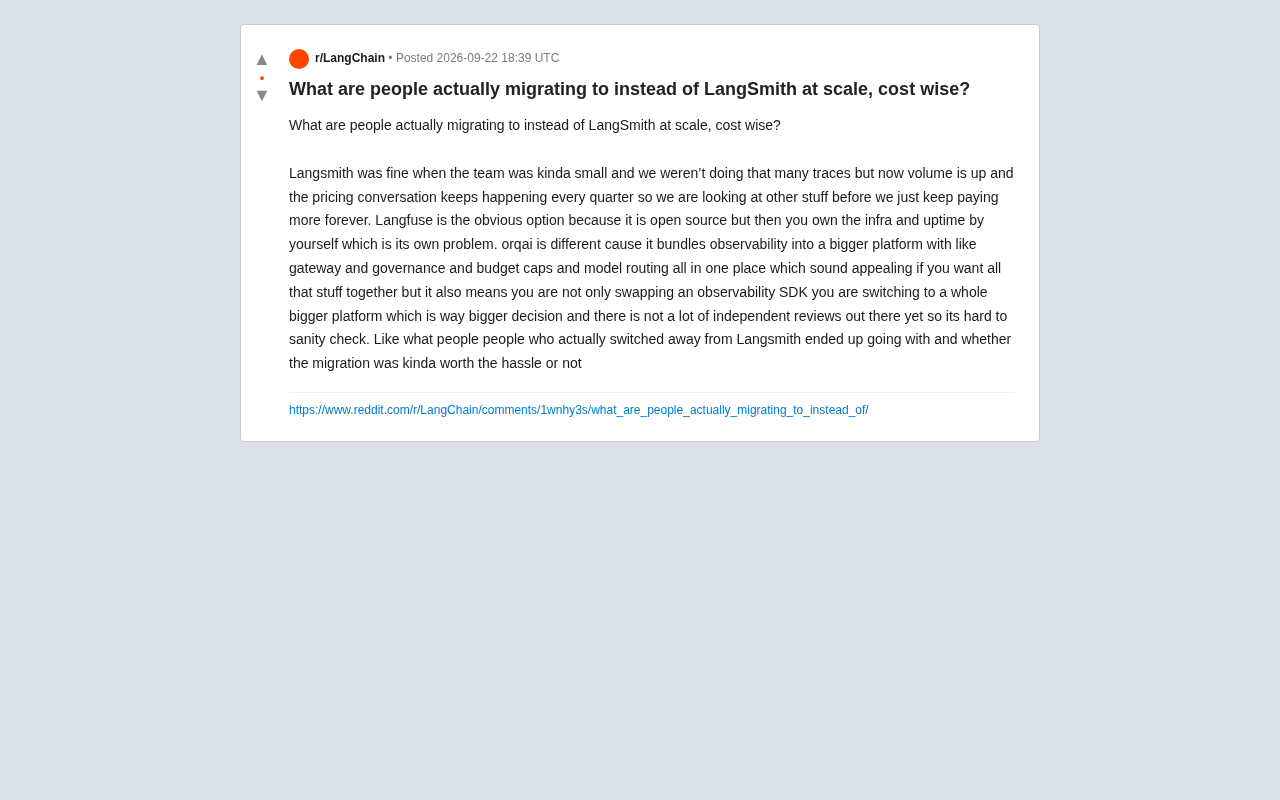
When LLM applications graduate from small-team experiments to production at scale, one topic becomes unavoidable: the cost of observability tooling. A Reddit user laid out a dilemma that many AI engineering teams are quietly grappling with — LangSmith works well enough when the team is small and trace volume is low, but as call volume surges, every quarter turns into a pricing renegotiation. Rather than paying an endlessly climbing bill, it makes sense to explore alternatives sooner rather than later.
This isn't an isolated complaint. It's a structural cost problem that consistently emerges once LLM applications hit production. Observability is fundamentally a data-volume-billed service — trace counts grow linearly or even exponentially with the business, and the marginal cost of SaaS subscriptions can easily spiral out of control.
The Core Issue: Observability Isn't Optional — It's a Cost Variable
For teams running LLM applications, traces and monitoring aren't nice-to-haves; they're essential for debugging hallucinations, tracking call chains, and evaluating model performance. The problem is that once call volume scales up, the pricing models of managed observability platforms cause costs to rise in lockstep with business growth.
The original poster's core anxiety was around "keep paying more forever" — that continuously growing, uncontrollable cost curve is the direct driver pushing teams to seek alternatives. It also explains why open-source, self-hosted solutions are back in the conversation: converting variable subscription costs into relatively fixed infrastructure costs.
LLM application observability is fundamentally different from traditional software monitoring. Trace data for traditional services is relatively lightweight, whereas every LLM call requires recording the full prompt input, model output, intermediate reasoning steps (especially in multi-step chains when using frameworks like LangChain), token consumption, latency distribution, and evaluation results. A single complex RAG (Retrieval-Augmented Generation) call can generate dozens of sub-spans, with data volumes far exceeding those of ordinary API calls. This is why mainstream LLM observability platforms — including LangSmith, Langfuse Cloud, and Helicone — universally adopt a tiered, per-trace SaaS pricing model. Unit costs are manageable at low volumes, but once daily active users grow or call frequency increases, billing growth often outpaces revenue growth, creating a classic cost-squeeze problem.
The Open-Source Self-Hosted Route: Langfuse
Langfuse was the "obvious option" called out in the discussion, with its core advantage being that it's open source. This means teams can self-deploy and escape per-trace billing entirely — in high-volume scenarios, this can theoretically drive costs down significantly.
But open source has never been a free lunch. The original poster nailed the trade-off succinctly: "you own the infra and uptime by yourself" — once you self-host, all infrastructure operations and uptime responsibility land squarely on your own team. That's a new problem in itself.
The Hidden Costs of Self-Hosting
Switching from SaaS to self-hosted means weighing the subscription savings against the following:
- Operational headcount: Someone needs to maintain the deployment and monitor system health
- Uptime guarantees: SLAs are no longer backed by a vendor — outage risk is yours
- Scalability: As data volumes grow, storage and query performance require your own tuning
For teams with ample engineering resources, Langfuse's economics make sense. But for lean teams, maintaining an observability system in-house may simply shift costs from the finance ledger to the engineering burden.
Langfuse was open-sourced in 2023. Its core architecture consists of a Next.js frontend, PostgreSQL for trace storage, ClickHouse (optional) for accelerating analytical queries, and a Worker service — deployable via Docker Compose or Kubernetes. It offers a feature set closely mirroring LangSmith: full trace tree views, prompt management, evaluation pipelines, and dataset management. For teams migrating from LangSmith, Langfuse provides OpenAI SDK-compatible integrations as well as native SDKs for major frameworks like LangChain and LlamaIndex, keeping code-change overhead relatively manageable. Its business model is "open-source core + managed cloud": self-hosting is completely free, while the cloud version is priced by seat and trace volume. Teams with high data volumes can achieve significant cost savings through self-hosting — at the cost of managing database storage growth and query performance tuning themselves.
The All-in-One Platform Route: orqai
Another direction surfaced in the discussion was orqai, representing a fundamentally different philosophy. Unlike Langfuse, which focuses on observability, orqai bundles observability into a much larger platform — packaging in a gateway, governance, budget caps, and model routing, among other capabilities.
For teams that want everything in one place, this kind of integrated solution is appealing — especially features like budget caps, which directly address cost control pain points.
Higher Decision Stakes for an All-in-One Platform
But the original poster stayed clear-eyed: choosing orqai isn't as simple as "swapping in a different observability SDK" — it means "switching to a whole bigger platform," which is a much weightier architectural decision.
The more practical obstacle is that there aren't "a lot of independent reviews out there yet," making it hard for teams to do a proper sanity check on viability. For core infrastructure carrying production traffic, the absence of third-party validation is a legitimate concern.
The "LLM Gateway + Observability" all-in-one architecture that orqai (Orq.ai) represents is a product category that has gained traction in recent years. Its core idea is to route all LLM calls through a centralized intermediary layer, enabling — within a single control plane — traffic routing (automatic failover or load balancing across model providers), cost governance (budget caps, per-team/project quota allocation), caching (semantic caching to reduce redundant call costs), security filtering (PII detection, content moderation), and full observability logging. The advantage of this approach is "zero-friction observability" — teams get trace data without touching business code, since all calls already pass through the gateway. The downside is that the gateway itself becomes a new critical path, and its latency, availability, and vendor lock-in risks all need to be factored into the evaluation. Similar products in this space include Portkey and Helicone Pro.
Three Dimensions for the Migration Decision
Synthesizing this discussion, the decision to migrate from LangSmith ultimately comes down to trade-offs across three dimensions:
- Cost vs. operational burden: SaaS is convenient but expensive; self-hosting is cheaper but you carry the ops
- Focused tool vs. all-in-one platform: A dedicated observability swap has lower migration cost; an integrated platform offers broader coverage but demands a heavier decision
- Maturity vs. novelty: Established tools have community validation and independent reviews; newer platforms offer fresh capabilities but are harder to verify
The question the original poster ended with is the one every team in the same situation wants answered: what did teams that actually switched end up choosing, and was the migration worth the hassle?
Closing Thoughts
This discussion doesn't offer a definitive answer, but it clearly maps out the decision framework for LLM observability tooling selection. For teams actively evaluating LangSmith alternatives, the recommendation is to start by clarifying your own situation: if engineering resources are ample and data volumes are large, Langfuse's self-hosted option deserves serious evaluation. If you need more than just observability — including cost governance and model routing — then platforms like orqai are worth considering, but thorough POC validation is non-negotiable.
Whichever path you take, don't overlook the hidden cost of migration itself — switching your observability stack isn't just a technical exercise. It involves rebuilding team workflows and migrating historical data. Sometimes the answer to "is it worth the hassle" depends entirely on how much your current bill is hurting.
Related articles

A Single Prompt Triggers a Global PHP Security Storm: Is AI a Savior or a Hidden Risk?
A single AI prompt triggered a global PHP security crisis affecting Wikipedia and the Internet Archive. This article reviews the incident, analyzes the OpenAI-Amazon controversy, and explores the security paradox of lowered vulnerability discovery barriers in the AI era and developer response strategies.

When AI Is Taken Away: How Reliance on Shortcuts Undermines Your Problem-Solving Resilience
A study of 1,222 people found that after using AI to answer questions, once AI was removed, people gave up on more problems than a control group that never used AI. The article analyzes the impact of AI reliance on learning resilience and metacognition, and explores design implications for AI learning tools.

Carta and NewView Partner to Let Startup Employees Cash Out Equity Early
Carta and NewView Capital partner to simplify startup tender offers, helping employees sell equity early. Analysis of the mechanism, liquidity pain points, and impact.