LaraCopilot: The Paradigm Leap from AI Copilot to Autonomous Engineer

LaraCopilot aims to evolve AI coding from copilot assistance to autonomous full-stack engineering with no vendor lock-in.
LaraCopilot, a new entrant on Product Hunt, positions itself as an agentic AI engineer capable of building complete production-ready applications from natural language descriptions. Covering UI, backend, database, auth, and APIs, it differentiates through a no-lock-in strategy with GitHub export, flexible deployment options, and full code ownership. Likely built on the Laravel ecosystem, it represents the latest evolution in AI coding—from line completion to autonomous engineering.
Recently, a product called LaraCopilot landed at number seven on the Product Hunt leaderboard, attracting widespread attention from the developer community with 145 upvotes and 26 comments. Its self-positioning is remarkably bold—an "Agentic AI Engineer" that can truly build production-ready applications.
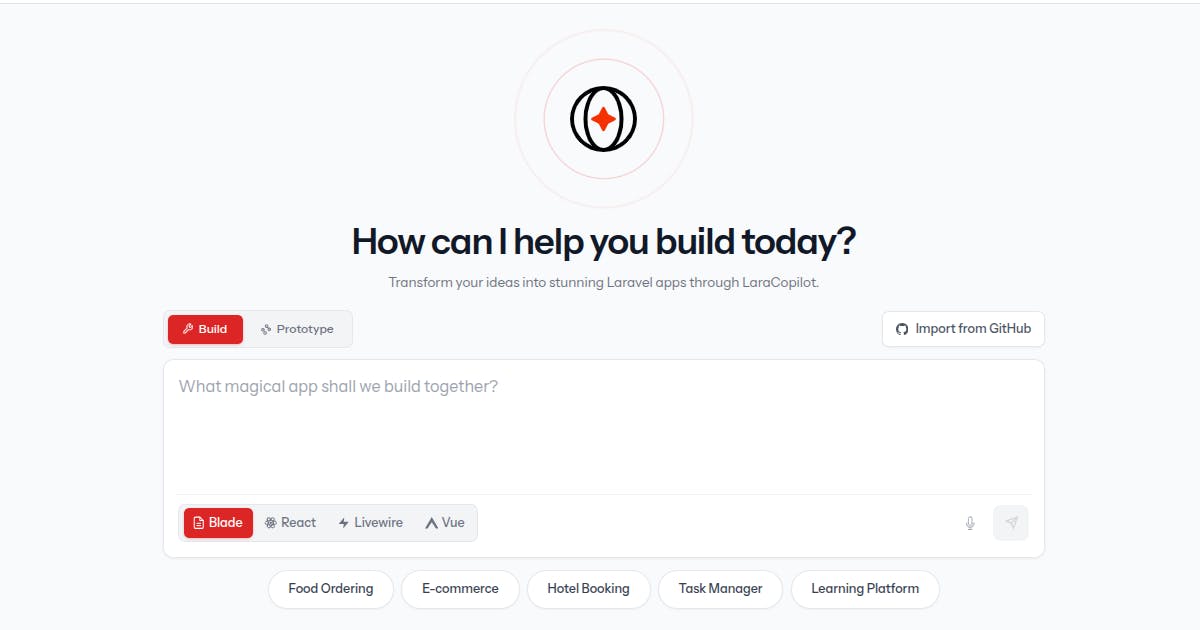
"Agentic AI" has been one of the hottest paradigms in the AI field since 2024. Unlike traditional conversational AI, agentic AI can autonomously plan, decompose complex goals, invoke multiple tools, self-correct during execution, and ultimately deliver complete results. AI luminaries like Andrew Ng consider it a critical step in transforming large language models into genuine productivity tools. In the programming domain, this means AI is no longer passively completing a single line of code—instead, it understands entire project requirements, autonomously plans architecture, writes multiple files, handles dependencies, and ensures all modules work together correctly.
In an era flooded with AI coding assistants, LaraCopilot is attempting to evolve from a "code completion tool" into "an engineer capable of independently completing entire projects." This reflects a critical paradigm shift happening in the AI coding space.
From Code Assistants to Agentic Engineers: Three Evolutionary Stages of AI Coding
Over the past two years, AI coding tools have progressed from GitHub Copilot-style "line-by-line completion," to Cursor and Windsurf-style "context-aware editing," to today's emphasis on end-to-end delivery in the "agentic" stage. LaraCopilot represents the latest manifestation of this trend.
Specifically, the first generation, represented by GitHub Copilot, was based on OpenAI's Codex model and primarily provided line-level or function-level code completion within IDEs—essentially a supercharged autocomplete engine. The second generation, represented by Cursor and Windsurf, introduced context awareness across entire codebases, understanding project structure, cross-file references, and code style to enable broader code editing and refactoring. The third generation centers on agentic architecture, where AI is no longer confined to in-editor assistance but can execute complete development workflows—from requirements analysis and architecture design to code generation, testing, and deployment—forming a closed loop. This three-generation evolution fundamentally reflects AI's capability leap from "completing individual tokens" to "understanding context" to "autonomously executing tasks."
According to its official description, users simply describe their ideas in natural language, and LaraCopilot builds complete applications including:
- UI (Frontend Interface)
- Backend (Server-side Logic)
- Database (Database Design)
- Auth (Authentication System)
- APIs (Interface Layer)
More importantly, these modules aren't generated in isolation—they're "wired together" to form a complete application ready for deployment. This is fundamentally different from merely generating code snippets—it promises to deliver a "working product" rather than parts that developers must assemble themselves.
Core Value Proposition: No Lock-in and Code Ownership
Among the many AI application generation platforms, a long-standing criticism has been "vendor lock-in"—generated applications are bound to a specific platform, making it difficult for users to migrate or control the underlying code. LaraCopilot plays a clear differentiation card on this front.
Platform lock-in is a classic problem in cloud computing and SaaS, and it's particularly pronounced in the emerging category of AI application generators. Many tools (such as early no-code platforms like Bubble and Webflow) run applications on proprietary runtime environments where users cannot export standardized source code. Once the platform raises prices, shuts down, or can't meet requirements, migration costs are extremely high. Among the new generation of AI generation tools, some products can generate code, but the code is heavily dependent on platform-specific SDKs or deployment pipelines, effectively constituting lock-in. This is especially sensitive for enterprise users, as it involves critical issues like data sovereignty, compliance auditing, and long-term maintenance costs.
Flexible Deployment Options
LaraCopilot offers multiple deployment options:
- One-click deployment to the cloud, or
- Deploy to your own server
This means users aren't forced to be tied to any specific hosting platform and can flexibly choose based on their cost, compliance, or performance requirements.
The Code Is Completely Yours
The product explicitly promises "The code is yours." It supports:
- GitHub Export—generated code can be pushed directly to your own repository
- Instant Rollback—quickly revert to a previous version when issues arise
This suite of design choices directly addresses developers' core anxieties. For serious production projects, whether you can control the source code and freely migrate is often more important than generation speed. LaraCopilot uses its "no lock-in" strategy to win the trust of professional developers who are skeptical of no-code/low-code platforms.
Why "Production-Ready" Is the Most Critical Promise
LaraCopilot repeatedly emphasizes "real, production-ready apps"—phrasing that deserves careful consideration.
The current market has no shortage of AI tools that can quickly generate demos or prototypes, but between a "seemingly functional prototype" and a "production application that can actually sustain business operations" lies an enormous gap. In software engineering, production-grade applications must address challenges across multiple dimensions: input validation, SQL injection prevention, XSS attack defense, and CSRF protection on the security front; database index optimization, caching strategies, connection pool management, and load balancing on the performance front; error handling, logging, monitoring alerts, and disaster recovery on the reliability front; and environment configuration management, CI/CD pipelines, database migrations, and version management on the operations front. Currently, AI-generated code often has obvious deficiencies in these "non-functional requirements"—the code appears to run, but lacks edge case handling, has incomplete security protections, and features poorly designed data models.
By making "production-ready" its core promise, LaraCopilot is directly responding to a pain point across the entire AI coding industry. Of course, the degree to which this promise is fulfilled can only be determined through validation in real-world projects.
Judging from the product name, it likely has deep ties to the Laravel ecosystem. Laravel is the most popular full-stack web framework in the PHP space, created by Taylor Otwell in 2011, and has since grown into a massive ecosystem. Its core advantage lies in its highly structured and "convention over configuration" design philosophy—Eloquent ORM handles database operations, the Blade template engine handles view rendering, the built-in authentication system (Laravel Breeze/Jetstream) provides out-of-the-box user management, plus queue systems, event broadcasting, API resources, and other modules form a complete and standardized full-stack solution. This highly standardized architecture is extremely AI-friendly for code generation: because patterns are fixed, naming conventions are clear, and file organization structures are uniform, AI can more reliably generate code that follows best practices based on training data from numerous open-source Laravel projects. This may provide a mature technical foundation for its "full-stack generation" capabilities.
Competitive Landscape and Differentiated Positioning
Looking at its Product Hunt category tags, LaraCopilot spans SaaS, Developer Tools, and Artificial Intelligence—targeting both indie developers looking to quickly validate ideas and professional teams seeking efficiency gains.
The competition it faces is equally fierce—Replit Agent, Bolt.new, v0, Lovable, and a host of other "text-to-app" products are all vying for the same market. These competitors take different technical approaches: Replit Agent leverages Replit's online IDE ecosystem, emphasizing instant execution and collaboration; Bolt.new, developed by the StackBlitz team, uses WebContainer technology to run Node.js environments in the browser for zero-configuration instant previews; v0, launched by Vercel, focuses on UI component generation within the React/Next.js ecosystem; and Lovable (formerly GPT Engineer) emphasizes a conversational iterative development experience. These products each have their focus areas, but share a common limitation: most lean toward frontend or lightweight applications and still fall short when dealing with complex backend logic, database relationship design, and enterprise-grade security requirements.
For LaraCopilot to stand out, its combined positioning of "no lock-in + code ownership + production-ready" represents a clear path to differentiation. If it's indeed built on Laravel as a mature full-stack framework, it may have a natural advantage in backend completeness. But whether it can ultimately hold its ground depends on the actual quality of generated code and its reliability in complex business scenarios.
For developers, the value of such tools isn't about "replacing programmers" but about automating tedious boilerplate code and infrastructure setup, freeing developers to focus their energy on genuine business logic and product innovation. LaraCopilot's emergence is yet another footnote in AI's journey from "assisted coding" to "autonomous engineering."
Conclusion: Worth Watching, But Still Needs Validation
LaraCopilot represents the latest direction in AI coding tool evolution: no longer content to be a "copilot," it aims to become an "engineer" capable of independent delivery. Its insistence on code ownership and deployment freedom responds to the real needs of professional developers.
However, as with all AI generation tools, the promise of "production-ready" still requires time and real-world case studies for validation. For interested developers, it's worth experimenting with on low-risk small projects first to assess whether its code quality truly meets production standards.
Related articles

Should U.S. College Fraternities Be Banned? A Researcher's Incisive Observations
Why not just ban U.S. college fraternities? A researcher finds the key resistance comes from decision-makers' own fraternity identities and schools' "willful ignorance."

Microsoft Discovery: Accelerating Scientific Discovery with AI Agents
Microsoft's Discovery platform runs specialized AI agents to help researchers screen and prioritize the most promising compounds and experimental paths, reducing experiments and accelerating scientific discovery.

Cambridge Heavy Industries Secretly Develops Desktop-Scale Nuclear Fusion Device
Cambridge Heavy Industries is secretly developing a desktop-scale laser-driven nuclear fusion device, targeting the equipment supply market for fusion power plants. This article analyzes its miniaturization technology path, commercialization logic, and unique positioning in the fusion startup wave.