Latent Prediction Beats Reconstruction: A New Paradigm for Tactile Pretraining

LingBot-Touch uses JEPA latent prediction instead of reconstruction for tactile pretraining, far surpassing MAE/VAE on recall.
The Robbyant team's LingBot-Touch proposes a JEPA-style self-supervised tactile encoder that predicts latent representations of masked sensor signals instead of reconstructing them. On tactile-to-video top-5 recall, JEPA reaches 32.1% with 1K hours of data versus 5.6% for MAE and 4.4% for VAE; at 4K hours JEPA rises to 49.3% while reconstruction methods stay below 9% or even degrade. The authors attribute this to the near-zero background dominating tactile clips, which lets reconstruction loss drop without learning contact features. Engineering-wise, a mask ratio warms up from 40% to 80%, and normalized fingertip coordinates plus 5D RoPE let three sensor types share one Transformer. On real robots, frozen features are best in 89 of 104 combinations, and on an unseen magnetic hand LingBot-VLA improves from 57.21 to 75.04.
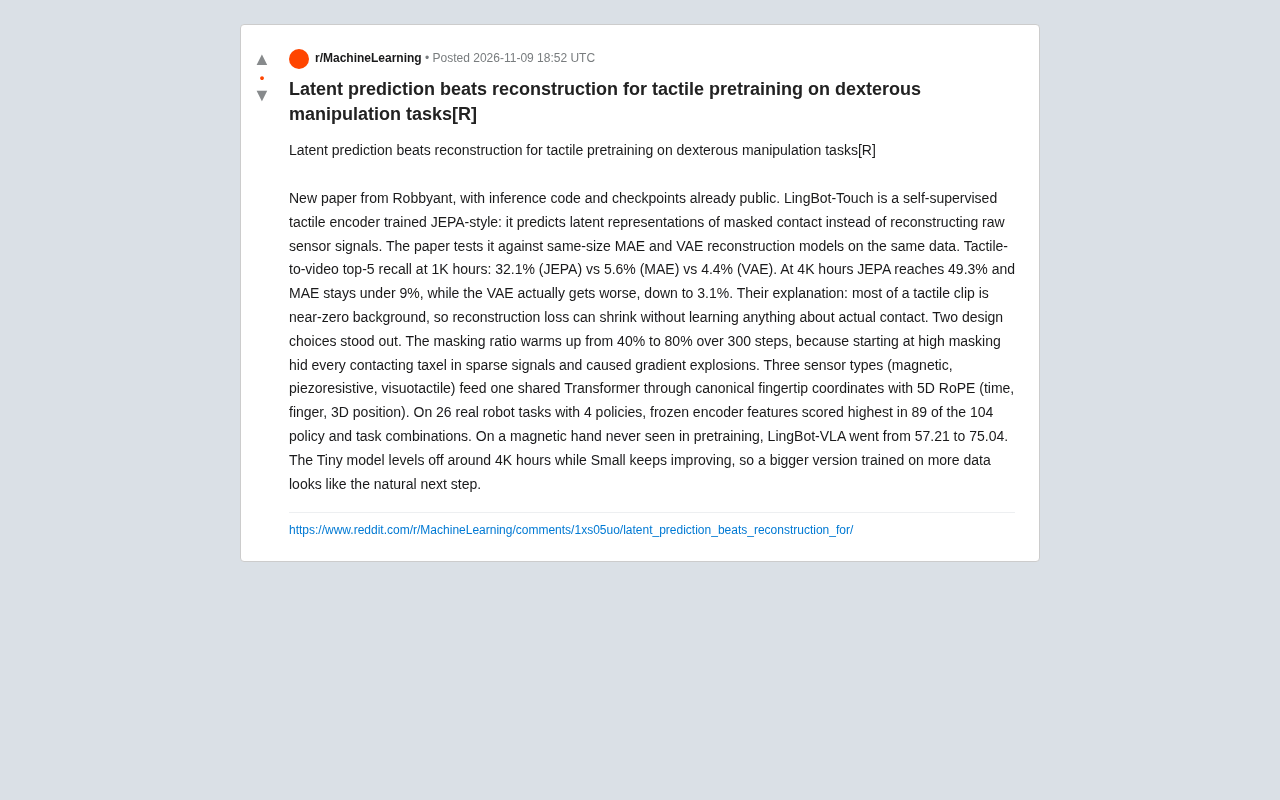
Tactile sensing has long been regarded as one of the hardest modalities to exploit in robotic manipulation. Sensor signals are sparse, noisy, and spend most of the time in a near-zero background state, so directly applying self-supervised methods from the vision domain often yields little. The Robbyant team's new paper LingBot-Touch offers a counterintuitive but data-backed answer: in tactile pretraining, predicting the latent representation of masked contact is far more effective than reconstructing raw sensor signals. The paper's inference code and checkpoints have been released.
Bringing the JEPA Idea to Touch: Why Not Reconstruct
The core of LingBot-Touch is a self-supervised tactile encoder trained in a style inspired by JEPA (Joint Embedding Predictive Architecture) — the model does not reconstruct the masked raw signal but predicts its latent representation. The paper compares it against same-sized MAE (masked autoencoding) and VAE (variational autoencoding) reconstruction models on identical data.
The gap is dramatic. On the tactile-to-video top-5 recall task, with 1K hours of data, JEPA reaches 32.1%, while MAE reaches only 5.6% and VAE 4.4%. Scaling to 4K hours, JEPA rises to 49.3%, MAE remains below 9%, and VAE actually degrades to 3.1%.
The authors' explanation is worth noting: the vast majority of a tactile clip is near-zero background, so the reconstruction loss can keep decreasing without ever learning genuine contact features. In other words, the reconstruction objective gives the wrong optimization direction on sparse tactile signals — the model can "take the easy way out" and still drive the loss down. Latent prediction, by contrast, forces the model to focus on the structure of contact itself rather than pixel-level reconstruction of the background.
JEPA (Joint Embedding Predictive Architecture) was proposed by Yann LeCun, with the core idea of making predictions in latent space rather than pixel/signal space: given the encoding of one part of the input, predict the encoding of another part. Unlike MAE, which reconstructs masked pixels, or VAE, which reconstructs the input distribution, JEPA's prediction target is itself a learned representation, so the model does not have to waste capacity modeling hard-to-predict low-level details (such as background texture). In vision this is believed to yield more semantic features; LingBot-Touch transfers this logic to touch precisely for its inherent robustness to "uninformative background."
MAE (Masked Autoencoding) is a visual self-supervised method proposed by He et al.: it randomly masks most image patches and uses a lightweight decoder to reconstruct the masked raw pixels, with a pixel-level MSE loss. VAE (Variational Autoencoding) instead encodes to a latent distribution and then decodes for reconstruction, optimizing the evidence lower bound. The shared problem of both on touch is that the reconstruction target acts directly on raw sensor readings, and since tactile readings are near zero most of the time, the model can substantially reduce the loss simply by outputting "zero," while contact events get ignored.
Two Key Designs: Masking Warmup and Unified Multi-Sensor Encoding
The paper contains two engineering details that directly determine whether training converges stably.
Mask ratio warmup. Training starts at a 40% mask ratio and gradually rises to 80% over 300 steps. What happens if you start directly at a high mask ratio? In sparse tactile signals, a high mask ratio can easily mask out all the taxels currently in contact, leaving the model with no learnable signal and triggering gradient explosion. Gradual warmup lets the model first build basic representational ability, then progressively increase difficulty.
Three sensor types share one Transformer. Data from magnetic, piezoresistive, and visuotactile sensors is fed into the same shared Transformer via normalized fingertip coordinates and 5D RoPE (time, finger, three-dimensional position). This approach aligns tactile signals from different physical principles within a unified spatio-temporal encoding framework, laying the groundwork for cross-sensor transfer.
taxel is short for tactile pixel, referring to a single sensing unit in a tactile sensor array, analogous to a pixel in an image. A fingertip tactile array typically contains tens to hundreds of taxels, each outputting a contact intensity value at each moment. Since fingers are not always in contact with objects, most taxels read near zero most of the time — this is the source of the "near-zero background" mentioned in the text. Under a high mask ratio, if the masked units happen to be the few taxels currently in contact, the model receives almost no effective supervision signal, the variance of the gradient estimate increases sharply, thereby triggering the gradient explosion mentioned in the paper.
5D RoPE is a multidimensional extension of rotary position encoding (RoPE). Standard RoPE encodes rotational phase for one-dimensional sequence positions, so that attention scores naturally carry relative position information; 5D RoPE encodes time, finger index, and the fingertip's three-dimensional spatial coordinates into rotational components at different frequencies, allowing the shared Transformer to simultaneously perceive "when," "which finger," and "where" within the same attention mechanism. Combined with normalized fingertip coordinates (mapping different hand morphologies and sensor layouts into a unified coordinate system), signals from three physically distinct types — magnetic, piezoresistive, and visuotactile — can be aligned within the same spatio-temporal framework, which is the structural prerequisite for cross-sensor transfer to hold.
Real-Robot Validation: Frozen Features Win in Most Tasks
The value of a pretrained encoder ultimately has to be tested on real robot tasks. The paper evaluates on 26 real robot tasks across 4 policies, with frozen encoder features achieving the highest score in 89 of 104 policy-task combinations.
Even more convincing is the cross-sensor transfer experiment: on a magnetic dexterous hand never seen during pretraining, LingBot-VLA's score rises from 57.21 to 75.04. This shows that the encoder learns not surface statistics of a particular sensor type, but transferable contact representations.
On model scale, the Tiny version plateaus after about 4K hours of data, while the Small version keeps improving. The authors conclude that larger models with more data are the natural next step. This also suggests that tactile pretraining may still be in the early scaling stage of data and capacity.
Implications for Tactile Self-Supervised Research
This work echoes a recent debate in the vision domain: is reconstruction-based pretraining really the optimal self-supervised objective? On the tactile modality, the answer seems to lean more clearly toward "no." The peculiar statistics of sparse signals — a large near-zero background plus a small number of critical contacts — amplify the shortcomings of the reconstruction objective and make the advantage of latent prediction stand out even more.
For practitioners, directly reusable lessons include: masking strategies must be designed for signal sparsity and cannot simply copy vision recipes; unified multi-sensor encoding is worth prioritizing, as the benefits of cross-embodiment transfer have been validated on real robots; and evaluation should focus on downstream performance of frozen features rather than pretraining loss itself. Code and checkpoints are public, so these design choices can be directly tested and reproduced by the community.
One-line Summary
LingBot-Touch replaces reconstruction with JEPA latent prediction for tactile pretraining, far outperforming MAE/VAE on recall.
Paragraph Summary
The Robbyant team's LingBot-Touch proposes a JEPA-style self-supervised tactile encoder: instead of reconstructing masked raw sensor signals, it predicts their latent representations. On the tactile-to-video top-5 recall task, with 1K hours of data JEPA reaches 32.1%, while MAE reaches only 5.6% and VAE 4.4%; scaling to 4K hours, JEPA rises to 49.3%, while reconstruction methods remain below 9% or even degrade. The authors attribute this to the fact that most of a tactile clip is near-zero background, so the reconstruction loss can decrease without learning contact features. Engineering-wise, it warms up the mask ratio from 40% to 80% and uses normalized fingertip coordinates plus 5D RoPE to let three sensor types share one Transformer. On real robots, frozen features are best in 89 of 104 combinations, and on an unseen magnetic hand LingBot-VLA improves from 57.21 to 75.04.
Related articles

Why Microsoft CEO Nadella Still Backs Nvidia After Jensen Huang's Departure
Microsoft CEO Nadella publicly expresses confidence in Nvidia interim CEO Colette Kress. This article analyzes Nvidia's power transition after Jensen Huang's departure, Microsoft's compute dependency, and the trust logic of the AI supply chain.

Nadella: Critical Infrastructure Is 'Unpatchable' as AI Cybersecurity Arms Race Escalates
Microsoft CEO Nadella addresses AI cyberattack fears, saying much critical infrastructure is unpatchable, downplaying the Outlook outage, and analyzing AI's dual role in cybersecurity.

Musk Backs Jensen Huang: Firing Him Is Like Cutting Jordan
Musk says Jensen Huang is loyal to the U.S. and likens firing him to cutting Michael Jordan—highlighting politicization anxieties in the AI chip industry and defending talent value.