Lattice: An AI Rewriting Tool That Reshapes Text Through Multilingual Paths While Preserving Meaning

Lattice reshapes text through multilingual round-trip translation while claiming to preserve the original meaning.
Lattice is a newly launched AI writing tool on Product Hunt that routes text through multiple language paths and back, breaking free from original phrasing habits to generate fresh expressions while preserving core meaning. This mechanism is essentially a productized version of back-translation from translation theory, distinct from traditional synonym-based rewriting. Target users include content creators, non-native English writers, and marketing teams needing copy variants at scale. The key challenge is semantic drift from multiple translation passes — the more paths, the more thorough the rewrite, but the higher the risk of straying from the original intent. The product is in its early days with limited community feedback, and its real-world effectiveness remains to be validated.
A Cross-Language Approach to Text Reshaping
A writing tool called Lattice has appeared on Product Hunt, with a straightforward tagline: "Reshape your text across languages while preserving meaning." Built by Aryan Rastogi, it earned 80 upvotes on launch day and ranked 13th on the daily leaderboard, sitting at the intersection of the Writing and SaaS categories.
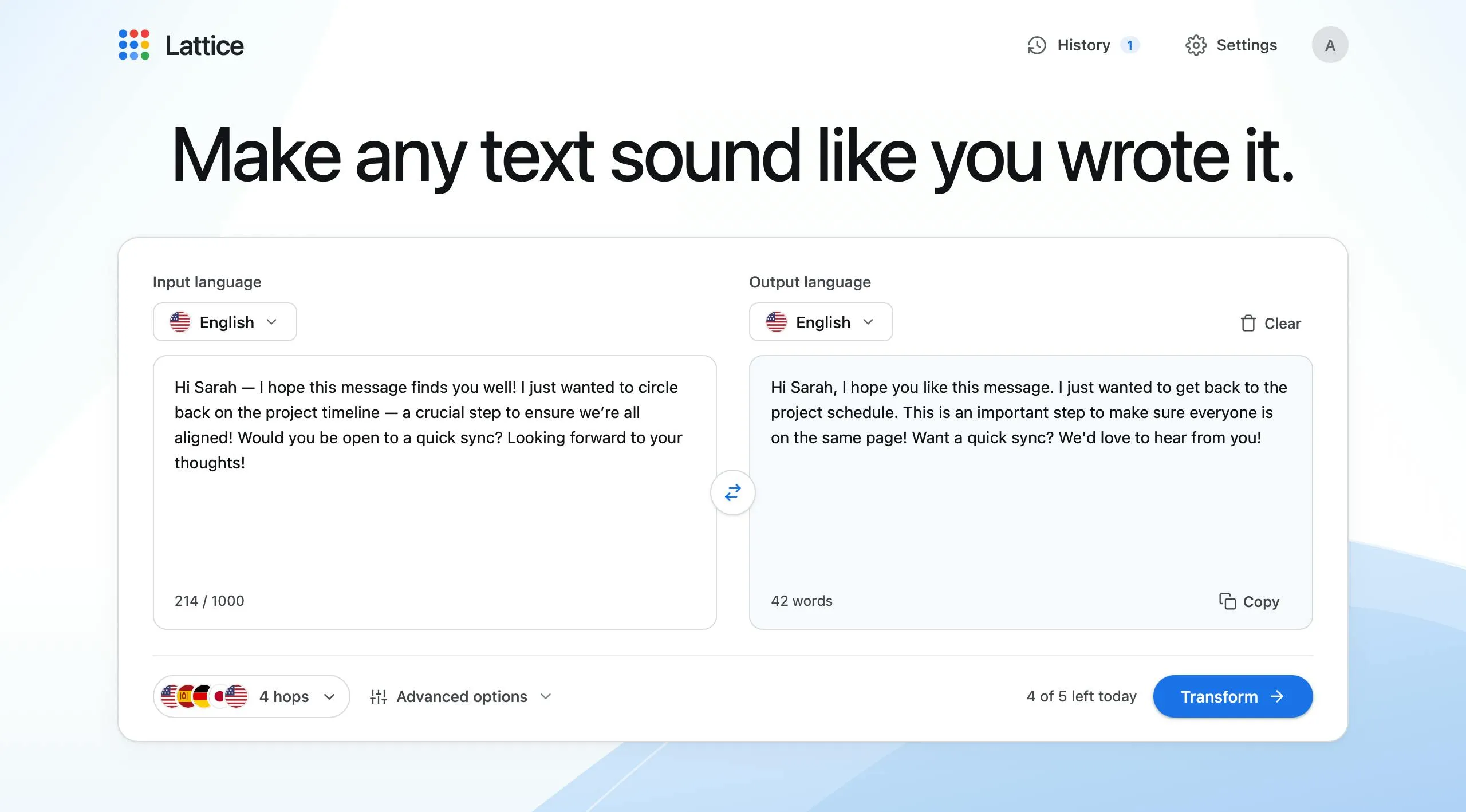
Lattice's core mechanism is fairly straightforward: your text is passed through multiple language paths, ultimately producing a "completely new expression" while keeping the original idea intact. In other words, it's not a simple synonym replacement — it reorganizes sentence structure and word choice by routing text through round-trip translations across languages.
What Problem Does It Actually Solve?
Traditional rewriting tools tend to operate within a single language — swapping synonyms, rearranging word order — and the results often feel like cosmetic changes rather than genuine rewrites. Lattice draws on an interesting phenomenon from translation theory: when a piece of text passes through different languages and returns to the original, its expression naturally shifts, because each language organizes the same concept differently.
This "multilingual detour" approach can, in theory, more thoroughly break free from the original text's phrasing habits, while relying on translation models' semantic understanding to preserve the core meaning. For users who need to avoid repetitive phrasing, find fresh ways to say something, or make text read more naturally, this is an angle worth exploring.
Potential Use Cases
Based on the product's positioning, Lattice may appeal to several types of users:
- Content creators: Who need to express the same idea in different ways to avoid monotony.
- Non-native writers: Who can use multilingual paths to make their English sound more natural.
- Marketing and copywriting teams: Who need to generate differentiated copy variants at scale.
Translation studies refers to this as back-translation. The basic process involves translating a source text from Language A to Language B, then back from B to A, and comparing the two versions to assess translation quality. The technique was originally used in academia for cross-cultural validation of medical questionnaires, and was later adopted in NLP as a data augmentation method — generating new samples with similar semantics but varied phrasing by routing training examples through multiple languages, thereby expanding datasets and improving model robustness. Lattice brings this approach to a writing tool, essentially converting a technique originally designed for data engineering into an end-user rewriting capability.
Opportunities and Risks of Multilingual Rewriting
The biggest challenge with this type of approach is actually delivering on the promise of "preserving meaning." Every language translation pass carries the risk of semantic drift — subtle tone, specialized terminology, and cultural context can all be lost or distorted in round-trip translation. The more paths involved, the "fresher" the expression, but the higher the probability of straying from the original intent. This is a careful engineering balancing act between "reshaping power" and "semantic fidelity."
As a result, Lattice's real-world effectiveness is heavily dependent on the quality of its underlying translation models and how it controls the depth of transformation. The product page currently discloses limited information, making it difficult to assess its performance with long-form content, specialized material, or ambiguous vocabulary.
Semantic drift in multi-hop translation is a well-documented research problem. Studies show that after passing through five or more languages in sequence, a sentence's core proposition is largely preserved, but modal verb strength, the scope of negation, and implied causal relationships often shift in unpredictable ways. Additionally, proper nouns, industry terminology, and culturally-loaded words often lack equivalent concepts across languages, and translation models tend to fill the gap with the most common generic expressions, diluting specialized context. This is why multilingual rewriting approaches typically perform better on general content than on technical documentation or legal text — the latter demands far greater precision in wording.
An Early-Stage Product Worth Watching
As a tool that just launched on Product Hunt, Lattice has limited community feedback so far (only 2 comments), with most of the interest stemming from the appeal of the concept itself rather than large-scale user validation. It represents a niche direction in the AI writing tool space: rather than chasing "a more powerful single model," it creates differentiated value by cleverly combining existing translation capabilities.
For anyone following the AI writing landscape, Lattice is worth adding to your watchlist. Whether it can truly "reshape expression without losing meaning" still needs to be tested across more real-world scenarios. Interested users can visit its official website to learn more and try it out.
Related articles

Gemini 4 Argon Hands-On: AI Builds Board Games, Constructs Temples, and Trains Robots Autonomously
Gemini 4 Argon hands-on roundup: AI autonomously builds a desk racetrack and temple in Blender, writes a ray tracing engine, trains a humanoid robot to sink 7 shots, plus API pricing and developer access.

The Magic Octagonal Coin: Why Only 9% of People Can Predict Its Flip?
Only 9% of people can correctly predict the Magic Octagon coin flip. This article explains its spatial rotation mechanism, common cognitive pitfalls, and a new hypothesis based on Relevance Theory, exploring the limits of human spatial reasoning.

Sam Altman: AI Is Entering the Era of Scientific Discovery — Math Breakthroughs Will Replicate in Biology and Energy
Sam Altman says AI is entering the era of scientific discovery — math breakthroughs will replicate in biology, materials science, and energy to help develop new drugs and energy sources.