Laylight: Connecting Enterprise Tools with AI for Clear, At-a-Glance Management
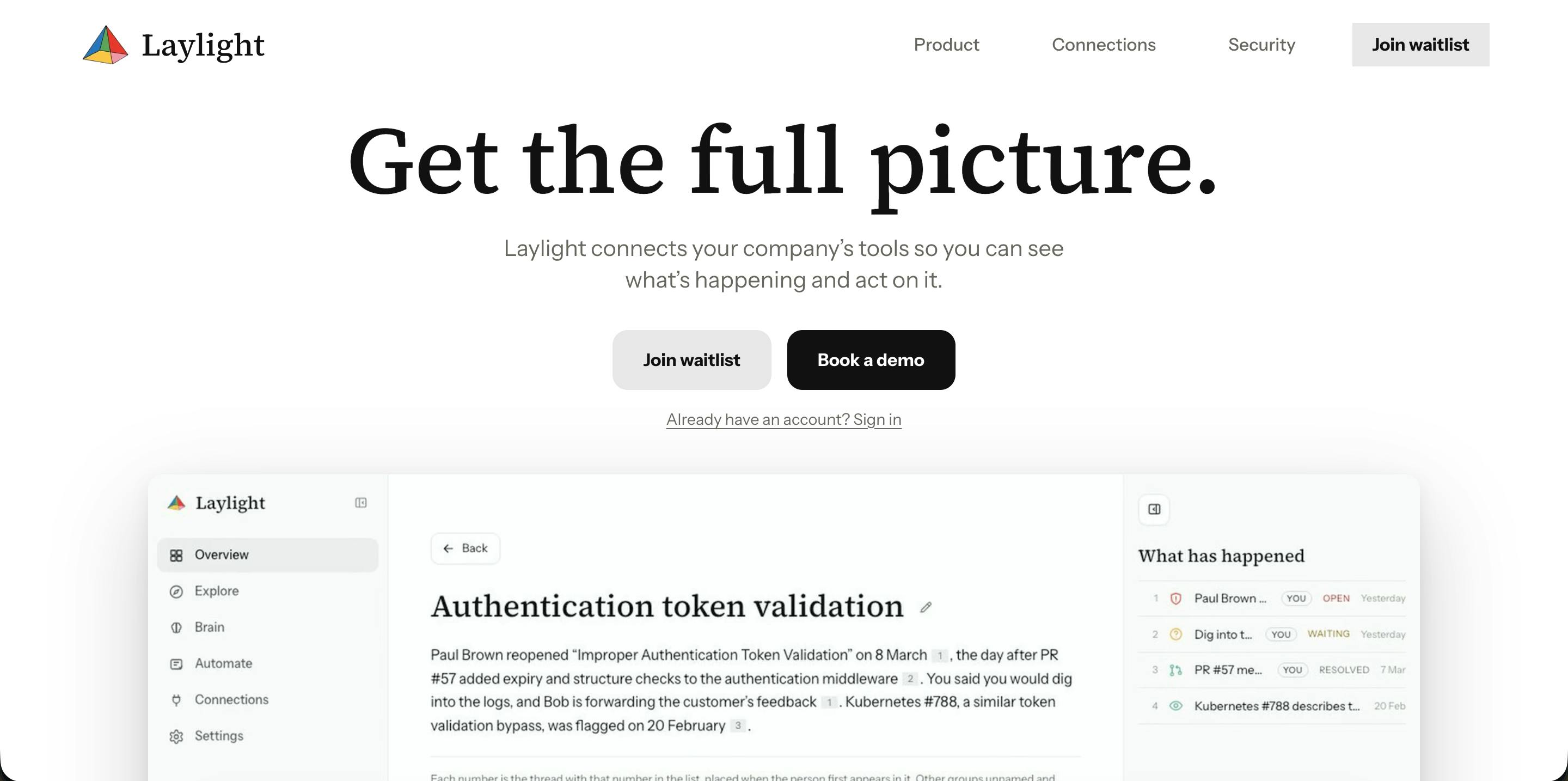
Open-source AI platform Laylight aims to connect existing enterprise tools and present the full business picture in one place.
Laylight is an open-source, AI-driven collaboration platform newly launched on Product Hunt with the tagline "Get the full picture." It does not require replacing the existing software stack, but instead aggregates data scattered across SaaS tools into one view, uses AI to automate cross-tool repetitive tasks, and provides management with a real-time overview. The product is in development, has 13 votes and ranks 17th daily, with limited community discussion. Its open-source and self-hostable nature appeals to data-sensitive teams, but technical details and integrations are undisclosed, so actual usability remains to be verified.
Why Do Enterprises Need the "Full Picture"?
Modern companies use dozens of tools on average—project management, communication and collaboration, CRM, code hosting… Data is scattered across various SaaS platforms, and when managers want to understand "what's happening in the company," they often need to manually aggregate information, which is time-consuming and delayed. Laylight, newly launched on Product Hunt, attempts to solve this pain point. Its tagline "Get the full picture" gets straight to the core: connect a company's existing tools and present the entire business in one place.
According to its Product Hunt page, Laylight is positioned as an open-source, AI-driven collaboration platform. It currently has 13 votes, ranks 17th among products that day, and is still in the "Work In Progress" stage (i.e., under development).
Core Features: Connection, Automation, and Visibility
According to the official description, Laylight's value proposition revolves around three levels:
- Connect existing tools: It does not require companies to replace their existing software stack; instead, it aggregates scattered data into a single view through integrations.
- Automate repetitive tasks: It uses AI to automatically handle routine cross-tool work, such as syncing statuses, generating reports, or triggering reminders, thereby saving team time.
- Improve management visibility: It provides management with a real-time cross-departmental business overview, reducing information asymmetry.
This approach aligns with the current "aggregation layer" trend in enterprise software—not replacing tools, but becoming an intelligent layer on top of them.
The "Aggregation Layer" and SaaS Integration Mechanisms
The so-called "aggregation layer" refers to a layer of software built on top of existing SaaS tools. It pulls data from various platforms via APIs, unifies field definitions, and presents everything in a single interface. It does not replace the original systems but acts as a "data bus + presentation surface." Such products typically rely on the REST or GraphQL APIs exposed by each SaaS platform and need to handle data model mapping across different tools (for example, unifying Jira issues, Asana tasks, and CRM deals into "work items"). The difficulty of an aggregation layer is not single-point connectivity, but OAuth authorization management, incremental synchronization, rate limits, and data consistency. Understanding this makes it clear why the breadth of the integration list often determines the practical boundaries of such products.
The Dual Positioning of Open Source and AI
Laylight is categorized as open source, artificial intelligence, and work-in-progress. Open source means enterprises can deploy it themselves and review the code, which is attractive to data-sensitive teams; the introduction of AI, meanwhile, allows automation to go beyond simple rule triggers and may involve semantic understanding of task content and priority judgment. However, currently available public information does not disclose the specific technical architecture, the list of supported integrations, or details about the AI models. These will be key to determining the product's actual usability.
The Practical Meaning of Self-Hosting and Open Source Licensing
"Can be deployed and code reviewed by oneself" corresponds to the self-hosted model: enterprises run the software on their own servers or private cloud, and data does not leave the internal network. This is especially critical for teams subject to compliance constraints in finance, healthcare, and similar sectors. But open source does not equal free commercial use; specific rights depend on the license type—permissive licenses (such as MIT or Apache 2.0) allow free modification and commercial use, while copyleft licenses (such as AGPL) require derivative services to also be open source. In addition, self-hosting means enterprises must bear deployment, upgrades, and security patches themselves, so operational costs need to be included in the evaluation. Therefore, in procurement decisions, "open source" should be assessed based on license terms and community activity, not merely code visibility.
Early Stage: Opportunity and Uncertainty Coexist
As an early-stage project on Product Hunt, Laylight currently has only 13 votes and 6 comments, with limited community discussion. This means both that the product has not yet been validated at scale and that early adopters have an opportunity to influence its direction. For technical teams looking for a lightweight, self-hostable business visualization solution, Laylight is worth watching; but for enterprises that need mature SLAs and a rich integration library, it may be better to wait and see how subsequent iterations develop.
The information in this article mainly comes from the Product Hunt product page. Some feature descriptions are the vendor's own statements and have not yet been independently tested and verified.
The Reference Value of Product Hunt Rankings and WIP Status
Product Hunt's daily leaderboard is sorted by the number of votes that day. A rank of 17th usually means early attention within a few dozen votes; the sample size is small and volatile, making it difficult to judge product maturity from it. The "Work In Progress" label indicates that features may change at any time and that there is no stability commitment. When evaluating such early-stage projects, pay more attention to: the frequency of changelog updates, issue response speed, documentation completeness, and whether there is a runnable minimum viable version (MVP). These signals reflect team execution capability and product direction better than vote counts.
Key Takeaways
- Laylight is an open-source AI tool designed to connect enterprises' existing software and centrally present the full business picture.
- Three major capabilities: tool integration, automation of repetitive tasks, and improved management visibility.
- The product is in development, ranks #17 on Product Hunt, and has limited community feedback.
- Technical details and the integration ecosystem have not yet been made public, and actual effectiveness remains to be verified.
One-line Summary
Open-source AI platform Laylight aims to connect enterprises' existing tools and present the full business picture in one place.
Paragraph Summary
Laylight is an open-source, AI-driven collaboration platform newly launched on Product Hunt, with the tagline "Get the full picture." It does not require enterprises to replace their existing software stack; instead, it aggregates data scattered across SaaS tools such as project management, communication, and CRM into one view through integrations, uses AI to automate repetitive cross-tool tasks, and provides management with a real-time cross-departmental overview. The product is currently in development, has received 13 votes, ranks 17th on the daily leaderboard, and has limited community discussion. Its open-source and self-hostable features are attractive to data-sensitive teams, but its technical architecture, supported integration list, and AI model details are all undisclosed. Its actual usability remains to be verified, and it is suitable for teams willing to try early-stage products.
Related articles
AWS AgentCore Gateway: Connecting AI A…
AWS AgentCore Gateway: Connecting AI Agents to Enterprise Backends with MCP
How AWS AgentCore Gateway acts as a primary MCP server to aggregate REST APIs, Lambda, and existing MCP services? Analyzing its AST real-time mapping, zero cold start, semantic search for tool overload, session isolation, and key injection security design, plus the architectural approach to decoupling enterprise AI agents from backends.

One Link Gives Figma AI a New Skill: Hands-On with MCP Connectors
Paste one MCP server link and the AI Agent in Figma gains new tool capabilities. We break down the setup flow, 20+ one-click apps, read/write permissions and execution policies, and the public HTTPS requirement.

Cognition SWE-2 in Practice: One Prompt to Handle the Whole Product Launch Process
Analyzing a YouTube creator's prompt for using Cognition SWE-2 to launch a product: a landing page, seven-email sequence, and non-buyer follow-up tool, plus how the 'test and report' constraint changes AI delivery quality.