Learned Context Planning Falls Short of Strong Retrieval: A Long-Context QA Comparative Study

Learned context planning fails to outperform classic BM25 retrieval in long-context QA benchmarks.
A controlled experiment on long-context multiple-choice QA finds that the popular "learned context planning" approach — using a trained planner to pre-select evidence before reasoning — offers no stable advantage over strong retrieval baselines. Tested on LongBench-v2's 503 questions with Qwen2.5-7B-Instruct, anchored hybrid retrieval and BM25 achieved 36.18% and 35.98% accuracy respectively, while the best planner-guided method reached only 34.19%. On the fully held-out 152-question subset, the gap widened to ~5 points. Routing and reranking mechanisms failed to convert the theoretical oracle gap into real gains, with results largely lacking statistical significance. The core conclusion: learned planning is a weak correlational signal, not a substitute for solid retrieval pipelines.
In the field of long-context question answering (Long-Context QA), selecting the most relevant evidence for answer models has always been a central challenge. A new arXiv study (arXiv:2609.26976) raises a sobering question about the increasingly popular approach of "Learned Context Planning": when compared against strong retrieval baselines, does this training-dependent evidence selection mechanism actually deliver meaningful improvements? The answer may surprise many.
What Problem Does Learned Context Planning Actually Solve?
At its core, learned context planning works by having a "planner" select the most critical evidence fragments (evidence atoms) from large volumes of text before the answer model performs any reasoning. The logic is intuitive — rather than feeding the model an entire long document, why not filter it carefully so the model only sees the most valuable content?
This approach has attracted attention because context window size and inference cost are hard constraints in long-context scenarios. A specially trained selector that filters noise upfront should, in theory, both save budget and improve accuracy. But the researchers pose a sharp question: when you already have sufficiently strong retrieval, routing, budgeted selectors, and reranking mechanisms, how much incremental value does this extra learned planning actually add?
BM25 is a classic retrieval algorithm based on term frequency statistics, formally known as Best Matching 25, and is a probabilistic extension of the TF-IDF family. It scores candidate passages based on query term frequency within documents and document length, requiring no training data whatsoever — making it one of the most robust baselines in information retrieval for decades. "Anchored hybrid retrieval" combines sparse retrieval methods like BM25 with dense retrieval based on semantic embeddings, merging both types of scores to leverage their respective strengths. Neither method requires task-specific fine-tuning, which is why they serve as "training-free" control baselines in this study, directly contrasted against the supervised fine-tuned planner. Understanding this context is key to grasping the paper's central argument: a specially trained planner failed to consistently outperform classic retrieval methods that require no training at all.
Experimental Design and Key Numbers
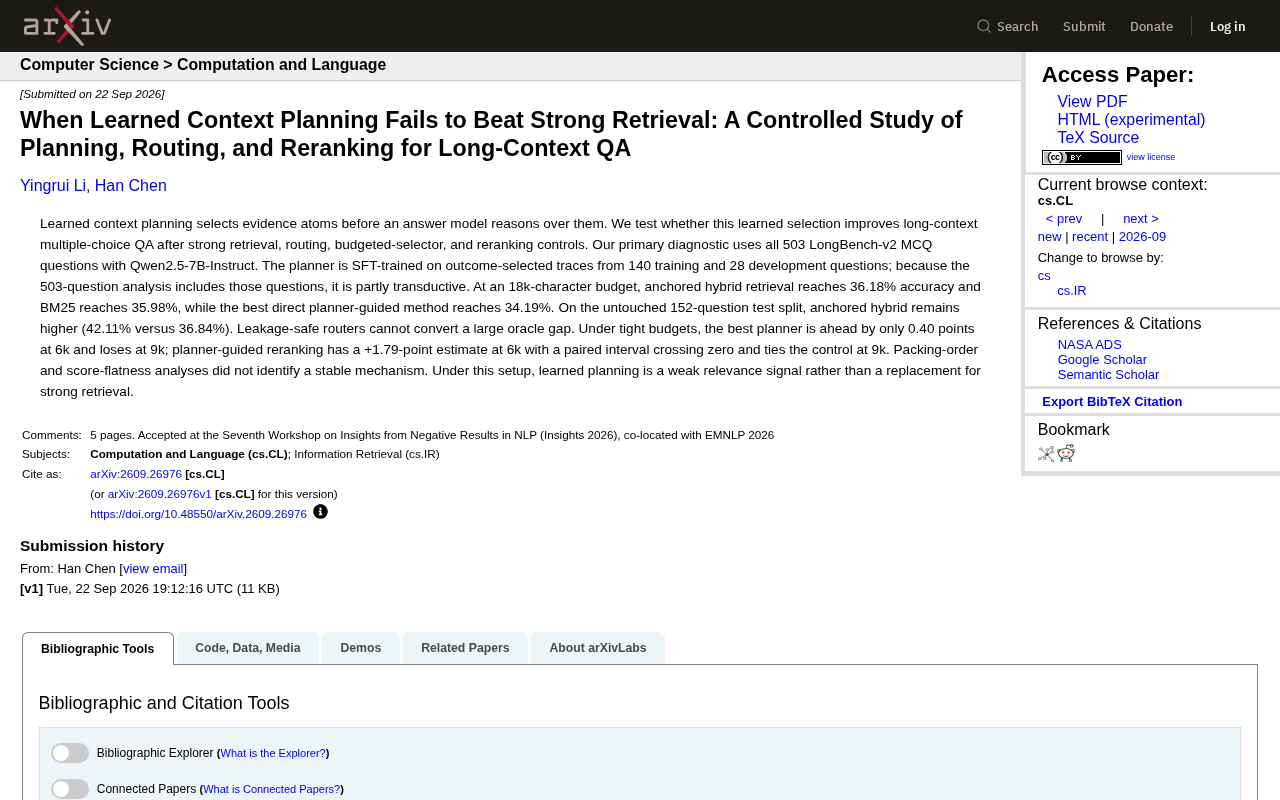
The study uses all 503 multiple-choice questions (MCQ) from LongBench-v2 as the primary diagnostic set, with Qwen2.5-7B-Instruct as the answer model. The planner was trained via supervised fine-tuning (SFT) on "outcome selection trajectories" from 140 training questions and 28 development questions. The authors honestly acknowledge a methodological concern: the 503-question analysis set itself includes the training questions, making the results "partially transductive" — which actually gives the planner a built-in advantage.
Even with this potential bias, results still favored the baselines over the planner. Under an 18k character budget:
- Anchored hybrid retrieval achieved 36.18% accuracy
- BM25 achieved 35.98%
- The best direct planner-guided method reached only 34.19%
In other words, even after the planner had "seen" some of the test data, it still couldn't beat a naive BM25 retrieval. On the completely held-out 152-question test subset, the gap widened further: anchored hybrid retrieval reached 42.11%, while planner-guided methods reached only 36.84%.
Routing and Reranking Can't Save It Either
The study further tested whether "leakage-safe routers" could translate the planner's potential advantages into real gains. The oracle gap refers to the large space between theoretically optimal selection and actual selection. The conclusion: even with a substantial oracle gap, leakage-safe routing failed to convert it into actual accuracy improvements.
Under tighter budget constraints, results were similarly inconsistent. At a 6k budget, the best planner led by only 0.40 percentage points; at 9k, the planner actually fell behind. Planner-guided reranking showed an estimated +1.79 points at 6k, but the paired confidence interval crossed zero (meaning the result was statistically insignificant), while at 9k it drew even with the control.
The authors also conducted packing-order and score-flatness analyses in an attempt to identify stable mechanisms through which planning provides value — neither revealed a reliable causal pathway.
Oracle gap is an important concept in information retrieval and QA system evaluation. It refers to the performance difference between "theoretically optimal selection" and "actual system selection." Specifically, an oracle selection means knowing the answer in advance and picking only the candidate passages that truly contain the correct answer — something impossible in real deployment, but useful for measuring an upper bound. A larger oracle gap means the current system's selection quality is further from the theoretical ceiling, suggesting greater room for improvement. In this study, the authors found that despite a substantial gap between planner-guided methods and the oracle (indicating real potential for improvement in the planner's selection quality), neither routing strategies nor reranking mechanisms could convert that potential into actual accuracy gains — suggesting the bottleneck lies not in "knowing where to look" but in deeper, more fundamental factors.
Conclusion: Planning Is a Weak Correlate, Not a Retrieval Substitute
The study's central judgment is measured but powerful: under this experimental setup, learned context planning is only a weak correlational signal, not a substitute for strong retrieval.
This conclusion has real implications for current research trends. In recent years, many approaches have favored replacing traditional retrieval pipelines with more complex, training-dependent selection mechanisms. This paper serves as a reminder: before making such complexity decisions, you must establish sufficiently strong retrieval and reranking baselines as comparisons. Quite often, seemingly advanced "learned" approaches have no stable advantage over solid classical methods — and may actually perform worse.
It's worth noting the study's limitations: it is restricted to a single model (Qwen2.5-7B-Instruct) and a single dataset (LongBench-v2), with a small training set (only 168 questions). These factors mean the conclusions shouldn't be over-generalized. But as a rigorously designed, well-controlled "negative result" study, its value lies precisely in challenging a popular assumption in a reproducible way.
For engineering teams working on RAG (Retrieval-Augmented Generation) and long-context processing, the takeaway is direct: prioritize getting retrieval and reranking right, and carefully evaluate whether any additional trained selector genuinely delivers gains beyond the baseline — rather than being seduced by concepts like "planning" that sound sophisticated.
RAG (Retrieval-Augmented Generation) is one of the most mainstream architectures in current large language model applications. The basic idea: before the model generates a response, retrieve relevant document passages from an external knowledge base, then feed those passages along with the original question into the model. This allows the model to access up-to-date information beyond its training data while reducing the risk of hallucination. Learned context planning can be viewed as an additional step between retrieval and generation in the RAG pipeline — using a trained planner to further filter retrieved results. This study's negative findings offer direct guidance for RAG engineering practice: when resources are limited, investing effort in optimizing retrieval quality and reranking is generally more robust than introducing additional learned selection components.
Related articles

Why Does the Tesla Roadster Need to Fly? A Deep Dive into Musk's Wild Demo
Tesla's Roadster launch showed wall-climbing, upside-down driving, and flying stunts—but The Vergecast notes the demo car may lack a battery, the Rocket version is invite-only and not street-legal, and the website terms don't guarantee delivery. After nine years of delays, why does this car still need to exist?

AI Is Not a Replacement: Human-AI Collaboration Through the Lens of Factory Root Cause Analysis
Starting from factory root cause analysis, this article explains how AI accelerates evidence chain construction rather than replacing human experts, exploring the pragmatic implementation logic and business value of 'AI supporting people rather than replacing them.'

AI Agent Decision Auditing: Building an Evidence Chain in Regulated Workflows
Starting from a Reddit discussion, this article analyzes three core issues in AI agent decision auditing within regulated workflows: what fields audit records should contain, how to handle feedback latency for erroneous decisions, and how to continuously calibrate LLM judge consistency with human judgment.