Learning AI Large Language Models from Scratch: A Complete Roadmap That Avoids the Three Biggest Mistakes

A practical, mistake-free roadmap for learning AI large language models from absolute zero.
Most AI beginners fail not because the field is too hard, but because they fall into three key traps: chasing model internals without purpose, rushing into fine-tuning with poor Prompt design, and copying tools without understanding deployment logic. This article outlines a six-module learning path — from foundational LLM understanding to Prompt Engineering, RAG-based knowledge bases, Agent development, and no-code fine-tuning — designed to take anyone from zero to real-world AI deployment.
Why 90% of AI Beginners Struggle to Learn Large Language Models
As more individuals and businesses leverage AI large language models to build practical tools and boost productivity, "learning AI" has evolved from a niche tech topic into a widespread source of anxiety. Yet a common misconception persists: many people believe the barrier to entry is too high — that without coding skills or a technical background, they simply can't get started.
The reality is quite the opposite. The problem has never been that the field is inaccessible. Rather, beginners tend to fall into several critical traps right from the start. Recognizing these traps matters more than diving into learning blindly.

Three Common Mistakes Beginners Make When Learning AI from Scratch
Mistake #1: Chasing general-purpose large models without a clear purpose. Many people dive straight into model architectures and parameter details without defining a specific use case, ultimately failing to produce any meaningful output — they accumulate concepts but have no idea what to do with them.
It's worth noting that modern large language models (LLMs) — including GPT-4, Claude, ERNIE Bot, and Qwen — typically contain billions to hundreds of billions of parameters, pretrained on massive text datasets using the Transformer architecture. Understanding the "capability boundaries" of large models is critical: at their core, they are probabilistic prediction systems, well-suited for language understanding, content generation, and logical reasoning, but inherently limited in areas like real-time information retrieval and precise numerical computation. Obsessing over the underlying architecture while ignoring capability boundaries is the most common cognitive trap beginners fall into.
Mistake #2: Disorganized Prompt logic and rushing into fine-tuning. Attempting model fine-tuning without a systematic methodology — combined with poorly structured prompt design — leads to outputs with little practical value.
Prompt Engineering refers to the methodology of designing and optimizing input prompts to guide large models toward desired outputs. Core techniques include Role Prompting, Chain-of-Thought, Few-shot Learning, and instruction decomposition. Research shows that the same model can produce outputs of vastly different quality depending on how prompts are designed. While fine-tuning can tailor a model's output to specific scenarios, rushing into it when data is insufficient or requirements are unclear tends to produce poor results — in most cases, well-crafted prompts are more efficient than fine-tuning.

Mistake #3: Copying existing tools without understanding scenario-specific deployment. Using ready-made tools may seem efficient, but without understanding the underlying logic of scenario adaptation, you'll be stuck the moment you face a real business requirement — wasting time and effort in the process.
A Learning Roadmap for AI Large Language Models — No Background Required
To address these pain points, a complete AI learning system should emphasize "progressive steps with immediate practical application" — even someone with zero technical background can follow this path from start to finish.

Six Core Learning Modules
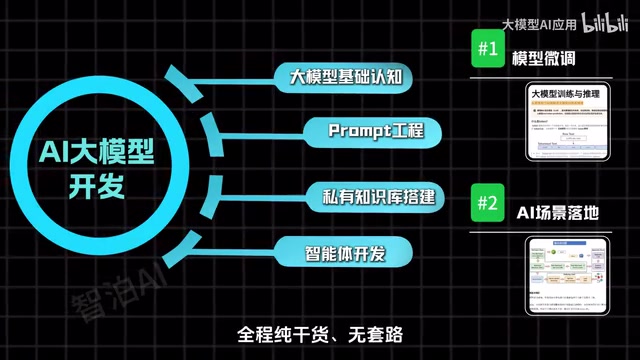
From building foundational understanding to real-world deployment, a comprehensive learning journey typically covers the following modules:
- Foundational Understanding of Large Models: Start by developing an accurate understanding of what large models can and cannot do, avoiding the trap of blindly following trends.
- Advanced Prompt Engineering: Master the underlying logic of prompt design — this is the key differentiator in output quality. Techniques like Role Prompting, Chain-of-Thought, and Few-shot Learning are foundational skills every learner must systematically develop.
- Building Private Knowledge Bases: Enabling large models to answer questions based on your own data is one of the most practical deployment directions for both individuals and businesses. The core technology here is RAG (Retrieval-Augmented Generation) — converting private documents into vector embeddings stored in a database, then retrieving the most relevant passages at query time to inject into the model's context, allowing it to answer based on private data. This approach resolves the knowledge cutoff limitation while avoiding costly full-model fine-tuning, making it one of the most widely adopted enterprise AI deployment paths today.
- AI Agent Development: Evolving AI from "conversation" to "autonomous task execution." An Agent's core architecture consists of a perception layer, planning layer, memory layer, and action layer — enabling autonomous multi-step tasks such as searching for information, reading and writing files, and calling APIs. This represents the key technological leap that transforms AI from a "tool" into a "digital employee."
- No-Code Model Fine-Tuning: Lowering the barrier to fine-tuning so non-technical users can customize their own models. With parameter-efficient fine-tuning methods like LoRA and QLoRA, along with no-code platforms such as Coze and ModelScope, it's now possible to optimize a model's style and capabilities for specific scenarios — even without GPU resources or a deep learning background.
- Scenario-Based AI Deployment: Integrating all of the above capabilities into real-world business scenarios to close the loop.
The design logic of this roadmap directly addresses the three mistakes outlined earlier: first build understanding to avoid blind experimentation, then use systematic Prompt methodology to ensure output quality, and finally focus on scenario-specific deployment.
Learning Methods Matter More Than Learning Materials
"Complete AI tutorial packages" are everywhere these days, and they deserve a critical eye. While comprehensive in volume, they can easily push beginners into "hoarding anxiety" — saving resources they never actually open.
Four Practical Tips for Learning AI from Scratch
Tip #1: Start with the end in mind — define your goal before you begin. Before diving in, think clearly about what specific problem you want to solve with AI: Do you want to build a customer service knowledge base, or create a content production tool? Learning with a defined goal is far more efficient than watching every video from start to finish.
Tip #2: Prioritize Prompt Engineering — don't rush to fine-tune. For the vast majority of users, solid prompt engineering can address over 80% of needs; model fine-tuning is only necessary in a minority of scenarios. Techniques like Chain-of-Thought prompting and Role Prompting can significantly improve output quality at zero cost and should be mastered first.
Tip #3: Learn by doing — validate your progress through projects. AI proficiency is fundamentally a hands-on skill; watching videos without practicing is the same as not learning at all. After completing each module, immediately build a minimum viable project — even something as simple as a basic RAG knowledge base or a carefully designed Prompt template.
Tip #4: Master the underlying methodology, not specific tools. Tools evolve rapidly, but the conceptual frameworks for knowledge base construction, Agent development, and scenario deployment are the long-term, durable assets — far more valuable than memorizing the steps for any particular tool.
The Barrier Is Dropping; Methodology Is Appreciating
As no-code fine-tuning and visual Agent development tools continue to mature, the technical barrier to AI large language models is genuinely falling — the era of "no coding skills means no entry" is passing. Lightweight fine-tuning techniques like LoRA allow anyone to customize models without deep learning expertise; visual Agent frameworks like LangChain and Coze make "having AI autonomously complete complex tasks" increasingly accessible; and a growing ecosystem of RAG tools makes combining enterprise private data with large models cheaper than ever.
But as the barrier drops, what becomes truly scarce is methodology: how to precisely identify needs, how to design effective output workflows, and how to integrate AI capabilities into real-world business scenarios. The value of a good learning roadmap lies less in the volume of content it provides than in offering a framework that helps you avoid common pitfalls.
For beginners, rather than agonizing over "whether to learn AI," start with a small, concrete project and validate your learning through practice. In the age of AI, the best way to get started is always to start using it.
Key Takeaways
Related articles

The Truth Behind Codex 'Build a Website in 5 Minutes': AI Isn't Creating Sites—It's Helping You Copy Them
Exposing the truth behind viral Codex 5-minute website videos: creators aren't building original sites with AI—they're copying shared prompts or scraping others' work. Learn AI coding tools' real limits.

Getting Started with AI Agent Development: A Complete Guide from Concept to Practice
A comprehensive guide to AI Agent architecture and development, covering automated marketing, intelligent customer service, and investment analysis scenarios with single and multi-agent collaboration.

The Truth Behind Codex 'Build a Website in 5 Minutes': AI Isn't Creating Sites — It's Helping You Copy Them
Exposing the truth behind viral Codex 5-minute website videos: creators aren't building original sites with AI — they're copying shared prompts or scraping others' work.