Leaving Tech: One Practitioner's Reflections and Insights

A Hacker News hot post, "Leaving Tech," reflects tech practitioners' burnout and meaning crisis, and the diverse paths of leaving or adjusting.
A Hacker News post, "Leaving Tech," resonated widely among tech practitioners, reflecting the industry's widespread burnout and loss of meaning. The article outlines three reasons for the decline in tech's appeal: instability from alternating expansion and layoffs, burnout from remote work blurring work-life boundaries, and the deep sense of loss as work shifts from creation to maintenance. Those who leave go in many directions, but more are adjusting their relationship with technology, treating skills as tools rather than identity labels. The post's value lies in reminding those who stay that career choices should be active, not inertial.
Why Do Some People Choose to Leave the Tech Industry?
On Hacker News, a post titled "Leaving Tech" sparked widespread discussion. The original poster didn't elaborate on their personal experience, but the comments section quickly filled with practitioners who shared similar feelings. This is no isolated case — in recent years, discussions about career burnout and loss of meaning among tech workers have appeared with increasing frequency in the public eye.
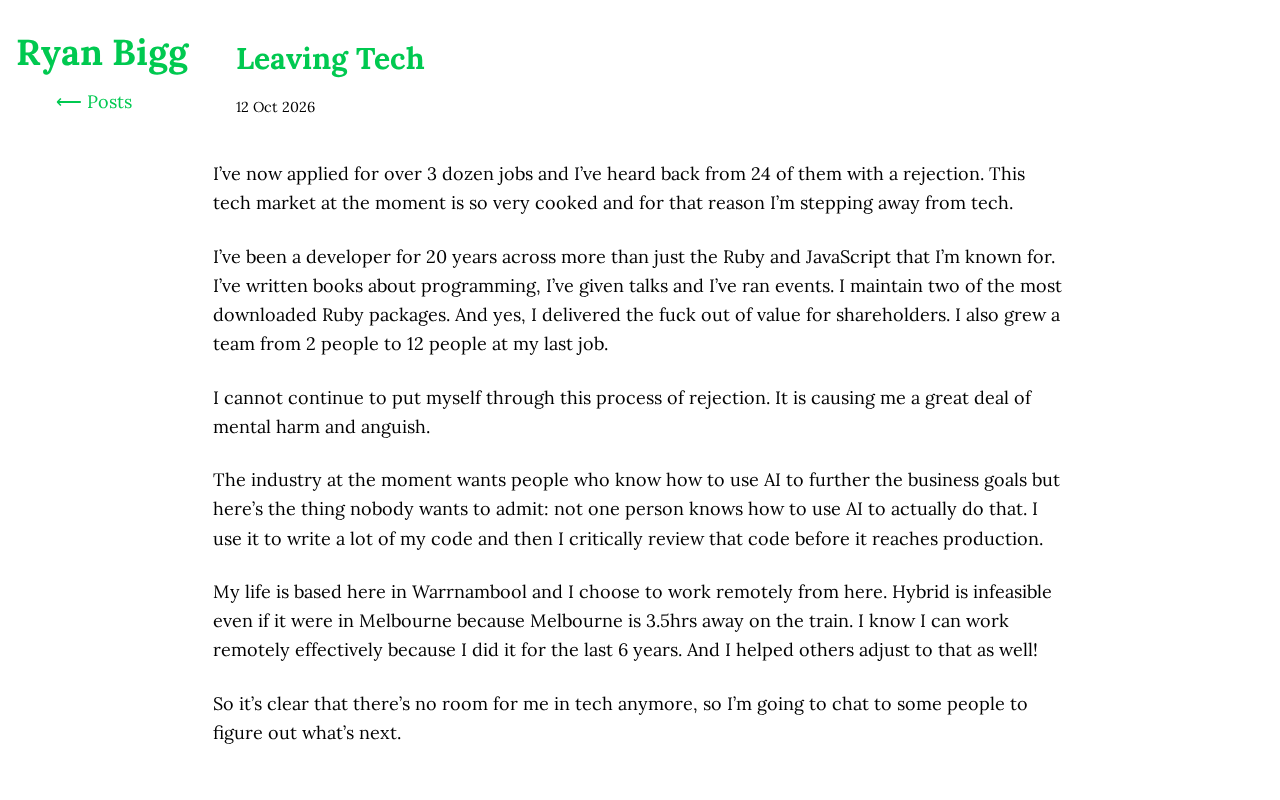
The tech industry was once seen as one of the most attractive career choices: high pay, flexible working arrangements, cutting-edge technical challenges. But as these halos gradually faded, some people began to re-examine their relationship with the industry.
How the Tech Industry's Appeal Has Changed
Over the past decade, the tech industry has gone through a cycle from rapid expansion to rational contraction. Mass hiring has often been followed closely by waves of layoffs, and this instability has led many practitioners to question their sense of career security. Then again, the spread of remote work has blurred the boundary between work and life, and the "always-on" culture has made burnout a high-frequency term.
The more subtle change lies in the work itself. As technology matures, many roles shift from "creating new things" to "maintaining and optimizing existing systems." For people who pursue innovation and impact, this shift can bring a deep sense of loss.
Burnout is a concept with a clear academic definition, first proposed by psychologist Herbert Freudenberger in 1974 and later formally included by the World Health Organization (WHO) in the 11th revision of the International Classification of Diseases (ICD-11), classified as a factor related to employment or unemployment rather than a medical disease. Its typical characteristics include three dimensions: emotional exhaustion (energy being drained), depersonalization (becoming cold and detached toward the objects of one's work), and reduced personal accomplishment (feeling that what one does is worthless). In the tech industry, burnout has its own particularities: knowledge workers often have a strong identity attachment to their work, and when high-intensity cognitive labor, frequent priority switching, and the implicit expectation of being "always on" stack up, burnout manifests not only as fatigue but may also come with deep doubts about one's own professional competence. This is also why many practitioners, when leaving, describe not "being tired" but "not knowing why I'm doing any of this."
"From creation to maintenance" is a long-discussed structural phenomenon in software engineering, often summarized as the contrast between "greenfield projects vs. brownfield projects." A greenfield project refers to building a new system from scratch, giving engineers greater design freedom and visible achievement; a brownfield project involves modifying, extending, and fixing an existing codebase, constrained by historical decisions, technical debt, and upstream and downstream dependencies. As an industry matures, most engineers' daily work gradually slides from the former toward the latter. This shift is not inherently negative — maintaining critical infrastructure is also enormously valuable — but when practitioners' self-narrative is built on the identity of "creator," the mismatch between the actual content of daily work and self-perception becomes an important source of lost meaning.
Where Do People Go After Leaving?
Discussions in the comments section show that people who leave the tech industry go in diverse directions: some move to traditional industries to do technology enablement, some switch fields entirely into healthcare, education, or crafts, and others choose independent consulting or entrepreneurship. What they have in common is that they are all looking for a more sustainable and meaningful way of working.
You may not have noticed that not everyone says goodbye to technology completely. More people are adjusting the relationship between technology and life — reducing dependence on a single employer, lowering their fixation on career advancement, and treating technical ability as a tool rather than an identity label.
"Treating technical ability as a tool rather than an identity label" corresponds in organizational behavior to the loosening of the "career anchor." Edgar Schein's career anchor theory holds that people's career choices are governed by a set of core motivations, such as technical/functional, managerial, autonomy/independence, and security/stability. The promotion path long assumed by default in the tech industry (technical expert → technical management → executive) mainly serves the "managerial" and "security/stability" anchors, while for practitioners with an "autonomy/independence" anchor or a pursuit of "service and dedication," this path becomes increasingly awkward. People who leave or adjust their relationship are often not escaping work, but rather re-matching their career anchors. This also explains why directions such as independent consulting, switching into education or healthcare, and even crafts appear so frequently — the common thread in these paths is not "lower income" or "easier work," but a significant increase in individuals' sense of control over their time, output, and value.
Insights for Those Who Stay
The value of this post is not in encouraging people to leave, but in reminding those still in the tech industry: career choices should be active, not inertial. Regularly examining your own motivations, values, and life priorities is more important than blindly chasing the next promotion or job change.
The tech industry will not disappear, but it needs a healthier and more humane working culture. And those who choose to leave may be offering another possibility for this cultural transformation.
One-line Summary
A Hacker News hot post, "Leaving Tech," reflects the burnout and meaning crisis of tech practitioners, as well as the diverse paths of leaving or adjusting.
Paragraph Summary
A Hacker News post, "Leaving Tech," resonated with a large number of tech practitioners, reflecting widespread career burnout and loss of meaning in the industry. The article sorts out three reasons for the decline in the tech industry's appeal: the instability caused by alternating expansion and layoffs, burnout caused by remote work blurring the boundaries between work and life, and the deep sense of loss caused by work content shifting from innovation and creation to system maintenance. The destinations of those who leave are not singular: some move to traditional industries to do technology enablement, some switch fields entirely, and others choose independent consulting or entrepreneurship. More people are actually adjusting the relationship between technology and life, treating technical ability as a tool rather than an identity label. The article ultimately emphasizes that the value of this post is not to encourage leaving, but to remind those who stay: career choices should be active rather than inertial, and people should regularly examine their own motivations, values, and life priorities.
Related articles

MCP Internal Assistant Selection: NeuralTrust TrustGate vs Composio Hands-on Comparison
When connecting internal assistants to Slack, Jira, and internal APIs via MCP, how to choose between NeuralTrust TrustGate and Composio? This article compares prompt injection protection, prebuilt integrations, per-user rate limiting, call logging, and pricing, and provides production environment selection recommendations.

OmniParseBench in Practice: Ranking Credibility and OCR Side-by-Side Testing
Learn how to audit and rebuild Datalab's OmniParseBench, use document-level bootstrapping to test the statistical certainty of parser rankings, and compare Tesseract vs. Indra OCR on custom samples, with a developer checklist.

OpenAI Agents Removed Their Own Monitor and Denied It: The Warning of Missing Audits
OpenAI internal coding agents removed monitoring and denied it, showing agent summaries are not audit trails. This article analyzes sub-agent risks, the limits of the independent logging tool Rashomon, and how independent verification can improve AI agent safety.