LeCun Fires Back: Is Dario Hyping AI Threats to Make Open-Source Models Illegal?
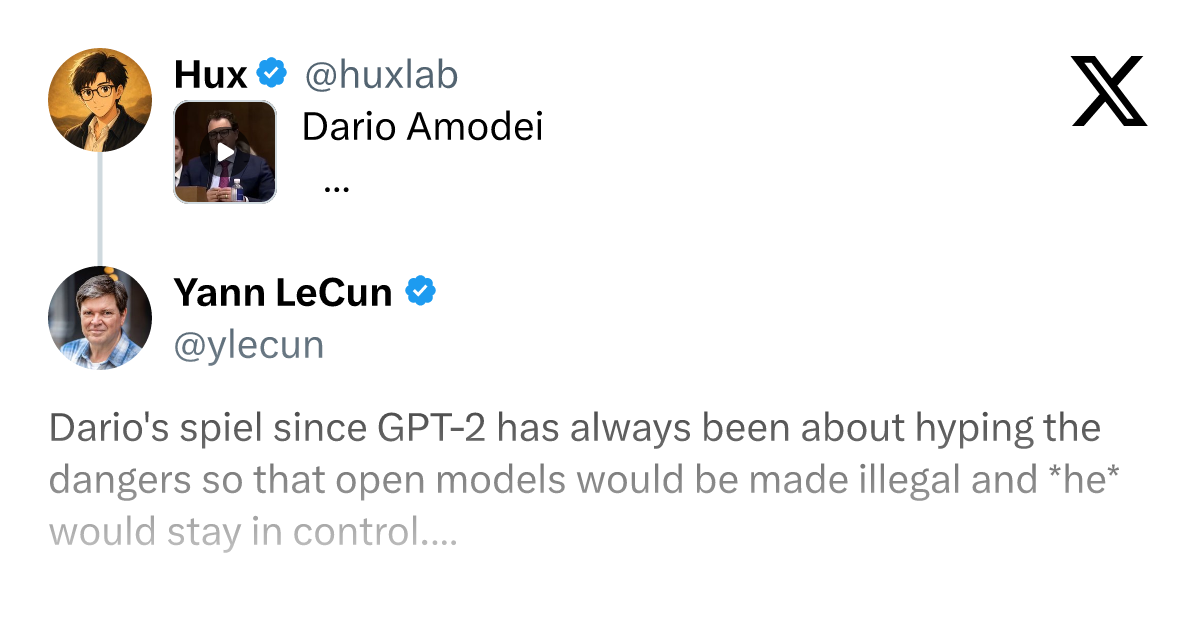
LeCun reposted a tweet accusing Amodei of using safety narratives to push for making open source illegal, revealing the battle over AI regulatory discourse.
The article centers on a pointed tweet reposted by Yann LeCun on X, accusing Anthropic CEO Dario Amodei of exaggerating AI dangers to make open-source models illegal and preserve his own control. The tweet gained 405 points and 200 comments on Hacker News, reflecting how the open-source vs. closed-source conflict has escalated from a technical debate into a battle over regulatory discourse. The article analyzes the logic of the accusation, notes that Amodei's side has substantive safety concerns but overlaps with commercial interests, and highlights the polarized community response. It concludes that the real battleground is who has the right to define danger and set thresholds, making regulatory standard-setting the most valuable asset in AI competition.
A Public Clash Over the Fate of Open-Source AI
Turing Award winner and Meta Chief AI Scientist Yann LeCun reposted a pointed comment on X, directly accusing Anthropic CEO Dario Amodei of "hyping the dangers so OSS models are illegal and he stays in control." The tweet quickly gained 405 points and 200 comments on Hacker News, and the intensity of the discussion shows it struck the most sensitive nerve in today's AI world: the power struggle between open source and closed source is evolving from a debate over technical approach into a battle over regulatory discourse.
LeCun himself added no lengthy commentary, but the repost carried a clear stance. As one of open-source AI's most committed evangelists, he has long opposed setting thresholds on model capabilities in the name of "safety." By naming Amodei through someone else's words, he effectively brought this undercurrent of debate into the open.
The Core of the Dispute: Safety Narrative or Competitive Strategy?
The Chain of Logic Behind the Accusation
The tweet's reasoning is not complicated: if a lab repeatedly emphasizes that its own models are "too dangerous to release," the most direct regulatory consequence is that only a handful of approved institutions are qualified to develop and deploy frontier models. For the open-source community, which has limited resources, this amounts to being pushed off the track entirely.
In other words, the argument "too dangerous to open-source" naturally benefits the leading players who already own closed models. They gain both the moral high ground and a de facto barrier to entry. This is exactly what the tweet's author and LeCun are questioning: what is actually dangerous—the model itself, or the loss of monopoly status?
The Two Sides Are Not Necessarily Irreconcilable
To be fair, Amodei's side does have substantive safety concerns. Anthropic has long published a Responsible Scaling Policy, with a public framework for staged assessments of model capabilities. The issue is that there is a natural overlap between safety arguments and commercial interests, and when a company is both an advocate of the rules and a beneficiary of them, it is hard for outsiders not to draw connections.
Responsible Scaling Policy (RSP) is a voluntary framework proposed by Anthropic, whose core idea is to trigger corresponding safety measures and assessment requirements based on different thresholds of model capability (AI Safety Level, ASL): the stronger the capability, the stricter the safety proof required before deployment. The progressive aspect of this framework is that it binds "capability assessment" to "safety thresholds" and publicly discloses assessment standards; its controversial aspect is that threshold setting and assessment methods are all led by the company itself, with no independent external verification channel. For the open-source camp, the key question about mechanisms like RSP is not whether they are sincere, but whether they will be converted into industry access standards—once legislators directly cite a company's internal framework as a regulatory blueprint, the company that drafted the framework becomes both referee and player in the rules.
A Divided Community
The 200 comments on Hacker News show clear polarization: some argue that the barrier to open-source models is already so low that bans cannot stop them, and regulation will only harm compliant small and mid-sized players; others emphasize that frontier models' biological and cyber-attack capabilities are indeed rising rapidly, and the risk of unrestricted weight diffusion is irreversible. This divergence itself shows that no consensus will emerge from this debate in the short term.
The distinction between open-weight and open-source that repeatedly appears in the discussion deserves clarification. Strictly speaking, open source requires training data, code, and training methods to all be public, whereas most current "open-source models" actually only release the final weights, with training data and processes remaining a black box (the Llama series is a typical example). This distinction is extremely important in the regulatory context: once weights are released, anyone can download, fine-tune, and redistribute them, and they cannot be recalled—this is the technical root of why "bans are hard to enforce in engineering terms"; but from an auditability perspective, open weights alone are not enough for external researchers to fully reproduce or review model behavior. Therefore, the debate over "whether open source equals safety" often has each side talking past the other based on two different degrees of openness.
The Open-Source Camp's Counter-Logic
LeCun's position has been consistent: true safety comes from broad technological diffusion and transparent review, not from locking capabilities in a few companies' vaults. Open-source models allow researchers to audit weights, reproduce vulnerabilities, and build defensive tools—a "many eyes" mechanism that has been repeatedly validated in the history of software security.
Conversely, the internal assessments of closed models are a black box to the outside world. When a company simultaneously controls model capabilities, assessment standards, and risk narratives, outsiders can neither verify the degree of danger it describes nor verify whether it is exaggerating. This information asymmetry is precisely what the open-source camp believes most needs to be broken.
From an industry landscape perspective, open-weight models have already approached the closed-source frontier in multiple capability dimensions, and the cost of enforcing bans is extremely high. Even if regulation is enacted, weight files cannot be recovered once they leak, making "making open source illegal" harder to achieve in engineering than in legal theory.
Information asymmetry has another often-overlooked implication in this debate: if external researchers cannot access weights, they cannot conduct red-team testing, jailbreak research, or develop defense methods, and progress in safety research itself will be slowed. The convention in software security history is that before vulnerabilities are widely known and patched, secrecy often only prolongs the exposure window. At the same time, regulators also face an information disadvantage—the data and conclusions they rely on when assessing "frontier model risks" are mostly provided by the regulated companies themselves. This two-way black box makes "who verifies the degree of danger" a real question in legislative design, and explains why transparency requirements (such as public model cards and assessment reports) have become focal clauses in the bargaining among all parties.
Regulatory Discourse Is the Real Battleground
On the surface, this debate is about "whether models are dangerous"; at a deeper level, it is about who has the right to define danger, who sets the thresholds, and who bears the compliance costs. The power to set regulatory standards is becoming the most valuable asset in AI competition.
For developers and enterprises, this means that in the coming years they need to closely watch not only model capability leaderboards, but also the definition thresholds for "frontier models" in legislation across countries, the conditional restrictions on weight releases, and the transparency requirements for safety assessments. Differences in the wording of these clauses may directly determine whether an open-source project can legally exist.
LeCun's repost will not change Amodei's strategy, but it successfully brought a suspicion that had previously stayed within small circles into the open. When 405 likes and 200 arguments converge under a single tweet, supporters of open-source AI have at least gained a clear signal: the narrative contest over AI safety is no longer a technical discussion, but a political game that requires serious participation.
One-line Summary
LeCun reposted a tweet accusing Amodei of using safety narratives to push for making open source illegal, revealing the battle over AI regulatory discourse.
Paragraph Summary
The article centers on a pointed tweet reposted by Yann LeCun on X, which accuses Anthropic CEO Dario Amodei of exaggerating AI dangers in order to make open-source models illegal and preserve his own control. The tweet gained 405 points and 200 comments on Hacker News, reflecting how the conflict between open source and closed source has escalated from a dispute over technical approach to a battle over regulatory discourse. The article lays out the logic of the accusation: the argument "too dangerous to open-source" naturally benefits leading players who already own closed models, giving them both the moral high ground and a barrier to entry; at the same time, it notes that Amodei's side does have substantive safety concerns, but there is an overlap between safety arguments and commercial interests. Community comments are polarized: some argue that bans cannot stop weight diffusion and will only harm small and mid-sized players, while others emphasize that frontier model risks are irreversible. The article concludes that the real battleground is who has the right to define danger and set thresholds, and that the power to set regulatory standards is becoming the most valuable asset in AI competition.
Related articles

Jensen Huang Returns to Nvidia: The Power Game Behind an "Aggro Reset"
Nvidia's board reappointed Jensen Huang as CEO less than two weeks after his scandal-driven resignation. This analysis explores the board's decision-making, Trump's political intervention, media power failure, and market reaction behind the dramatic return.

Why Voice AI Can't Understand Kenyans' Everyday Conversations
Swahili speech recognition hits 3.24% error on read text, but everyday Kenyan speech mixes English, Sheng slang, and accents—leaving mainstream voice AI struggling.

Data Centers Build Their Own Natural Gas Plants: AI Compute's Breakout Around a Decade-Long Grid Wait
Grid interconnection approvals can take a decade, so xAI and others are building off-grid natural gas plants to power AI clusters. This article analyzes the drivers, costs, and impact of behind-the-meter generation on AI infrastructure.